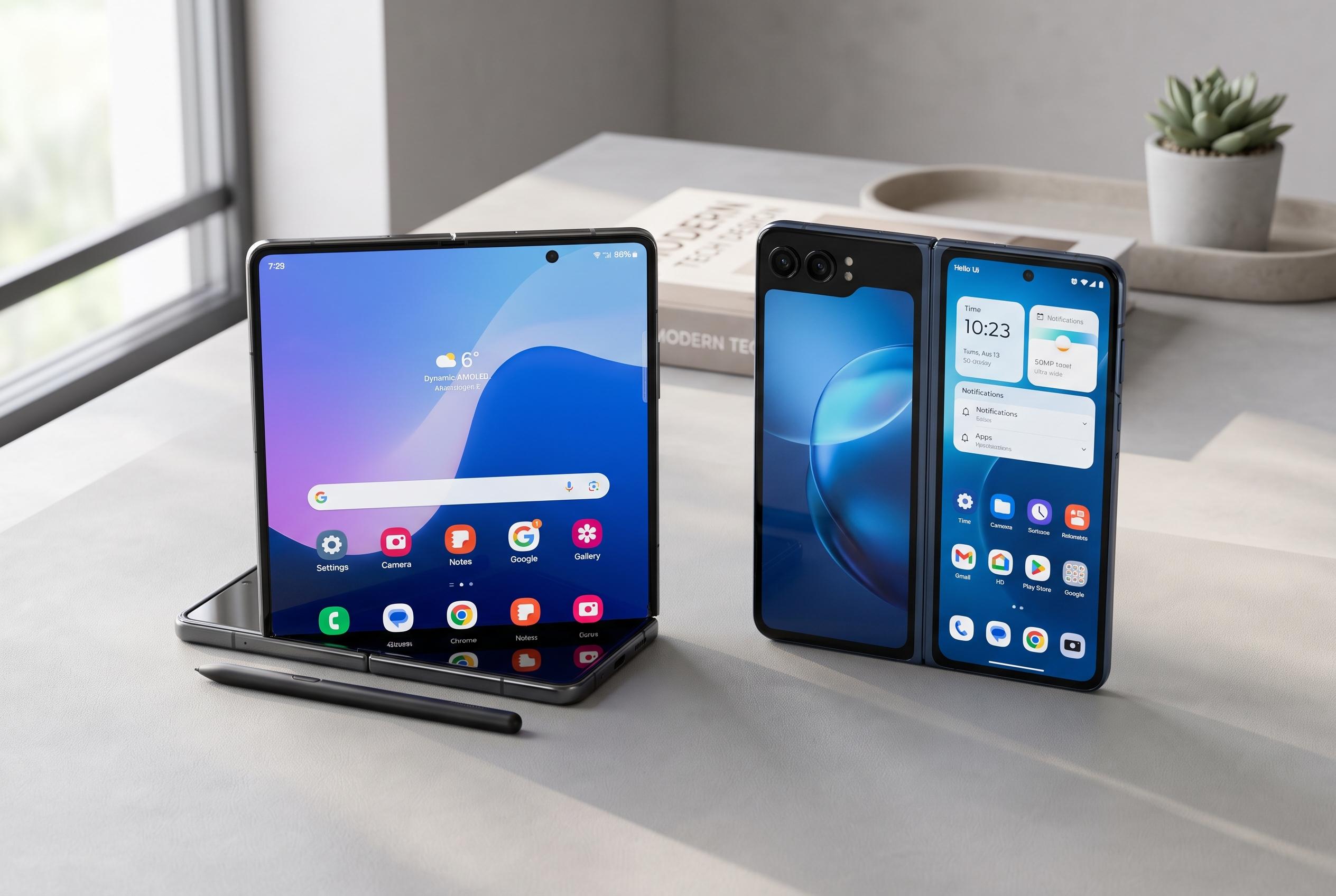

Samsung and Motorola are redefining the premium foldable market this year, with contrasting designs and capabilities that appeal to different user priorities, including battery life, camera performance, and form factor innovation.
Samsung and Motorola have each pushed the foldable category in a slightly different direction this year. According to Samsung’s own product pages, the Galaxy Z Fold8 is built around a more compact, phone-to-tablet format, while Motorola positions the Razr Fold as a larger, more open canvas with a premium clamshell-inspired design. Both are clearly aimed at buyers who want something beyond a standard flagship, and both sit firmly at the top end of the market. (samsung.com)
On design, Motorola gives the Razr Fold a vegan leather finish, aluminium sides and IP48/IP49 protection, and says the device weighs 243g. Samsung counters with a thinner and lighter build for the Z Fold8, using an Armour Aluminium frame, Gorilla Glass Ceramic 3 on the cover and Gorilla Glass Victus 2 on the rear, plus an IP48 rating. The displays also split their personalities: Motorola’s inner screen measures 8.09in and the cover display 6.56in, while Samsung offers a 7.6in main panel and a 5.5in outer screen. TechRadar and Digital Camera World both describe the Galaxy’s smaller outer display as a more deliberate compromise, aimed at portability and content use rather than one-handed comfort. (en-gb.support.motorola.com)
Under the hood, the difference is narrower than the names suggest. Motorola pairs the Razr Fold with the Snapdragon 8 Gen 5, 16GB of RAM and 512GB of storage, while Samsung uses the Snapdragon 8 Elite Gen 5 for Galaxy with 12GB or 16GB of RAM and up to 1TB of storage. Samsung markets its chip as the more powerful option, and the reviews back up that it is the stronger fit for heavy gaming and sustained multitasking, even if everyday use will feel fast on both phones. (en-us.support.motorola.com)
Cameras are where Motorola has the cleaner pitch. The Razr Fold carries three 50MP rear cameras, including a telephoto lens with 3x optical zoom, plus 20MP and 32MP selfie cameras depending on the screen used. Samsung keeps things simpler with dual 50MP rear cameras and 10MP front cameras, but no telephoto lens. Tom’s Guide notes that Samsung’s camera system holds up well in many situations, yet the lack of optical zoom becomes more obvious at higher magnification, where the Fold8 Ultra pulls ahead. (en-us.support.motorola.com)
Battery life may be Motorola’s strongest advantage. The Razr Fold carries a 6,000mAh battery with 80W wired charging and 50W wireless charging, while Samsung uses a smaller 4,800mAh cell with 45W wired charging and 20W wireless charging. Both companies promise seven years of Android and security updates, which is now a key part of the premium foldable argument. Price also matters: Samsung’s Fold8 starts at $1,899.99 in the US, while Motorola’s Razr Fold is listed at 15,999 reais in Brazil, with lower street pricing already appearing in some markets. In practice, the choice comes down to priorities. Motorola looks better for buyers who want more battery, brighter screens and a telephoto camera, while Samsung appeals to those who prefer a lighter body, a more powerful chipset and a more distinctive foldable shape. (en-us.support.motorola.com)
Disclaimer: This content is intended for informational purposes only. Readers are advised to exercise their own judgement, conduct due diligence, or consult a qualified expert before acting on any information provided.