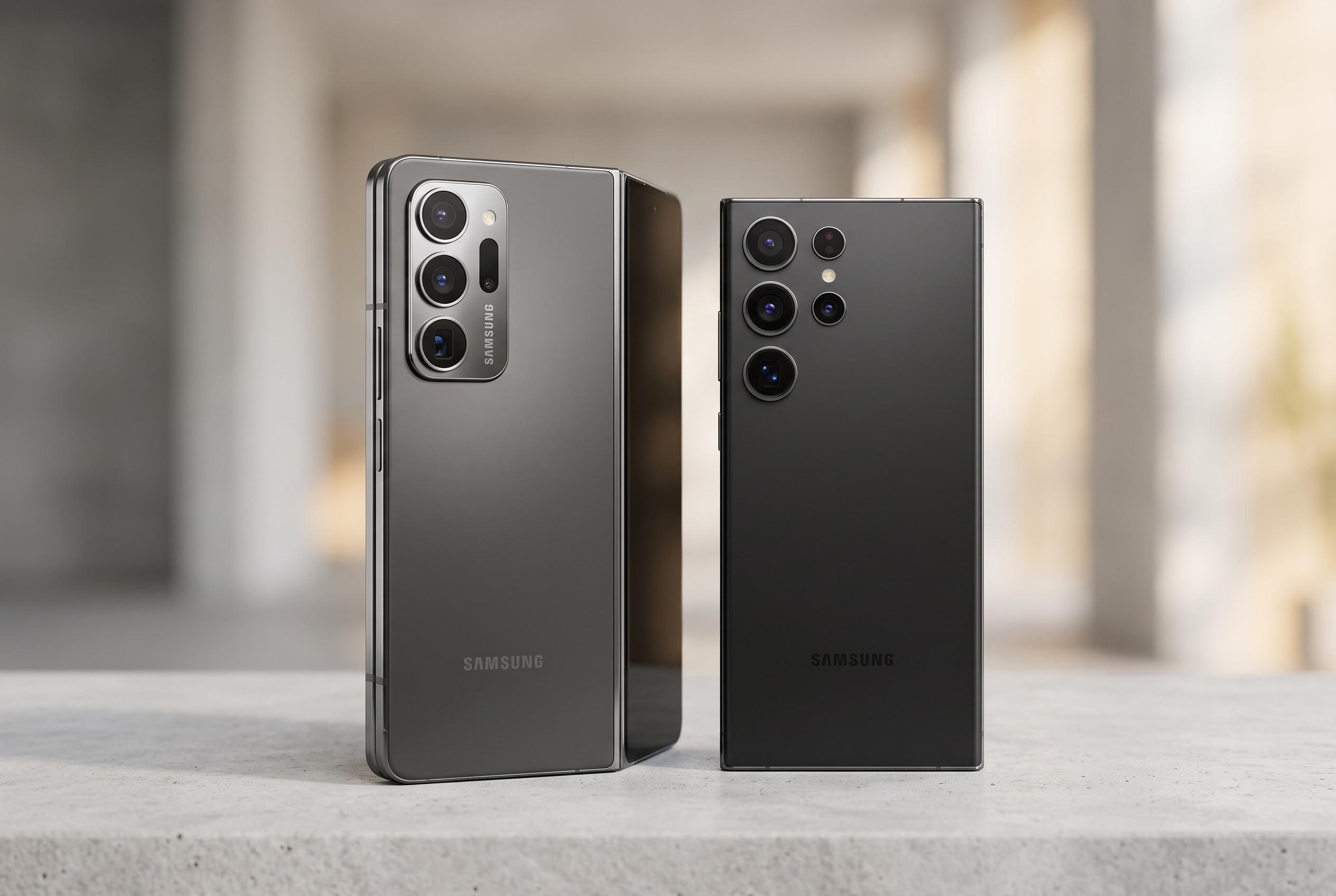

Samsung’s latest foldable, the Galaxy Z Fold 8 Ultra, adopts the ‘Ultra’ badge traditionally reserved for flagship phones, but in photography, the Galaxy S26 Ultra still leads with superior zoom and low-light performance, highlighting the limits of foldable camera tech.
Samsung has spent years reserving its “Ultra” label for the Galaxy S family, but that changed this year with the Galaxy Z Fold 8 Ultra, the company’s first foldable to carry the badge. That matters because the name now signals more than folding-screen ambition. It is meant to suggest a true flagship camera system, one that can stand beside Samsung’s slab-style top model rather than merely catching up from behind.
On paper, the foldable looks well equipped. According to Tom’s Guide, it shares a 200-megapixel main camera and a 50-megapixel ultrawide lens with the Galaxy S26 Ultra. The differences begin once the optics are examined more closely. The S26 Ultra uses a wider f/1.4 aperture on its main sensor, which lets in more light than the Z Fold 8 Ultra’s f/1.7 lens. It also adds a second telephoto camera: a 50-megapixel periscope lens with 5x optical zoom. The foldable relies on a single 10-megapixel 3x telephoto unit, a clear limitation for long-range shooting.
In side-by-side tests, the two phones were often close in the obvious categories. Tom’s Guide found that high-resolution 200-megapixel images were highly detailed on both, with the Z Fold 8 Ultra sometimes preserving finer texture. Colour handling was also broadly similar, while the ultrawide cameras produced near-identical results with strong edge sharpness. But the S26 Ultra separated itself where image quality usually becomes harder to maintain. It delivered better dynamic range, cleaner shadow detail and more controlled highlights. Portraits also looked slightly crisper on Samsung’s conventional flagship.
The gap widened in difficult conditions. In low light, the S26 Ultra’s wider aperture helped it produce brighter scenes with less noise and more detail in the background and on nearby surfaces. Telephoto performance showed the biggest advantage. At 5x, 10x and 30x zoom, the S26 Ultra held text and fine structure far better, while the Z Fold 8 Ultra leaned on digital cropping sooner and lost clarity much faster. The overall conclusion is straightforward: the Galaxy Z Fold 8 Ultra is a serious camera phone for a foldable, but Samsung’s older-style Ultra remains the stronger photographic tool. If camera quality is the priority, the S26 Ultra is still the safer buy.
Disclaimer: This content is intended for informational purposes only. Readers are advised to exercise their own judgement, conduct due diligence, or consult a qualified expert before acting on any information provided.