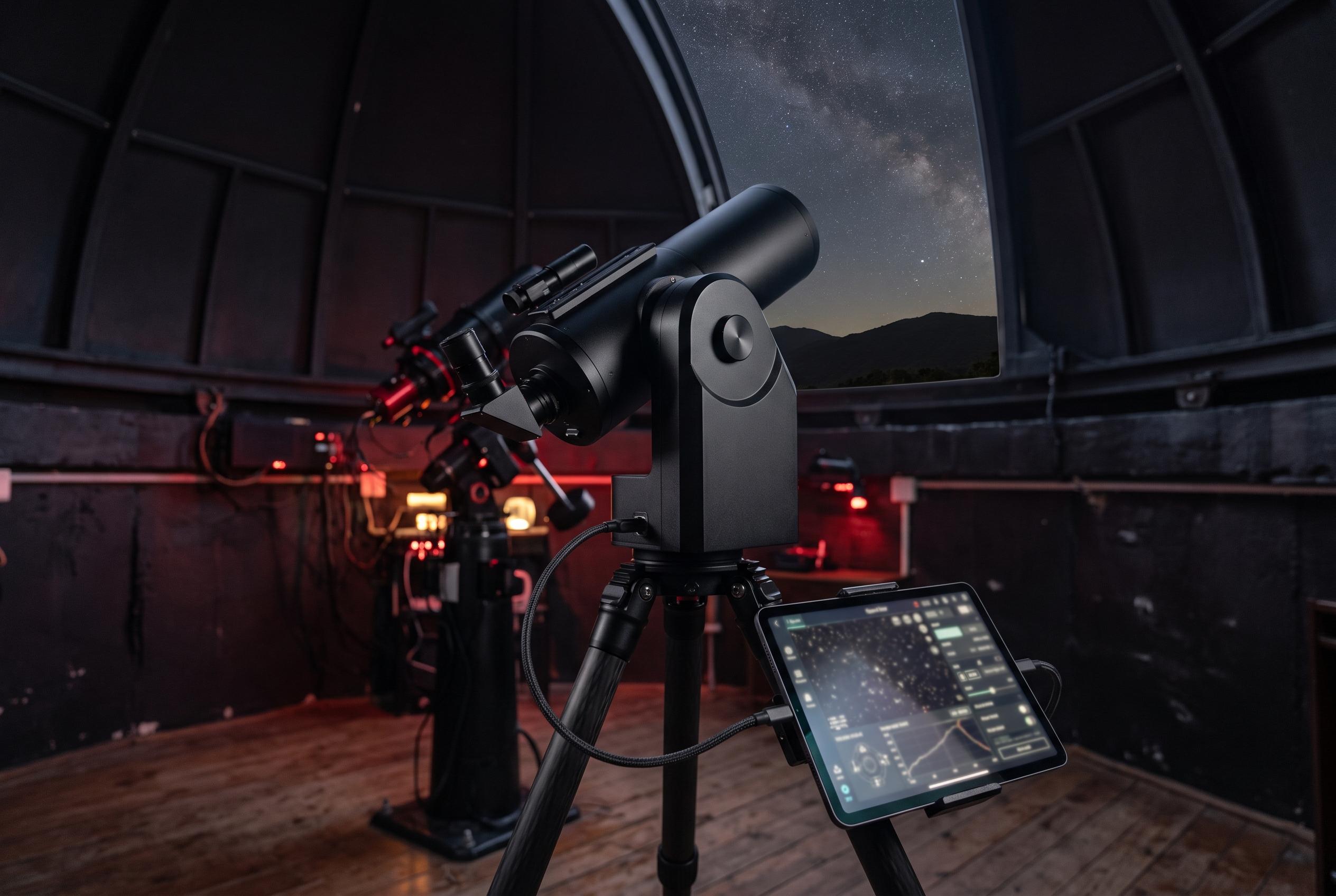

ZWO’s Seestar S50 Pro advances the connected telescope market with enhanced imaging capabilities, user-friendly automation, and a focus on seamless software integration, lowering barriers for newcomers and pros alike.
The Seestar S50 Pro has arrived as more than a modest hardware refresh. On paper, it is still a compact smart telescope with a 50 mm aperture and 260 mm focal length, but ZWO is clearly positioning it as a connected imaging system rather than a standalone optical device. The company’s own product details emphasise a four-element apochromatic design, a Sony IMX585 imaging sensor and a secondary wide-angle camera, while UK and European retail listings add that the unit also brings a larger battery, internal storage and an enhanced drive system for more accurate tracking.
That matters because the appeal of this product is as much about software as optics. The telescope is designed to be controlled through the Seestar app, which handles target selection, observing information, imaging control, stacking and later processing in one workflow. Retail and vendor descriptions say the device supports automated imaging plans and live stacking, which should make it easier for newcomers to begin capturing deep-sky objects without first learning the full traditional astrophotography chain of mount control, guiding, plate solving and post-processing.
The S50 Pro also appears aimed at lowering the barrier between beginner use and more advanced operation. ZWO says the telescope can be used with its standard automatic mode, then pushed further into equatorial operation and longer exposures. That progression is important: it allows users to start with a simplified experience and later export data into external tools if they want to move into a conventional processing workflow. Primalucelab’s first-look assessment says the upgrade is intended to extract more from the same 50 mm class of instrument through better imaging and tracking rather than by simply increasing aperture.
The dual-camera arrangement is another notable change. B&H Photo and ZWO both describe a main telephoto imaging path alongside a wider-angle camera, with the latter intended to provide broader context for navigation and target acquisition. In practice, that lets the software do more of the hard work: the app can help the user locate a subject, frame it and keep it centred without requiring separate cables, a dedicated computer or a stack of third-party drivers.
Taken together, the Seestar S50 Pro reflects a wider shift in astronomy equipment. Smart telescopes are moving away from a modular model in which each component is bought, configured and managed separately, and towards tightly integrated systems where firmware, optics, tracking and the mobile app are developed as one product. The result is a device that may be judged as much by its software maturity as by its glass, and that is likely to be where this category is headed next.
Disclaimer: This content is intended for informational purposes only. Readers are advised to exercise their own judgement, conduct due diligence, or consult a qualified expert before acting on any information provided.