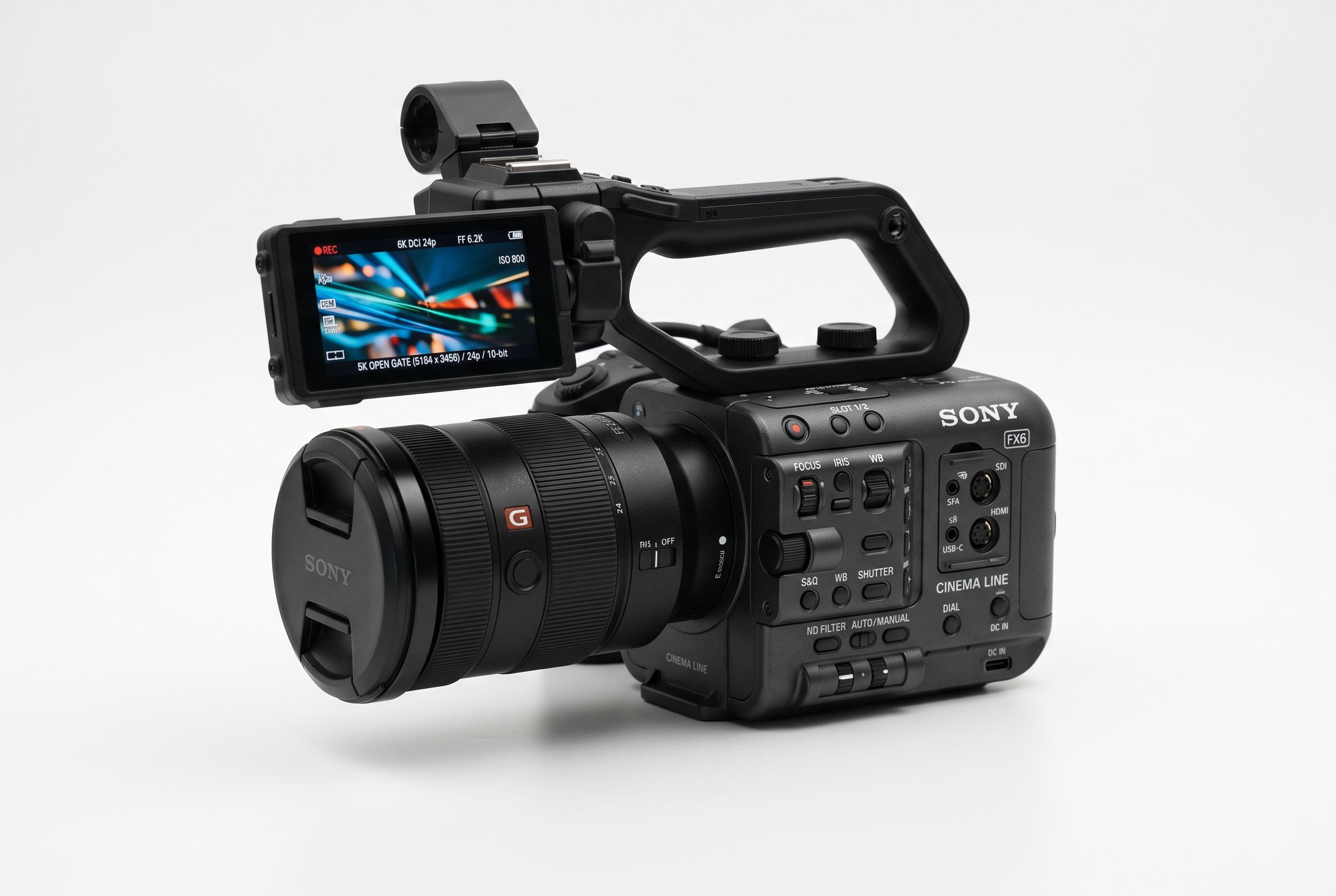

Sony’s FX5 cinema camera offers filmmakers a lightweight, versatile tool featuring a new 5K open-gate sensor, internal RAW recording, and robust autofocus, but without internal ND filters or SDI output, signalling a focus on handheld and gimbal work.
Sony’s FX5 is shaping up as a serious compact cinema camera rather than a general-purpose hybrid. In a hands-on review published by ProVideo Coalition, the camera was tested in a stripped-back Los Angeles shoot with no lighting and a small crew, where its small body proved useful across handheld, gimbal, motorcycle and vehicle-mounted work. The appeal is clear: Sony is aiming at filmmakers who want cinema-grade tools in a body that is easier to move, rig and live with than a larger production camera.
The most important change is the new 5K 3:2 open gate sensor. That format gives editors more room to crop, stabilise and reframe footage while still preserving a standard 16:9 delivery, and it is especially valuable for teams that need both landscape and vertical content from the same shot. TechRadar and B&H eXplora both note that the FX5 also supports high frame rates, including 5K at 60fps, 4K at 120fps and Full HD at 240fps, with higher open-gate speeds promised later through firmware. The camera records internal X-OCN RAW, a notable step up from earlier FX models that required external RAW capture.
Autofocus and stabilisation appear to be major strengths. ProVideo Coalition said focus transitions were smooth even during fast, run-and-gun shooting, while in-body stabilisation, especially in Dynamic Active mode, produced very steady results at the cost of a crop. The camera also inherits Sony’s triple-base ISO approach at 800, 4,000 and 12,800, with more than 15 stops of dynamic range quoted in S-Log3. Y.M. Cinema and B&H eXplora describe this as part of a broader workflow shift towards Sony’s higher-end Cinema Line cameras, with dual gain handling and improved shadow retention.
There are, however, clear trade-offs. According to the review and other launch coverage, the FX5 does not include internal ND filters, SDI output or built-in timecode, all of which may matter on more formal productions. Media costs are also significant: the highest-quality recording modes rely on VPG400 CFexpress Type A cards, which quickly push up both purchase price and storage demands. Digital Camera World reported that the body starts at £4,700, with an XLR handle and optional EVF sold separately, while the handle adds 32-bit float audio support. For filmmakers who value compact size, internal RAW, strong autofocus and robust stabilisation, the FX5 looks highly capable; for users who need stills features or a more all-purpose hybrid, other Sony models may remain the better fit.
Disclaimer: This content is intended for informational purposes only. Readers are advised to exercise their own judgement, conduct due diligence, or consult a qualified expert before acting on any information provided.