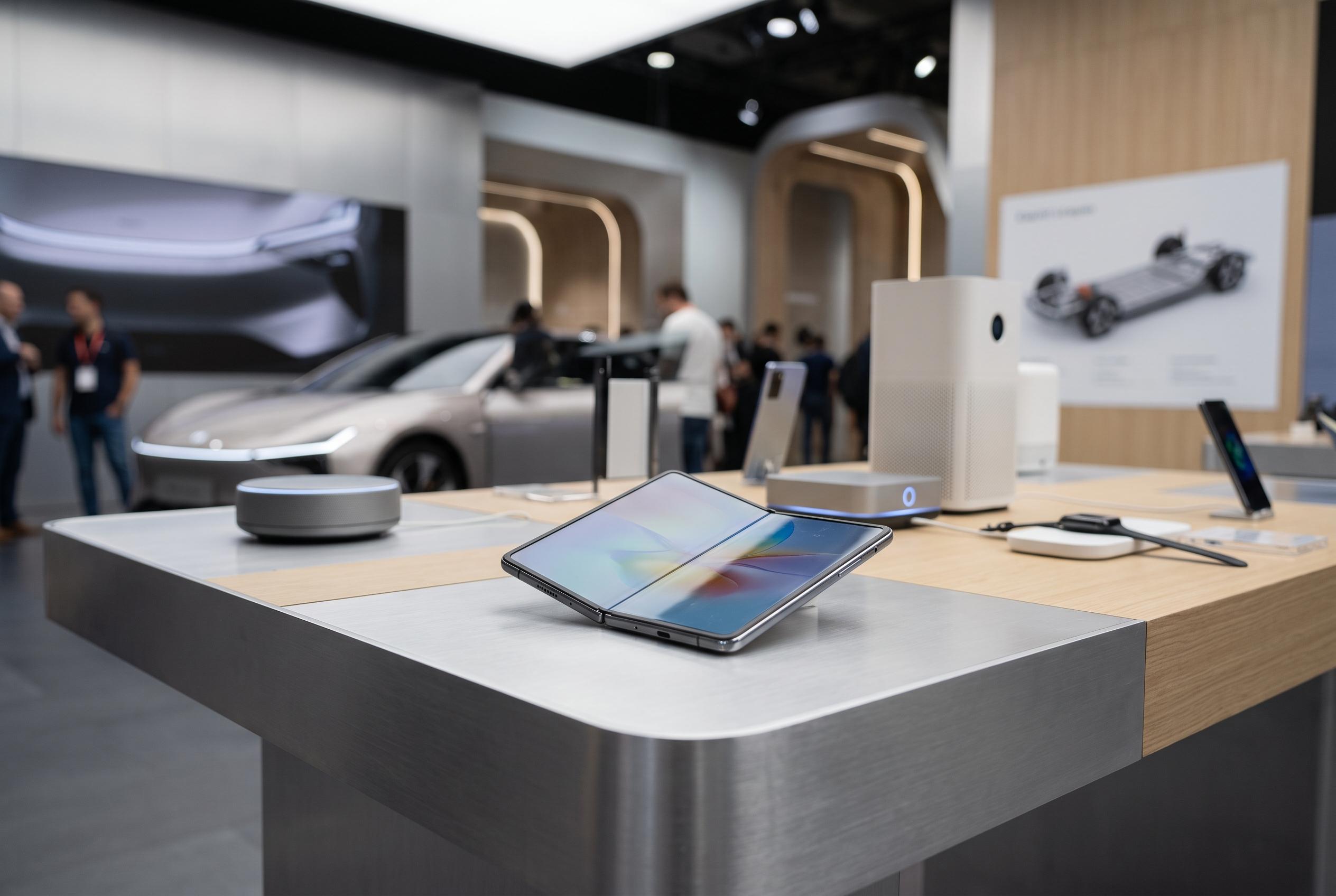

At IFA Berlin, Xiaomi showcased its return to foldable phones with the Xiaomi 18 Fold, alongside a suite of connected devices, AI innovations, and ambitious plans for electric vehicles and in-house chip development, signalling a strategic shift beyond smartphones.
Xiaomi used its first appearance at IFA in Berlin to present itself as more than a smartphone maker, placing its newest foldable handset alongside electric vehicles, home appliances and experimental devices under its “Human x Car x Home” strategy. The company showed the Xiaomi 18 Fold in a display case, as well as a life-size model of the Xiaomi Vision Gran Turismo Concept, a virtual hypercar created for the Gran Turismo 7 driving simulator.
The Xiaomi 18 Fold marks the company’s return to horizontal folding phones after about two years. According to details released at the Chinese launch on 7 September, the device has a 5.38in outer display and a 7.58in inner display, with a compact closed footprint and a tablet-like 4:3-style format when opened. Xiaomi says the handset weighs about 219g and measures 117.8mm in height, with the folded body measuring 83.6 x 10.68mm and the open body 163.8 x 5.02mm. PhoneArena and other specification trackers broadly match those figures, while Gadgets 360 reports the same 7.58in main panel and highlights the 200-megapixel main camera.
The camera system is one of the phone’s main selling points. Xiaomi says the rear array combines a 200-megapixel wide-angle camera, a 50-megapixel ultra-wide lens and a 50-megapixel 3x telephoto unit, with 32-megapixel front cameras on both the outer and inner screens. The battery is rated at 6,000mAh, with 60W wired charging and 50W wireless charging. The handset starts at 10,999 yuan, or about 25,600 yuan, and is already on sale in China.
The 18 Fold also serves as a showcase for Xiaomi’s own silicon. The company says the phone uses its XRING O3 chip, built on TSMC’s 3nm process and paired with an NPU that can reach 200 TOPS. At the same booth, Xiaomi also displayed the XRING O100 for large-scale AI inference and the XRING D100 for autonomous driving, signalling a wider push into in-house chips across mobile and automotive products.
Xiaomi’s automotive display reinforced that ambition. The Vision Gran Turismo Concept, which Gizmochina reported was originally unveiled earlier in the year for Gran Turismo 7, is not intended for production or road use. Xiaomi says it imagines a 900V drivetrain and roughly 1,900 horsepower. The company also showed the SU7 Ultra, its high-performance EV that set a Nürburgring Nordschleife lap record for production electric vehicles, with a claimed total output of 1,548 horsepower and a top speed of 350km/h.
The broader IFA stand was built around connected living. Xiaomi staged room-like demonstrations in its AI Today zone, using a 2026-model SU7 Max to anchor scenes representing a kitchen, living room, bedroom and study. In one demonstration, an AI camera detected movement in a bedroom and turned on the air conditioner; when a person sat on the bed and opened a book, a bedside lamp switched on. Xiaomi’s point was that the system is meant to interpret intent, not just simple presence, and can connect phones, cars and appliances within the same environment.
That message was backed by scale. Xiaomi said it was showing more than 380 related products, ranging from domestic appliances to next-generation devices such as humanoid robots and AI glasses. The company’s Xiaomi AI Glasses, already sold in China, weigh about 40g and come with a 12-megapixel camera, more than eight hours of battery life and optional electrochromic lenses, with prices starting at 1,999 yuan. In Europe, Xiaomi says it began a serious push into smart appliances in 2026 and plans to introduce EVs in 2027, while in Japan it is expanding smaller home appliances first and may follow with larger products later, depending on local power and housing requirements.
Disclaimer: This content is intended for informational purposes only. Readers are advised to exercise their own judgement, conduct due diligence, or consult a qualified expert before acting on any information provided.