
As Xbox cloud gaming expands across new TV models and brands in 2026, buyers must prioritise compatibility and gaming features over mere screen quality to enjoy seamless streaming experiences.
Anyone shopping for a television for Xbox cloud gaming in 2026 should begin with a less glamorous question than OLED versus Mini-LED: can the set run Microsoft’s Xbox app at all? Microsoft’s current Xbox on TVs guidance (xbox.com) says support now spans select Samsung smart TVs from 2020 onwards, LG sets running webOS 24 or newer, certain Amazon Fire TV devices and VIDAA OS-powered televisions, including some Hisense models. That is a wider field than the LG-focused expansion Microsoft was still outlining in early 2025, when it said the Xbox app would reach new LG smart TVs later that year and described cloud play on televisions as part of a push to bring games to more devices. (news.xbox.com)
The LG rollout shows how quickly the category changed. In January 2025, Xbox said millions of Game Pass Ultimate members were already using Xbox Cloud Gaming while it prepared the LG launch, with access through LG’s Gaming Portal to titles including Call of Duty: Black Ops 6 and Avowed, which was then due on 18 February 2025. (news.xbox.com) By 23 April 2025, that plan had become a live consumer service in more than 25 countries, covering 2022 OLED televisions, select 2023 LG models and newer sets, plus smart monitors on webOS 24, with support due to expand to StanbyME. Xbox also used the launch to push its “stream your own game” feature, naming Assassin’s Creed Shadows, NBA 2K25 and Hogwarts Legacy among titles players could stream even when they sat outside the standard catalogue. (news.xbox.com)
Samsung’s role is slightly different. Samsung said in June 2025 that Gaming Hub, first introduced in 2022, had turned its televisions and monitors into destinations for streamed games rather than simple displays. On Samsung’s account, the company was the first in the TV industry to integrate Xbox Cloud Gaming into smart TVs and monitors, and the same hub also carried services such as NVIDIA GeForce NOW and Amazon Luna. Samsung added that supported features and games varied by country and model, that a Samsung Account was required for network-based smart services, and that eligibility covered select 2022 or later TVs and monitors. (news.samsung.com)
Those platform details matter because they change what “best” means. For pure cloud gaming, Microsoft’s own checklist (xbox.com) is basic but more useful than many shopping guides: a compatible television or streaming device, a supported controller, an Xbox Game Pass subscription and a solid connection. The company recommends either wired networking or 5GHz Wi-Fi and says players should have 20Mbps down. It also says official Xbox controllers and Sony PlayStation pads are supported. In other words, a spectacular panel is wasted if the set is not on the compatibility list or if the network path is poor.
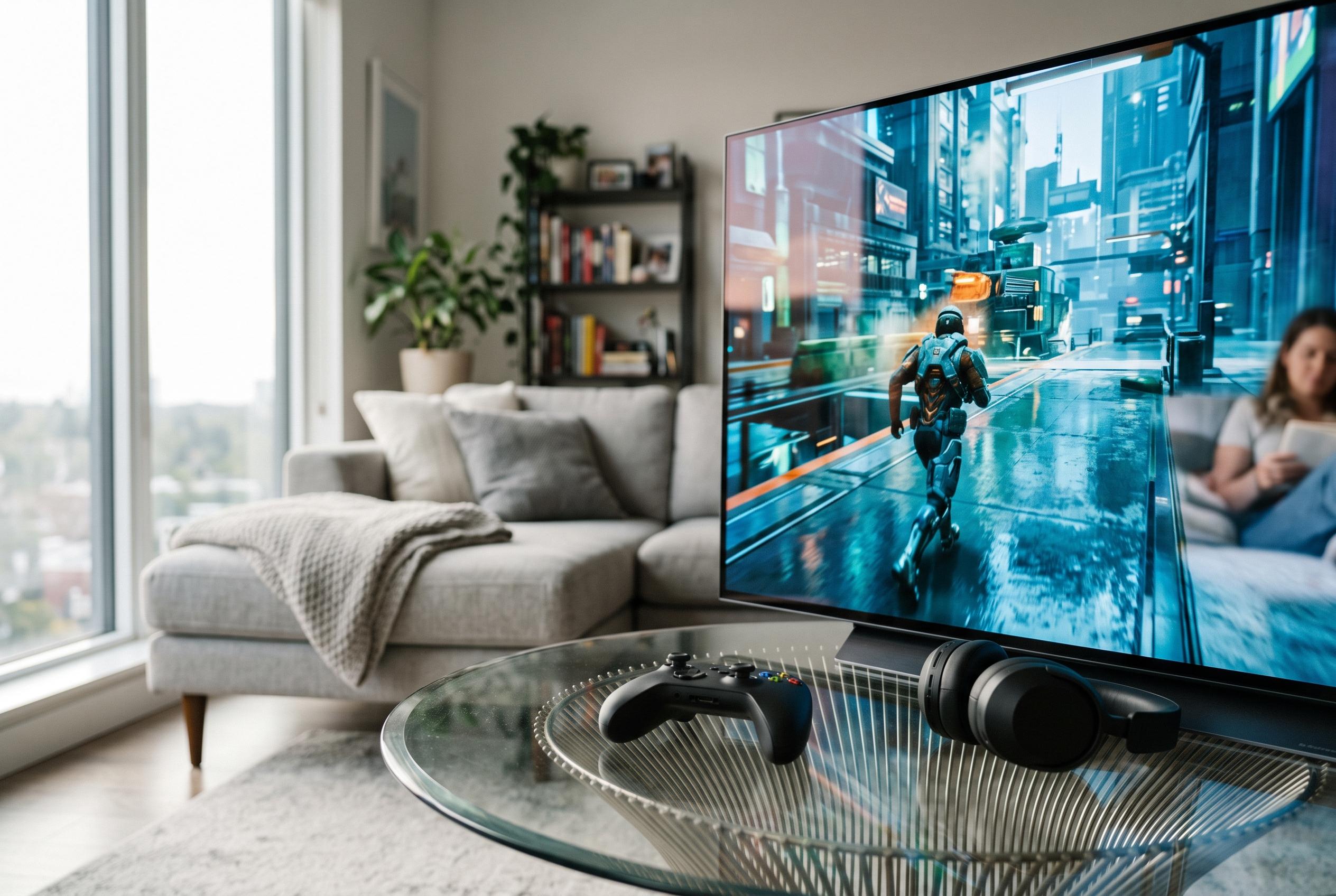
Once that compatibility hurdle is cleared, independent testing points towards a different set of winners from many generic round-ups. RTINGS, which says it has bought and tested 549 televisions, updated its 2026 Xbox rankings on 26 August and put the Samsung S95H OLED first overall, with the LG C6 OLED 2026 as the step-down choice if price rules out the Samsung. (rtings.com) Its reasoning is straightforward: Xbox buyers should look for 4K at 120Hz, VRR to cut screen tearing, fast response times for clearer motion and strong image quality. The Samsung offers four HDMI 2.1 ports and up to 4K at 165Hz, while the LG matches much of that gaming specification and adds Dolby Vision. (rtings.com)
That does not mean every cloud-gaming buyer needs a flagship OLED. RTINGS’ data is still useful because it shows where savings are sensible and where they become false economy. Its lower-priced TCL picks, such as the QM7K and QM6K, retain VRR, low input lag and high-refresh support, making them plausible choices for players who may later add a console or PC. At the cheap end, however, the compromises become more severe: the Hisense QD6QF cannot do 4K at 120Hz and, according to RTINGS, suffers very high input lag in 1440p at 120Hz, which limits the value of that mode. (rtings.com) That is a more precise way to judge value than simply chasing the lowest price or the biggest screen.
Real-world use also remains less perfect than the marketing suggests. In a hands-on test on a Samsung Odyssey Ark, Tom’s Guide described streaming directly to a Samsung television as “a passable replacement for an Xbox Series X/S” but said it still “falls notably short” of dedicated hardware. (tomsguide.com) The important detail is that this was not a weak-network failure: the publication tested over Wi-Fi at 136Mbps down and 228Mbps up, well above Microsoft’s stated minimum. Even then, the appeal was convenience and low friction rather than parity with a console. (tomsguide.com)
The practical conclusion for 2026 is that buyers should shortlist in two stages. First, verify support on Microsoft’s current device list, because Xbox on TV has expanded well beyond the early Samsung and LG story and now includes Fire TV and select VIDAA-based sets. (xbox.com) Then choose panel quality and gaming features according to budget. Shoppers who want the strongest all-round display performance should look first at the Samsung S95H OLED and LG C6 OLED tier identified by RTINGS. Players who mainly want a convenient living-room cloud setup can spend less, but they should still avoid models that sacrifice responsiveness or future console-friendly features too aggressively. What was a beta-era curiosity in 2022 has become a proper TV platform. It still does not fully replace a console, but it no longer makes sense to shop for it as though every large screen were equally ready for Xbox. (rtings.com)
Disclaimer: This content is intended for informational purposes only. Readers are advised to exercise their own judgement, conduct due diligence, or consult a qualified expert before acting on any information provided.