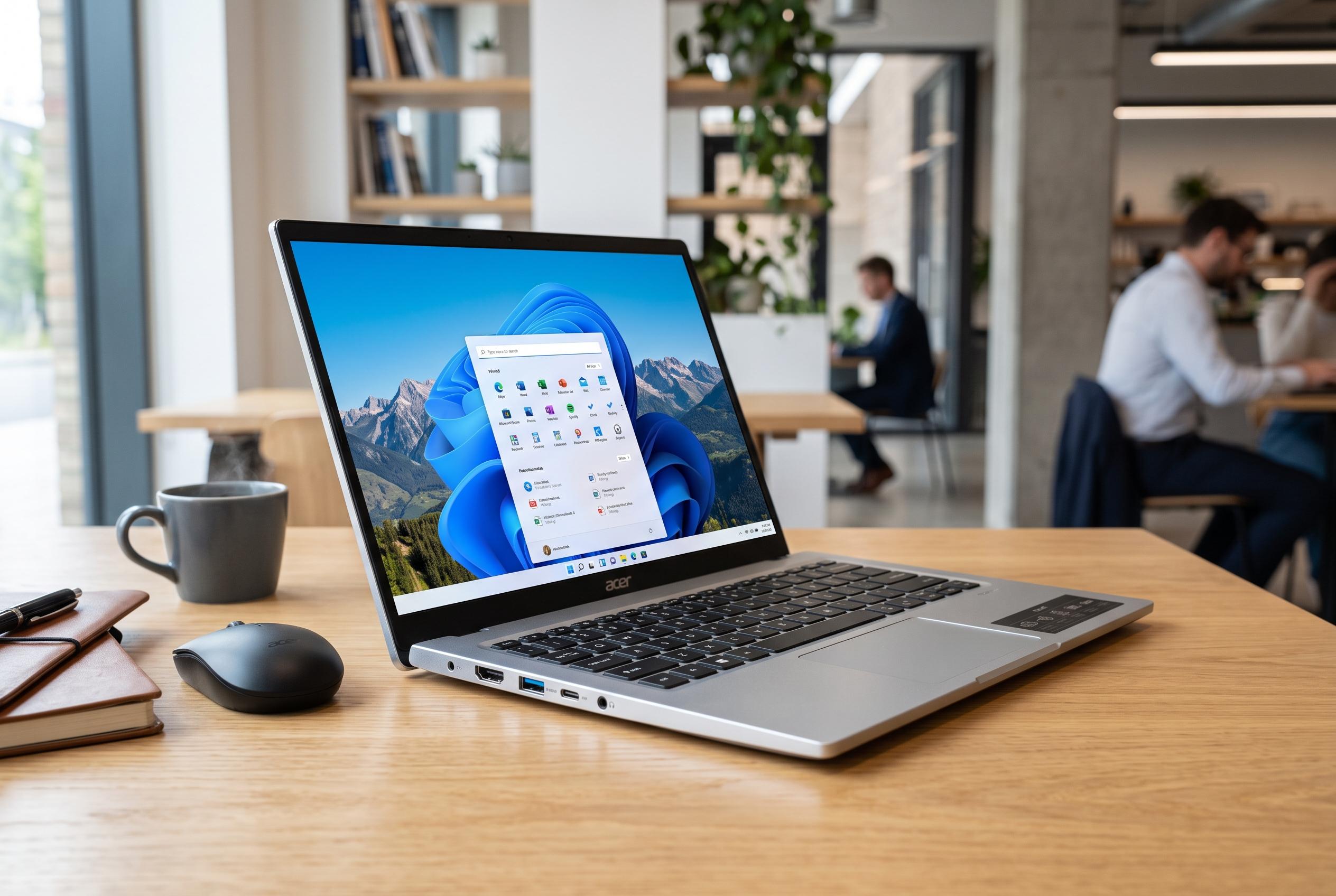

Acer introduces the lightweight Go Air in China, packing enhanced features such as a sharper display, better connectivity and increased storage, challenging Apple’s entry-level MacBook with a focus on practicality and portability.
Acer has added another lightweight Windows notebook to the growing challenge posed by Apple’s cheapest MacBook, this time with a configuration of the Go Air sold in China that leans on a sharper feature set rather than a lower sticker price. The model uses Intel’s new Core 5 320 processor, pairs it with 12GB of LPDDR5 memory and a 512GB SSD, and is priced at CNY 5,499, or about $815. Acer has not said when, or whether, this exact version will leave China, although the machine appears closely related to the Swift 14 shown at Computex 2026.
The comparison with Apple’s MacBook Neo is straightforward. Apple’s entry-level laptop starts at $699 with 8GB of unified memory and 256GB of storage, while the 512GB version costs $799. Acer’s Go Air is slightly dearer in converted terms, but it answers with more memory, more storage and a display that refreshes at 120Hz. The MacBook Neo, by contrast, uses a 13-inch IPS panel at 2408 x 1506 and offers a higher pixel density, so Apple retains the edge in sharpness rather than motion.
Ports are another clear point of contrast. Acer gives the Go Air two Thunderbolt 4 connections and one USB-A port, which makes it easier to use older accessories without a hub. Apple’s machine has two USB-C ports, but only one supports USB 3 speeds of up to 10Gbps and DisplayPort, while the other is restricted to USB 2. Apple officially supports one external display at up to 4K and 60Hz. For buyers who still use wired peripherals, Acer’s layout is more practical.
The chassis is also close in size to Apple’s machine. Acer says the Go Air weighs 1.19kg and is 12.99mm thick, while the MacBook Neo weighs 2.7 pounds and measures 12.7mm thick. The Go Air also carries a 70Wh battery and a claim of up to 19 hours of use, alongside 100W USB-C charging that can top the battery to 50% in 30 minutes. Apple rates the Neo for up to 16 hours of video streaming or 11 hours of wireless web use from a 36.5Wh battery, although the two companies use different test methods, so the figures cannot be compared directly.
Intel’s Core 5 320 is a six-core Wildcat Lake chip built on Intel 18A, with two performance cores, four low-power efficiency cores, a peak turbo frequency of 4.6GHz, integrated graphics and a 16-TOPS NPU. It is not aimed at heavy creative workloads, but neither is Apple’s A18 Pro-powered Neo. Both laptops are built for everyday computing, where battery life, portability, display quality and the right mix of ports matter more than raw performance.
Acer’s broader Go line suggests the company is pushing this formula across different sizes and price points. The Go 16, for example, has already appeared with Intel’s Core 5 210H, 16GB of RAM, a 1TB SSD and a 16-inch 1920 x 1200 screen, while other Go 14 variants sold by Acer have ranged from modest AMD-based models to more fully specified Intel versions. The pattern is clear: Acer is positioning the series as a practical alternative for buyers who want MacBook-style portability without Apple’s storage and connectivity limitations.
Disclaimer: This content is intended for informational purposes only. Readers are advised to exercise their own judgement, conduct due diligence, or consult a qualified expert before acting on any information provided.