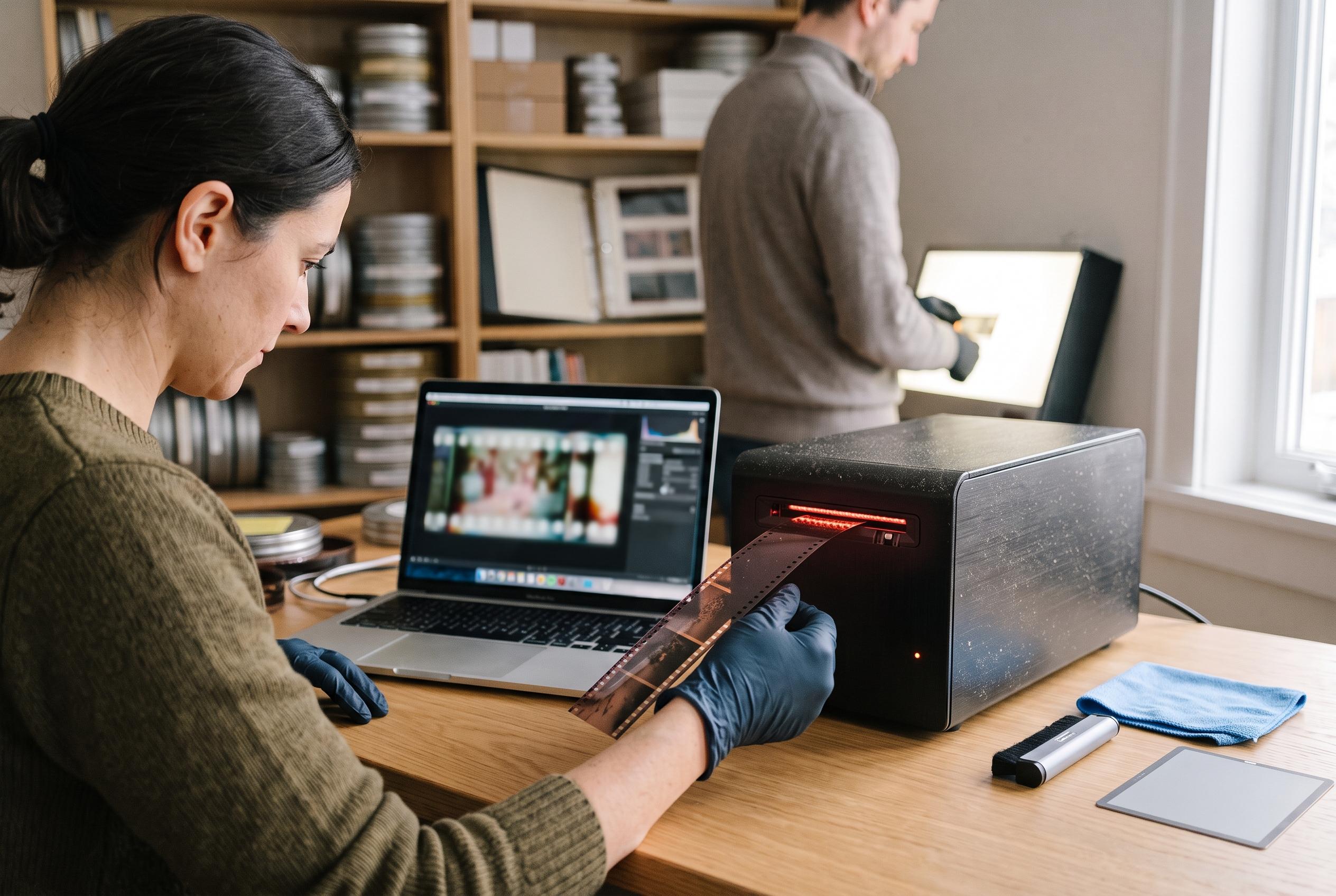

Modern film scanners go beyond nostalgia, focusing on preservation with features like infrared dust removal and custom software, catering to both casual users and archive-grade professionals.
Digitising old film has become less about nostalgia and more about preservation. As negatives and slides age, colour shifts, scratches and physical decay can make family archives harder to recover later. The best scanners now aim to reduce that risk by combining format flexibility, preview screens, direct-to-card storage and, in some cases, infrared dust removal for cleaner results.
The strongest broad advice from recent buying guides is that the right scanner depends first on the film you actually own. According to Digital Camera World, standalone units remain attractive for casual archiving because they are easy to use and work without a computer, while dedicated 35mm scanners are still the better choice when detail, colour control and restoration matter more than convenience. Camera Lookout makes a similar point, noting that mixed collections, mounted-slide libraries and serious 35mm work often call for very different devices.
That distinction explains why all-in-one models continue to dominate the home-archiving market. Devices such as the Magnasonic FS71, KODAK Slide N Scan and HPFS500 are designed for mixed household collections, where users want a simple workflow rather than a technically demanding setup. Their appeal lies in straightforward preview screens, one-touch scanning and SD-card saving. In practical terms, these scanners reduce the time spent on setup, software and driver compatibility, which matters more to many families than the last increment of image quality.
For users with higher expectations, the Plustek OpticFilm 8200i SE remains the most specialised option in this roundup. Digital Camera World and Ohio Drone LLC both single it out for serious 35mm digitisation, pointing to its infrared dust and scratch detection, 7200 dpi class resolution and bundled SilverFast software. That combination is more suitable for people planning archive-grade scans or print enlargements, although the workflow is slower and more dependent on a computer than the standalone models. The trade-off is clear: better image control, but less speed and simplicity.
Other recent guides show how the market is segmenting further. Camera Lookout highlights camera-scanning systems such as the VALOI easy35 v2 and VALOI 360 Professional for users who already own a capable digital camera, while ExifGrabber points to camera-adapter solutions like the Nikon ES-2 for photographers seeking a lower-cost route into digitisation. These approaches can be faster than flatbed or tray-based scanners, but they require more supporting equipment and a more deliberate setup. They are best suited to users who value throughput and consistency over all-in-one convenience.
There is also a practical caution running through the current advice: specifications on the box do not always translate into better scans in the real world. Higher interpolated megapixel claims can look impressive, but film alignment, lens quality, sensor design and software often matter more. That is why buyers are repeatedly urged to check format support, holder design, storage limits and bundled software before ordering. For small boxes of family memories, simplicity and compatibility may be enough. For larger archives, or for originals that may never be rescanned, it is worth paying for a model that offers better cleaning, higher optical quality and a more controlled workflow.
Disclaimer: This content is intended for informational purposes only. Readers are advised to exercise their own judgement, conduct due diligence, or consult a qualified expert before acting on any information provided.