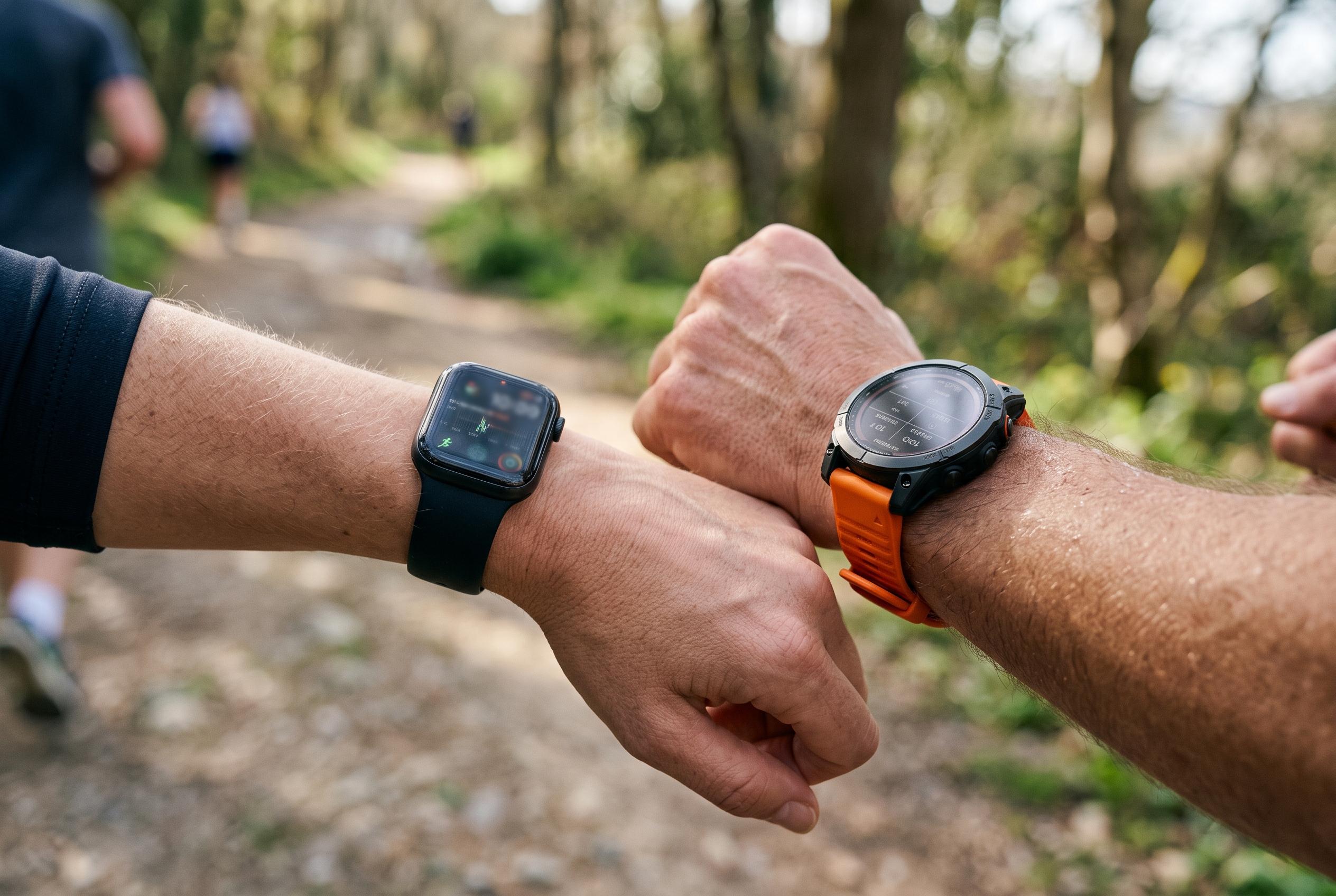

A controlled 5,000-step comparison found little between Apple’s smartwatch and Garmin’s budget running watch, with Garmin edging overall accuracy while Apple delivered the stronger pace reading.
A head-to-head walk test has put Apple’s latest smartwatch against Garmin’s budget running model, and the result was much closer than expected. Tom’s Guide logged a 5,000-step outdoor workout with the Apple Watch Series 12 on one wrist and the Garmin Forerunner 170 on the other, using a manual step count and Strava as the control data for distance, climb and pace.
On price, the Garmin starts at $349, while the Apple Watch Series 12 begins at $399 and rises to $549 depending on configuration. Tom’s Guide said both devices bring similar core fitness hardware, including heart-rate sensing, GPS and altimeter support, along with bright touchscreens and slim cases. The Apple Watch offers a broader app ecosystem and more general-purpose smart features, but the Garmin is positioned more directly at runners and adds more training and recovery tools. The Forerunner 170 Music also comes in more colourful, sporty finishes, although its plastic case is lighter than Apple’s aluminium design.
The test itself was tightly controlled. Tom’s Guide manually counted 5,014 steps, then compared the watches’ readings against Strava’s distance, elevation and pace figures. The Apple Watch Series 12 recorded 5,003 steps, while the Garmin Forerunner 170 logged 5,020, leaving both devices within a narrow margin of error. Both watches also measured the same 2.56 miles of distance, close to the 2.64-mile Strava control.
Elevation was the one area where Garmin edged ahead. Tom’s Guide found that the Apple Watch overstated climb by 22 feet versus the control, while the Garmin was only six feet out. On pace, Apple’s single post-workout metric was nearer to Strava’s control figure than Garmin’s recorded pace, although the publication noted that Apple appears to present elapsed pace rather than a true moving average. Strava’s own moving pace was also faster than Garmin’s reading.
Heart-rate tracking was effectively identical. Both watches reported an average of 129 bpm and a peak of 162 bpm during the walk, suggesting that left-wrist versus right-wrist placement made no practical difference in this case, provided the settings were entered correctly. Battery use was modest on both devices, but Apple drew slightly less power during the workout, consuming 4% against Garmin’s 5%.
Tom’s Guide concluded that Garmin produced the more accurate overall fitness record in this test, thanks to its closer step count and better elevation figure, while Apple was slightly stronger on pace and held its own on heart rate. For readers choosing between the two, the verdict was not that one watch dominates the other, but that each has strengths depending on whether the priority is broader smartwatch features or more training-focused fitness tracking.
Disclaimer: This content is intended for informational purposes only. Readers are advised to exercise their own judgement, conduct due diligence, or consult a qualified expert before acting on any information provided.