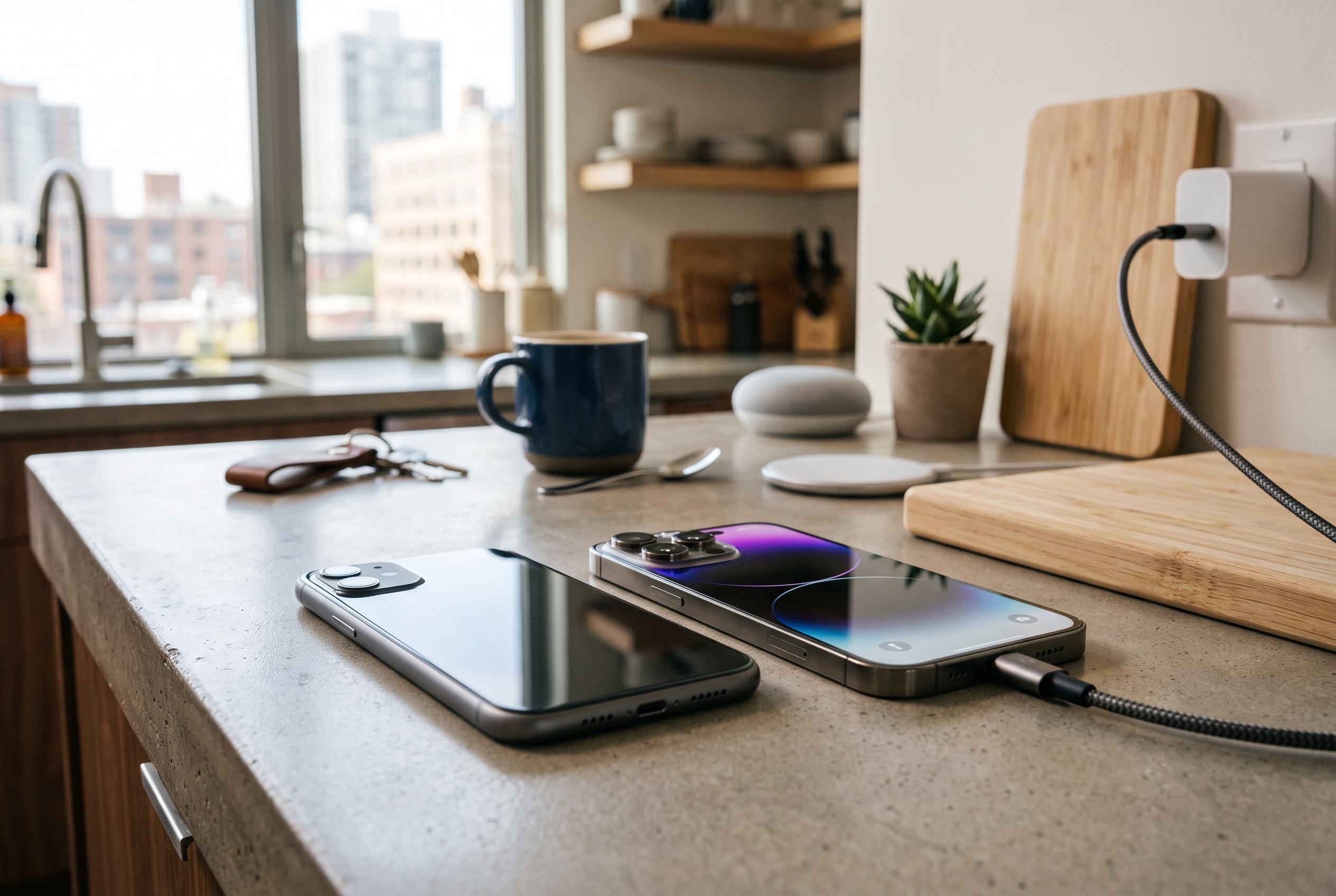

While both new iPhones share the same A19 chip and software features, the gap in display quality, camera capabilities, connectivity, and charging speed makes the flagship iPhone 17 the more compelling choice for most buyers, despite a $200 price difference.
Apple’s two most affordable recent iPhones now differ less on core performance than on day-to-day experience. The iPhone 17e and iPhone 17 both use the A19 chip and support Apple Intelligence, but comparisons published by GSMArena and other reviewers show that the cheaper model still gives up several of the features most buyers notice first: display smoothness, camera flexibility, charging speed and wireless connectivity.
Physically, the two phones are closely related. Both use aluminium frames, glass backs, Ceramic Shield 2 protection and an IP68 rating for dust and water resistance, with Apple claiming they can survive immersion in up to six metres of water for 30 minutes. The 17e is the smaller and lighter handset, measuring 146.7 x 71.5 x 7.8mm and weighing 169g, while the iPhone 17 is slightly larger and heavier at 149.6 x 71.5 x 8mm and 177g. The more obvious divide is on the front, where the 17e keeps the older notch design and the iPhone 17 adopts Dynamic Island.
The display is where the gap becomes most obvious in use. According to GSMArena, the iPhone 17e has a 6.1-inch OLED panel with a 60Hz refresh rate, while the iPhone 17 uses a 6.3-inch LTPO OLED screen with 120Hz ProMotion. Tom’s Guide and TechRadar say the iPhone 17 also reaches much higher peak brightness, making it easier to read outdoors and giving it a visibly more fluid feel when scrolling or animating the interface. The 17e remains perfectly usable, but it does not match the premium feel of the newer panel.
Battery results are more mixed. GSMArena found that the iPhone 17e lasted slightly longer overall in its tests, helped by a larger 4,005mAh battery and a less demanding display. In separate scenarios, however, the iPhone 17 performed better in video playback and gaming. That means the 17e may suit buyers who prioritise endurance in everyday use, but the advantage is not large enough to outweigh the rest of the specification gap for everyone.
Charging and connectivity also favour the iPhone 17. GSMArena reports that the iPhone 17 can reach a full charge in about 85 minutes with a 40W adapter or stronger, while the 17e needs about 94 minutes and is limited to slower wired and wireless charging. MacRumors and TechRadar also note that the iPhone 17 supports MagSafe and faster Qi2 wireless charging at up to 25W, whereas the 17e is capped at 15W. On top of that, the iPhone 17 includes Wi-Fi 7, Bluetooth 6.0 and Ultra Wideband, while the 17e uses older Wi-Fi 6 and Bluetooth 5.3.
Camera hardware creates another clear split. The iPhone 17e has a single 48-megapixel rear camera, while the iPhone 17 adds a 48-megapixel ultrawide lens and a more advanced 18-megapixel front camera. Reviewers quoted in the supplied summaries say the main camera performance is similar at standard zoom, but the iPhone 17 pulls ahead in 2x crops, ultrawide shots and low-light flexibility. It also offers stronger video features, including recording from the ultrawide camera and support for spatial capture in some reviews. For buyers who take many photos or videos, this is likely the most compelling reason to spend more.
On raw performance, the difference is smaller. Both phones ship with 8GB of memory and 256GB of base storage, and both are built around the same A19 platform, so general app use should feel close. The iPhone 17 does have the stronger five-core graphics processor, while the 17e uses a four-core version, and benchmarking cited by GSMArena shows a noticeable lead in graphics tests. Still, in normal tasks, the practical distinction is modest.
That leaves value. The iPhone 17e starts at $599, which makes it the lower-cost path into Apple’s current hardware and software platform. It delivers the same chip, the same baseline storage and a broadly similar iOS experience. But the iPhone 17 looks like the better all-round buy if the extra $200 is available. Its 120Hz screen, better camera system, faster charging and newer wireless standards make it the more complete phone, and that is why several reviewers recommend stretching to it unless price is the overriding concern.
Disclaimer: This content is intended for informational purposes only. Readers are advised to exercise their own judgement, conduct due diligence, or consult a qualified expert before acting on any information provided.