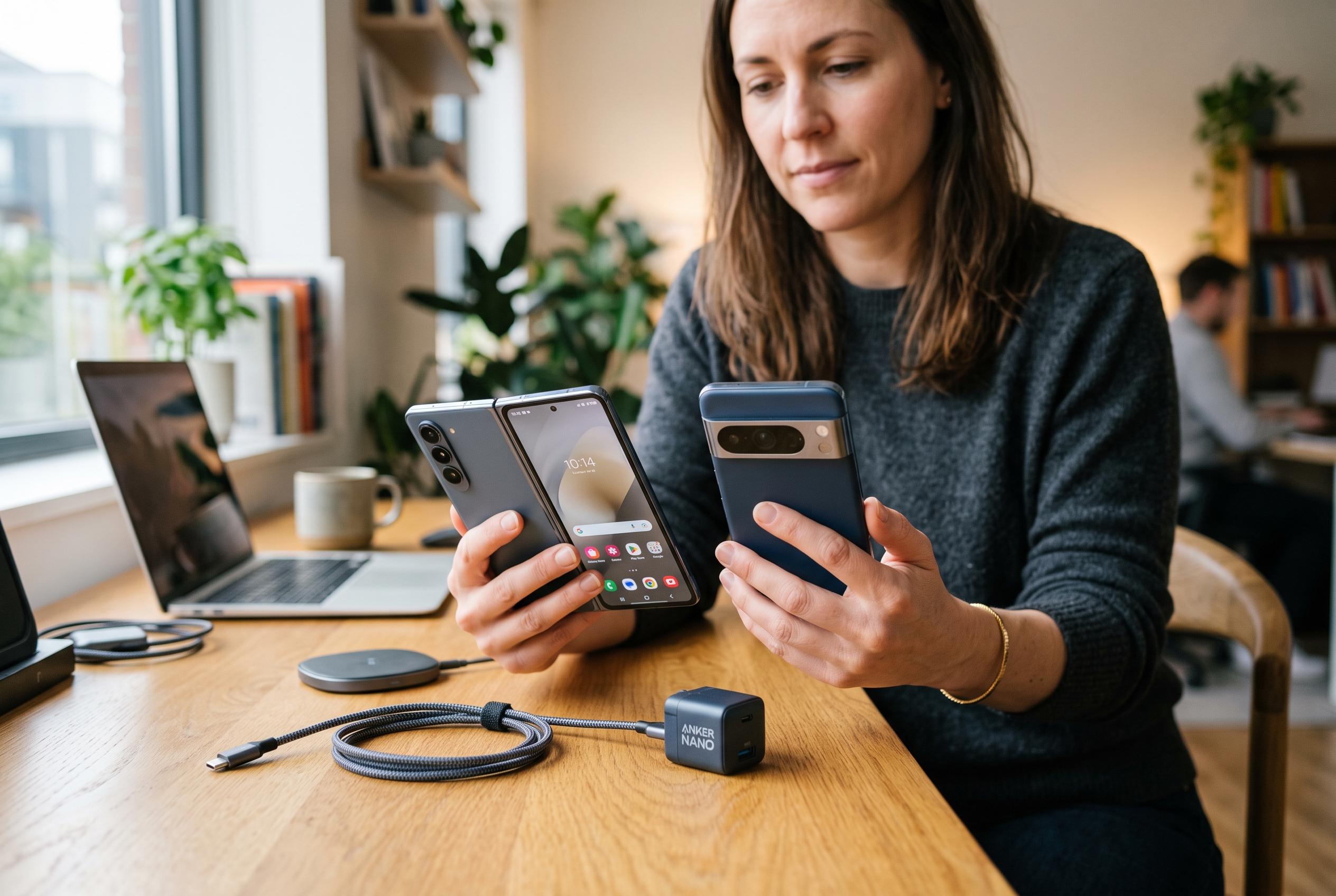

Apple’s iPhone 18 Pro models offer stronger cameras and simpler designs, while the new iPhone Duo brings foldable multitasking at a far higher price.
Apple’s next premium iPhones present buyers with a straightforward but expensive choice: a familiar slab-style handset or the company’s first book-style foldable. In a comparison published by PCMag, the iPhone 18 Pro is framed as the safest buy, the Pro Max as the battery champion, and the iPhone Duo as the bold new option for those willing to pay far more for a folding design. Apple’s own specifications page and recent pricing coverage confirm that the 18 Pro starts at $1,199 and runs to $1,999 for the 2TB model, while the Pro Max begins at $1,299 and climbs to $2,499. MacRumors reported that Apple’s launch pricing marked another clear step up for the Pro line, with higher storage tiers carrying especially steep premiums.
The design split is the most obvious distinction. According to PCMag, the iPhone 18 Pro and Pro Max keep Apple’s standard candybar format, with refined materials, IP68 resistance, Ceramic Shield protection and new finishes such as Burgundy and Glacier. The Duo, by contrast, is described as a titanium-hinged foldable that opens into a wider inner display and closes into a compact outer phone. That flexibility comes with trade-offs: it is thicker, heavier and inherently more complex than the conventional models. Reviews from TechRadar and What Hi-Fi? similarly portray the 18 Pro family as evolutionary rather than radical, with modest size changes and a slightly heavier feel than the previous generation.
On screens, the choice depends on how much versatility matters. Apple’s spec sheet lists a 6.3-inch OLED panel for the iPhone 18 Pro, while the Pro Max stretches to 6.9 inches, both with 120Hz ProMotion and 3,000 nits of peak outdoor brightness. PCMag says the Duo combines a 5.4-inch cover display with a 7.6-inch inner panel, giving it two different usage modes rather than one fixed format. That dual-screen approach is the foldable’s main attraction, but it also introduces the familiar compromises of the category, including a crease, extra moving parts and a more fragile-feeling experience than a flat slab.
Performance appears less divisive. PCMag says all three phones use Apple’s A20 Pro chip, and both TechRadar and What Hi-Fi? describe the processor as a meaningful but not dramatic step forward, with strong benchmark results and better efficiency. Apple has not publicly detailed all memory configurations, but the hardware stack is broadly similar across the range, with modern wireless features, satellite support and Apple’s updated thermal design. The practical message is that buyers are unlikely to feel underpowered on any of these models; the real question is which chassis they want wrapped around the silicon.
Battery life, however, should steer many decisions towards the larger non-folding model. PCMag’s testing found the iPhone 18 Pro Max lasted far longer than the smaller Pro, and the publication noted that Apple’s official estimates and real-world results both favour the larger device. Apple’s own product pages still avoid headline battery capacities, instead quoting video playback figures, but the pattern is familiar: a bigger body can hold more battery and generally sustains longer endurance. The Duo’s split-battery arrangement is more ambitious, yet the foldable format adds another layer of uncertainty until it has been tested in full.
Camera hardware is another decisive separator. Apple’s Pro models keep the more complete system, with a triple 48-megapixel setup, including a main Fusion camera with variable aperture, an ultra-wide lens and a telephoto camera with 4x optical zoom. PCMag also notes that the Pro pair support more advanced capture tools, including ProRes, ProRes RAW and Apple Log 2. The Duo has to make do with two rear cameras, omitting the telephoto lens in the name of thinness, and its front and inner cameras are less ambitious than the Pro’s TrueDepth setup. For buyers who care about zoom flexibility and video workflows, the slab phones remain the stronger choice.
Software is where the foldable finally pulls ahead. PCMag says the iPhone Duo runs a version of iOS 27 tailored to the folding format, with split-screen multitasking, two-instance app support, adaptive layouts and Apple Pencil compatibility on the inner display. The 18 Pro and Pro Max, by contrast, are built around the conventional iPhone experience, with the usual one-handed and two-handed interactions and the smaller Dynamic Island treatment Apple now uses across its premium range. That makes the foldable the most interesting device of the three from a software perspective, even if it is not the most practical.
For most people, the iPhone 18 Pro remains the balanced buy. It is the cheapest of the three, has the most complete camera array and avoids the compromises of a foldable hinge. The Pro Max is the one to choose if battery life and screen size matter most. The iPhone Duo is the experiment: expensive, distinctive and likely to appeal most to buyers who specifically want a pocketable tablet-like device rather than the most straightforward iPhone.
Disclaimer: This content is intended for informational purposes only. Readers are advised to exercise their own judgement, conduct due diligence, or consult a qualified expert before acting on any information provided.