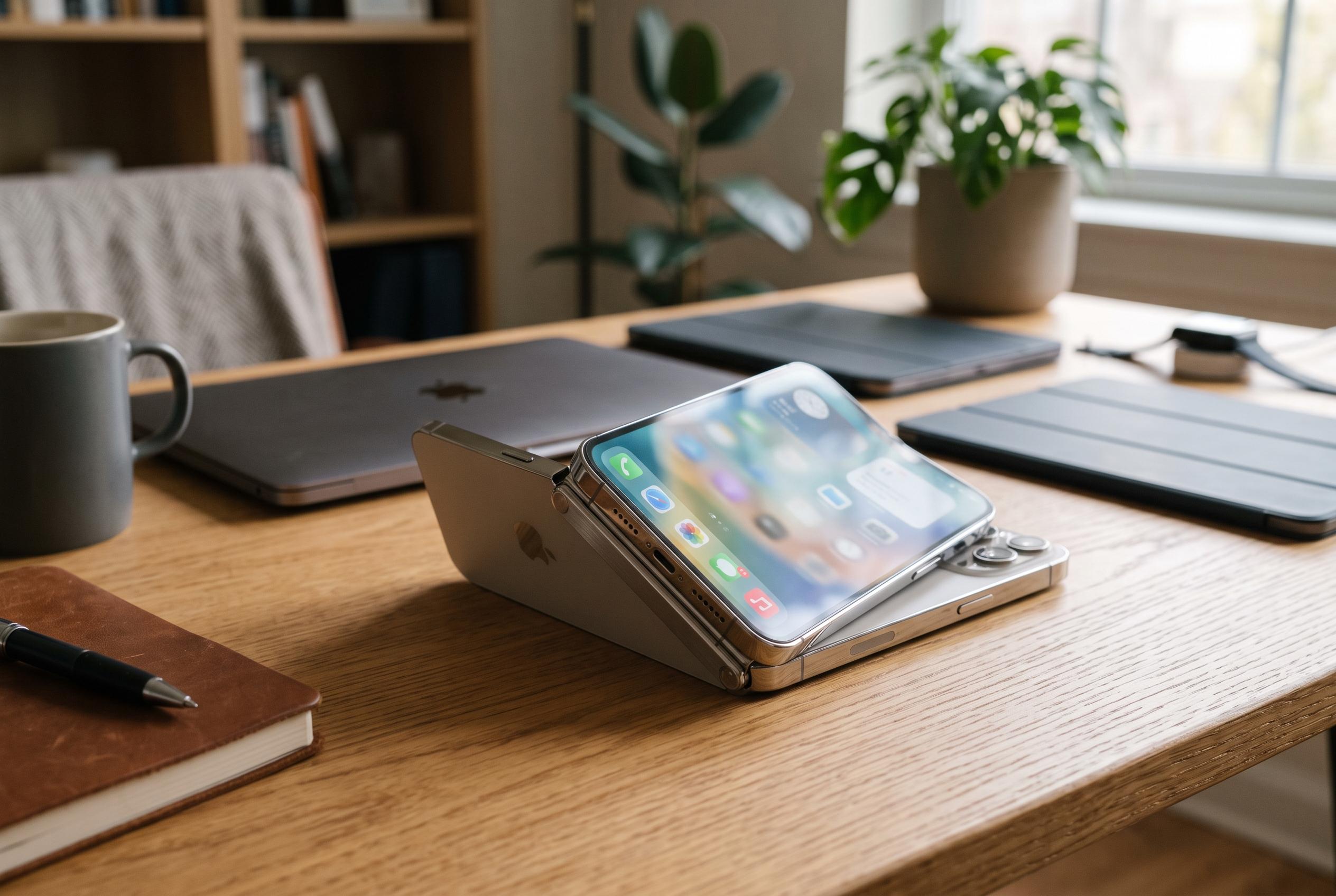

Apple has launched the iPhone Duo, a high-end foldable device emphasising premium materials, advanced durability, and seamless ecosystem connectivity, setting a new benchmark in the luxury foldable smartphone segment.
Apple has now joined the foldable market with the iPhone Duo, a device that arrives as a statement product rather than a volume play. The company priced its first foldable at $1,999 for the 256GB model, with storage rising to 2TB, while pre-orders begin on 16 October and sales start on 23 October. Samsung’s Galaxy Z Fold 8, by contrast, enters its eighth generation as the more accessible option, starting at $1,649. The result is a clear split in philosophy: Apple is leaning on premium materials and ecosystem integration, while Samsung is pressing the case for refinement and value.
On hardware, Apple has chosen a titanium frame, Ceramic Shield protection and IP68 water and dust resistance, which places the iPhone Duo near the top of the category for durability. Samsung’s Galaxy Z Fold 8 uses an aluminium build with IP48 protection, and Samsung has positioned its hinge and display design as robust enough for repeated folding, including a claimed 500,000-fold hinge rating. That gives Apple the stronger ingress protection on paper, but Samsung the lighter handset at 201 grams, versus 254 grams for the Duo.
The displays are broadly similar in size, with both phones opening to around 7.6 inches and using 120Hz LTPO OLED panels. Apple, however, has added two differentiators that matter in daily use: a Nano Texture finish to cut reflections and an under-display camera that avoids a visible cut-out on the main screen. Samsung’s foldable still relies on a punch-hole design. For cover-screen work, both phones are practical, but Apple’s slightly higher pixel density and reduced glare should make the Duo feel more polished in bright conditions.
Performance should also tilt towards Apple, at least in theory. The iPhone Duo runs on the A20 Pro, built on a 2nm process, while Samsung uses Qualcomm’s Snapdragon 8 Elite Gen 5 on 3nm silicon. Apple pairs that with 12GB of memory, but Samsung can go to 16GB, which may help when juggling several apps across a split screen. Apple counters with storage up to 2TB, which is double Samsung’s ceiling and will appeal to anyone keeping large video libraries or working heavily offline.
Cameras are a more awkward trade-off. Neither device includes a dedicated telephoto lens, which is a notable omission at this price level. Apple offers dual 48MP cameras, while Samsung uses dual 50MP sensors. Apple’s larger main sensor should help in low light, but Samsung can record 8K video at 30fps, whereas Apple tops out at 4K, albeit with higher-frame-rate options for slow motion. In short, both systems are competent, but neither matches the flexibility of some competing foldables that already include optical zoom.
Battery and software may matter more than any single spec sheet line. Apple has not disclosed the Duo’s battery capacity, though teardown estimates put it at about 4,883mAh; Samsung lists 4,800mAh. Apple also claims faster wired charging at 60W and 25W MagSafe/Qi2 wireless charging, compared with Samsung’s 45W wired and 20W wireless support. On software, the gap is more distinct: Samsung’s One UI brings DeX, better-established multitasking and foldable-specific features, while Apple is relying on iOS and Apple Intelligence to make the Duo feel native to the wider Apple ecosystem. For buyers, the choice is less about raw specifications than about which platform they already trust to carry a premium foldable.
Disclaimer: This content is intended for informational purposes only. Readers are advised to exercise their own judgement, conduct due diligence, or consult a qualified expert before acting on any information provided.