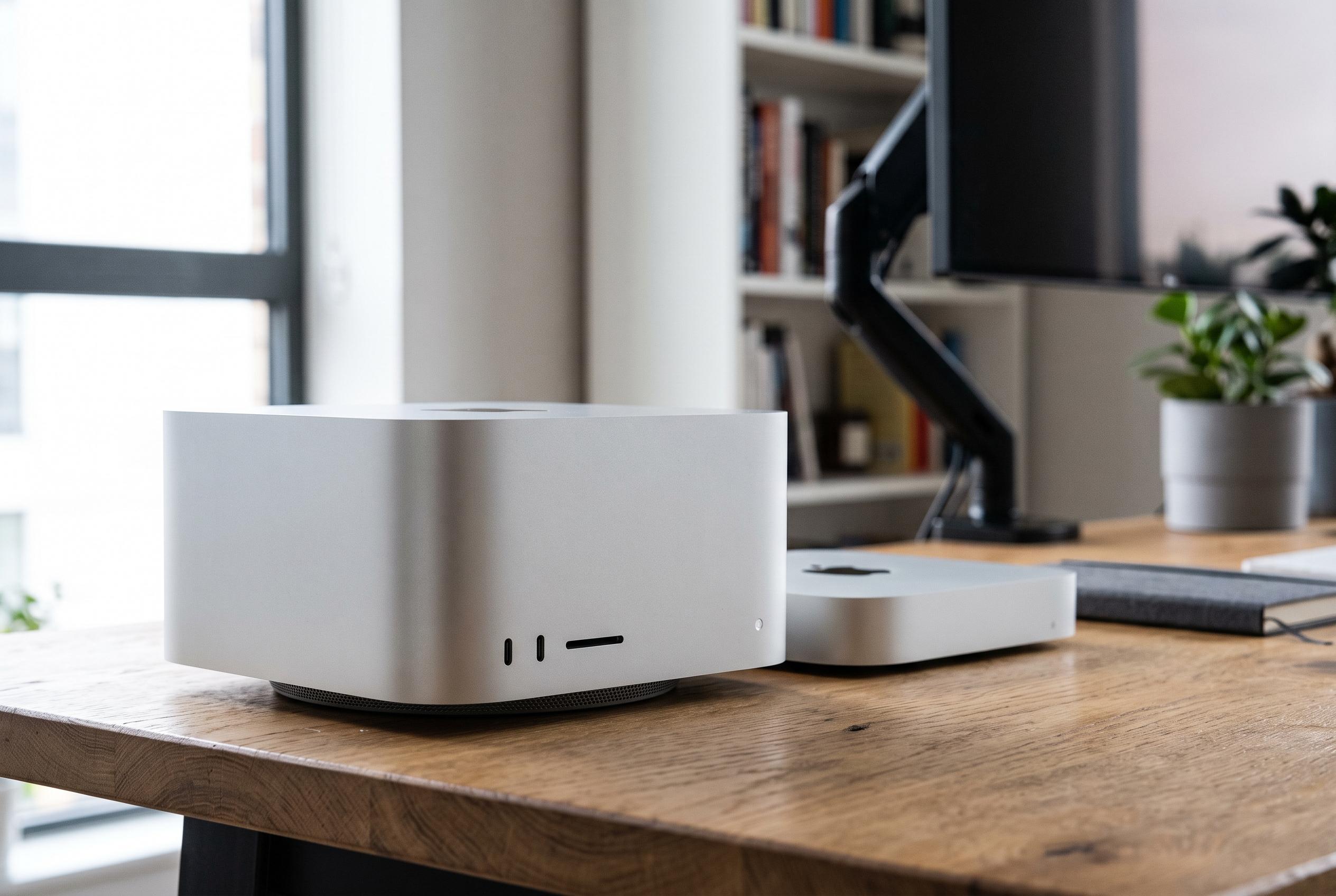

Apple’s Mac Studio is now significantly larger, more powerful, and pricier than the Mac mini, highlighting its position for demanding users versus mainstream buyers seeking practicality.
Apple’s Mac mini and Mac Studio occupy different parts of the same desktop line, but the gap between them is now wider than size alone. Engadget’s comparison says the Mac Studio is built for users who need sustained performance, while the Mac mini remains the more practical choice for most buyers. The distinction matters because both are compact Macs, yet one is aimed at mainstream use and the other at demanding creative and technical workloads.
According to Engadget, the Mac Studio is physically larger and heavier, measuring 3.7 inches high and weighing more than 6 pounds. It is also configured far above the entry-level Mac mini, with a base M5 Max chip that includes 18 CPU cores and 32 GPU cores. At the top end, Apple’s M5 Ultra model combines two M5 Max chips and can be specified with up to 36 CPU cores, 80 GPU cores, 512GB of unified memory and a 16TB SSD. Engadget says that makes it suitable for production studios, engineers and scientists, as well as other users running very heavy workloads.
The port selection is another clear divider. Engadget says the Mac Studio offers four Thunderbolt 5 ports, 10Gb Ethernet, HDMI, a headphone jack and two USB-A ports, plus two front-facing USB-C ports. Tom’s Guide’s earlier comparison of the Mac mini and Mac Studio reached the same broad conclusion: the Studio is the more expandable machine, with more generous memory, storage and connectivity options than the smaller desktop. By contrast, the Mac mini still offers enough connections for many users, but with fewer high-speed ports and no USB-A on the current configuration described by Engadget.
Price remains the deciding factor for most people. Engadget says the Mac mini now starts at $899, while the Mac Studio begins at $2,499. That makes the Studio a niche purchase, even if it is the better choice for people who cannot afford to wait on rendering, model training or other sustained tasks. Earlier specifications reported by EveryMac and a Macworld review of the M2-generation Studio show that Apple has long used the machine to bridge the gap towards Mac Pro-level performance, with support for higher memory ceilings and multi-display setups. The newer configuration pushes that positioning further, but only for users who genuinely need it.
Disclaimer: This content is intended for informational purposes only. Readers are advised to exercise their own judgement, conduct due diligence, or consult a qualified expert before acting on any information provided.