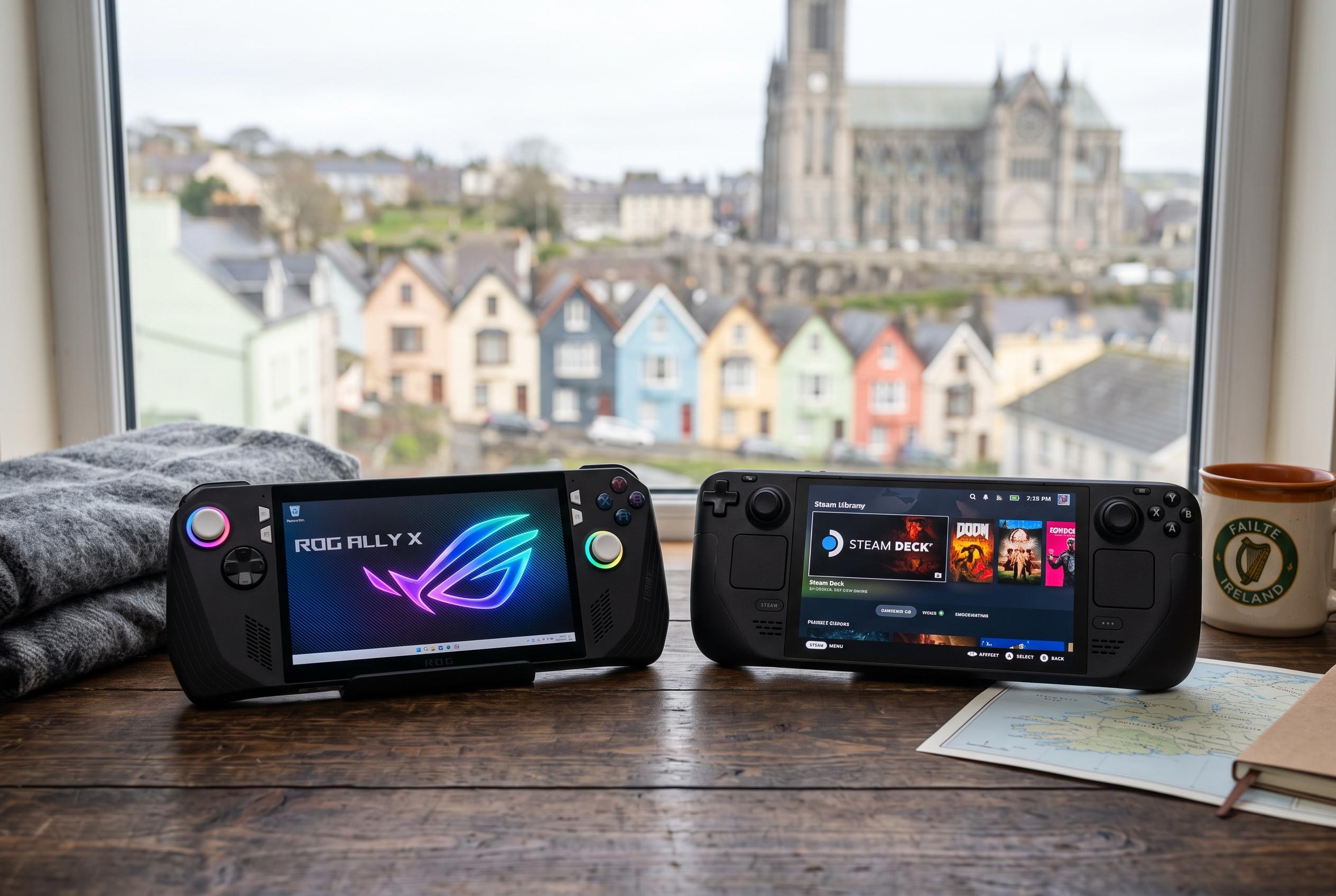

In Ireland, the battle between two handheld gaming PCs, ASUS’s ROG Xbox Ally X and Valve’s Steam Deck OLED, highlights diverging priorities of performance, price, and game library access as market choices narrow.
Two handheld PCs are competing for the same buyers in Ireland, but they are built around very different ideas. ASUS and Microsoft’s ROG Xbox Ally X is the more powerful and more expensive machine, with Windows 11 and a full 1TB of storage as standard. Valve’s Steam Deck OLED is cheaper, lighter and built around SteamOS, with an OLED panel and a smaller battery. In Ireland, the gap between the two starts at about €320, which makes the choice depend less on brand appeal than on library access, battery needs and how much platform flexibility matters. According to current Irish pricing, the Ally X sits at about €1,099, while the Steam Deck OLED starts at €779 for 512GB.
On paper, the Ally X has the clearer hardware lead. It pairs 24GB of RAM with an AMD Ryzen AI Z2 Extreme chip and a 16-compute-unit RDNA 3.5 GPU, compared with the Steam Deck OLED’s 16GB of RAM and 8-compute-unit RDNA 2 graphics. The Ally X also uses a 7-inch 1080p LCD panel with a 120Hz refresh rate, while Valve’s machine relies on a 7.4-inch 1280×800 OLED screen at 90Hz. That gives ASUS the edge in resolution, refresh rate and raw performance headroom, but Valve retains the stronger display for contrast and black levels.
The design trade-offs are just as clear. The Ally X is heavier at 715g and feels more like a compact Windows gaming PC, while the Steam Deck OLED comes in at 640g and has a more settled, console-like grip. ASUS uses familiar Xbox-style controls and textured side panels, which should suit players coming from Microsoft hardware. Valve’s device offers trackpads and rear inputs that remain useful in strategy games, desktop navigation and titles that were originally built around mouse input.
Benchmark coverage from Tom’s Hardware, PC World, PC Gamer and Reviewed points to a familiar result: the Ally X is usually faster, but the Steam Deck OLED often feels more coherent in everyday use. In demanding games such as Cyberpunk 2077, the ASUS machine tends to post higher frame rates, while in less GPU-bound games such as Baldur’s Gate 3 the gap is smaller. The Steam Deck OLED does not win on sheer horsepower, but it often delivers steadier pacing because SteamOS is tuned tightly to the hardware underneath it.
Battery life depends heavily on the workload, yet the pattern is consistent. PC World’s testing found the Ally X can run for close to two hours under heavy load, but far longer in lighter use, with low-power scenarios stretching towards 19 hours and 40 minutes. The Steam Deck OLED has a smaller 50Wh battery, but its lower-power SteamOS stack helps it remain efficient, especially in indie games, emulation and lighter sessions. In demanding AAA play, both devices tend to land in roughly the same broad two-to-four-hour range, which means long flights still call for a charger either way.
Software is where the real split begins. The Ally X runs full Windows 11 Home with an Xbox full-screen layer, so it can access Steam, Game Pass, Battle.net, the Epic Games Store and other launchers without compatibility workarounds. The Steam Deck OLED runs SteamOS, which uses Proton to translate many Windows games and has become much better at handling modern PC titles. Valve’s Deck Verified system also makes it easier to know in advance whether a game is likely to run well. The trade-off is that some anti-cheat systems used by competitive multiplayer games still block Linux entirely, which means certain titles simply will not launch on the Steam Deck OLED.
That makes library access the most practical difference for many buyers. If a player relies on Xbox Game Pass, wants broad launcher support, or needs access to anti-cheat-protected online games, the Ally X has the advantage. If the library is mostly Steam-based, single-player or already known to work on Proton, the Steam Deck OLED is usually the easier and cheaper choice. It also remains the better fit for emulation, where SteamOS’s Linux base gives tools such as RetroArch, Dolphin and PCSX2 a more natural home.
Pricing in Ireland has widened the decision further. Valve raised Steam Deck OLED prices in May 2026, citing memory and logistics pressures, but the device still undercuts ASUS by a meaningful margin. The 512GB Steam Deck OLED at €779 is around €320 cheaper than the Ally X’s only configuration, while the 1TB Steam Deck OLED narrows that gap to about €180. For many buyers, that difference can cover a dock, a case and several games.
Cooling and noise also matter more on the Ally X than the spec sheet suggests. Its bigger battery and stronger GPU require a more aggressive thermal system, so fan noise rises more quickly under sustained load. The Steam Deck OLED is generally quieter, helped by lower power draw and Valve’s years of hardware tuning across the original Steam Deck line and the OLED refresh. Neither machine is silent under pressure, but the Steam Deck OLED is usually the calmer device in handheld use.
The long-term picture is also worth weighing. Valve has continued to support the Steam Deck through regular SteamOS updates, and the wider handheld SteamOS rollout in 2026 has strengthened confidence in the platform. Windows on the Ally X offers broader compatibility, but it also brings the usual maintenance burden of a general-purpose PC, including updates, driver management and occasional background interruptions. That is not a deal-breaker, but it does make the ASUS machine feel more like a small computer than a sealed appliance.
For most buyers, the verdict is straightforward. The ROG Xbox Ally X is the stronger handheld if performance, Windows compatibility and Game Pass access are the priorities. The Steam Deck OLED is the better value if display quality, quieter operation, emulation and lower cost matter more. In a market where both machines are good, the right answer depends less on which is best in abstract terms and more on which one fits the games you already play.
Disclaimer: This content is intended for informational purposes only. Readers are advised to exercise their own judgement, conduct due diligence, or consult a qualified expert before acting on any information provided.