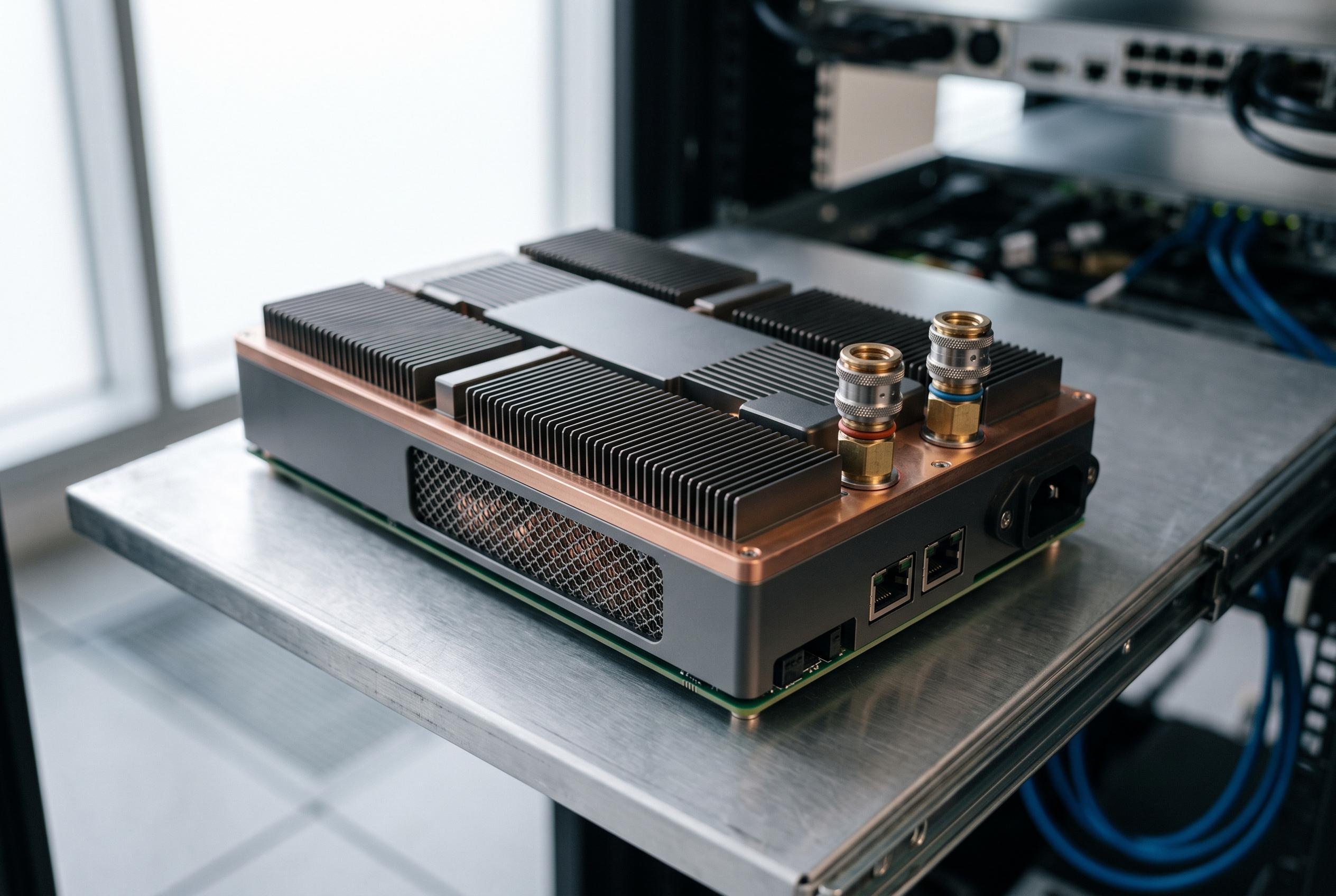

As agentic systems demand repeated loops, edge hardware must now contend with thermal and energy constraints previously overlooked, reshaping design priorities and benchmarking standards.
Edge AI hardware is being discussed more realistically than it was a year ago, but the debate is still too narrow. The old assumption was that designers should push throughput first and then work back to power and heat. That order has now largely reversed in industrial and battery-powered devices, where energy and temperature often set the real ceiling. Yet even that corrected view still assumes a fixed workload, usually a single model pass. Agentic systems are different: they do not simply infer once, they loop, and the cost of that loop is not known at design time.
That matters because the loop is not a theoretical abstraction; it is how these frameworks operate. OpenAI’s Agents SDK, for example, runs repeated turns until a limit is reached, and that limit can even be disabled. On a server, the consequence is usually financial. On a device, it is thermal. Every extra turn extends duty cycle, and passive cooling does not negotiate with duty cycle.
Recent benchmarking makes the problem concrete. A March 2026 preprint tested four platforms using the same quantised 1.5-billion-parameter model, a fixed prompt and twenty consecutive runs. It is only one model across four devices, so the numbers describe those systems rather than all edge hardware. Even so, the shape of the results is instructive: an iPhone 16 Pro started strongly but quickly slowed under heat, while a Galaxy S24 Ultra hit a thermal wall so hard that inference stopped altogether.
The key point is that the benchmark used an identical prompt each time, which is among the gentlest workloads an agent can face. Even then, sustained execution broke down. That echoes earlier work presented at MobiCom in 2024, which concluded that continuous LLM execution remains difficult on energy and thermal grounds. The underlying message has not changed: a phone can look capable in a short test and still fail under repeated real-world use.
There is also a structural reason agentic workloads are harsher than repeated prompts. Decoding is constrained by memory bandwidth, not just raw compute, and each loop step enlarges the key-value cache as tool outputs and intermediate state accumulate. At the same time, the device is heating up and reducing clock speeds. The cost per step rises just as the available budget falls. That is why the failure often appears suddenly rather than gradually.
Viewed through an energy lens, the ranking of hardware can change as well. In the same 2026 benchmark, a Hailo-10H NPU was far slower than a laptop GPU, but it was unusually stable and slightly more efficient per token. That distinction matters for bounded agent loops. If the task is judged by peak tokens per second, the fastest chip wins. If it is judged by the ability to finish a predictable sequence at a predictable cost, a different device may be the better choice. For edge AI, the more useful metric is joules per completed task, with variance included.
Thermal design guidance from engineering specialists points in the same direction. Edge AI systems must be evaluated under realistic ambient conditions, with proper attention to heatsinks, airflow and enclosure dissipation. Avnet and other industry guides stress that compact, battery-powered products often fail not because the silicon is incapable, but because the package cannot sustain output once throttling begins. The practical conclusion is that software designers should not treat heat as a back-end issue.
For agentic systems, that means the product specification should define the turn budget explicitly rather than discovering it in testing. The budget should reflect the thermal envelope, the battery state and any existing throttling. It also means the system should know when to stop searching and begin summarising. Hybrid designs can shift work to a server, but they do not remove variance; they move it to the network and repeat it on every loop. Better chips will help, but they will not change the fact that an agent’s demand is chosen at run time while a device’s budget is fixed in advance.
In practice, this pushes engineering towards tail testing, simulation and bounded execution rather than optimistic median-case planning. The difficult run is rarely the first one. It is the one that takes many steps because a tool response was ambiguous or an intermediate decision went wrong. That is exactly the kind of behaviour physical hardware can struggle to sustain. The lesson is straightforward: edge AI is no longer just about whether a model can run, but whether it can finish the job within a finite thermal and energy budget.
Disclaimer: This content is intended for informational purposes only. Readers are advised to exercise their own judgement, conduct due diligence, or consult a qualified expert before acting on any information provided.