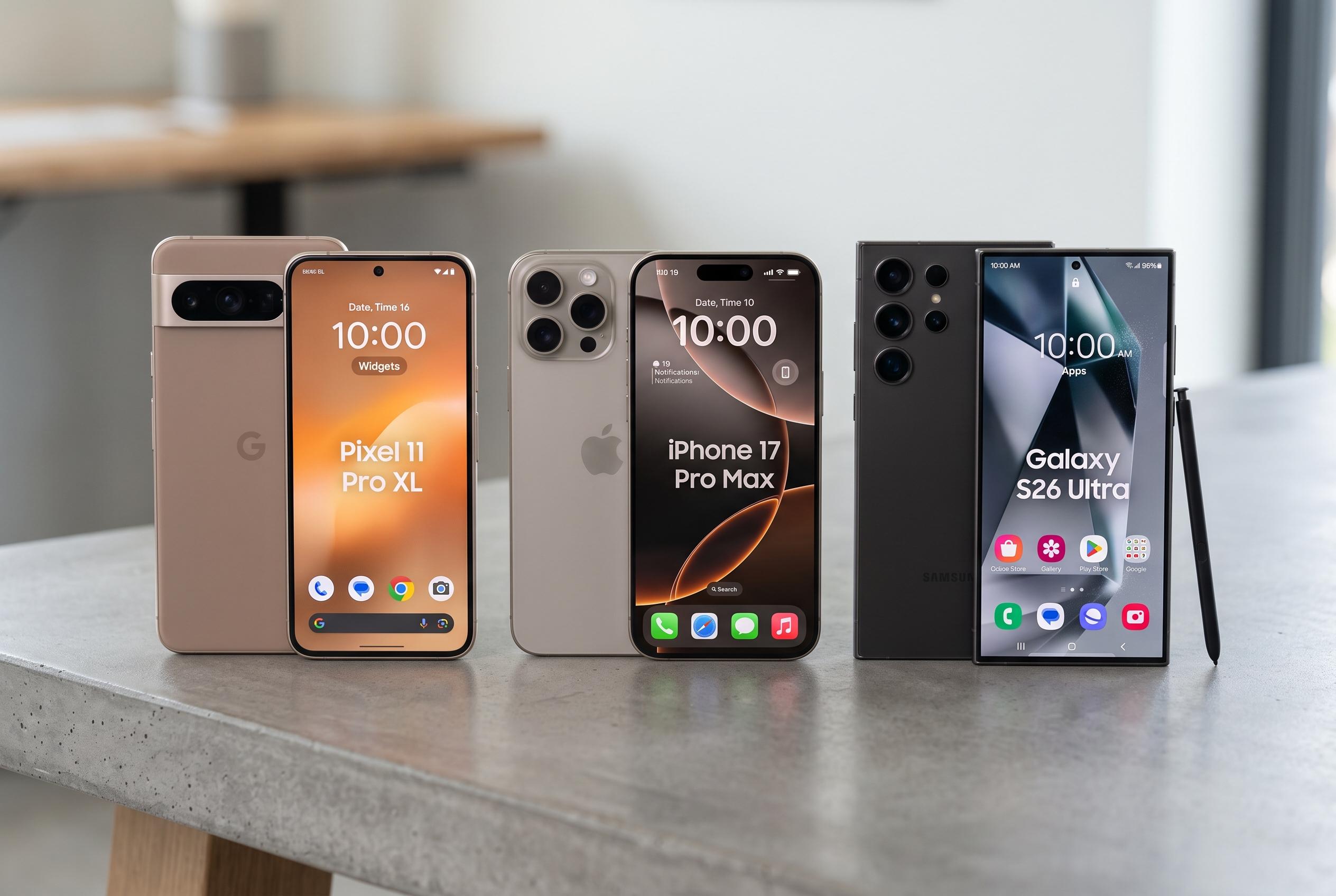

As the latest flagship smartphones arrive, each brand unveils distinct priorities: Google’s AI focus, Apple’s refined polish, and Samsung’s hardware versatility define the evolving landscape of 2026’s top-tier devices.
Choosing between the Pixel 11 Pro XL, iPhone 17 Pro Max and Galaxy S26 Ultra is less a search for one winner than a test of priorities. Google is leaning hardest into on-device AI and Gemini-led automation, Apple is relying on efficiency, polish and ecosystem depth, and Samsung is pairing strong hardware with a fuller productivity package, including the S Pen. Together, they represent three different ideas of what a 2026 flagship should be.
On design, the three phones follow familiar brand cues, but with distinct interpretations. The Pixel 11 Pro XL keeps Google’s horizontal camera bar, now softened into a cleaner glass visor, while the new HiLight ring around the flash gives it a more deliberate identity. Apple’s iPhone 17 Pro Max is the thinnest and lightest here, but also the most visibly reworked, with an aluminium unibody and a broad rear camera plateau. Samsung’s Galaxy S26 Ultra remains the most obviously business-focused device, yet it is also the lightest and slimmest of the trio, and the built-in S Pen gives it an advantage neither rival can match. Tom’s Guide’s hands-on report on the Pixel 11 family says Google has kept the design language broadly consistent while refining the overall package, which matches the impression of an incremental but better resolved update.
Display quality is excellent across the board, but each company emphasises a different strength. The Pixel 11 Pro XL’s 6.8-inch LTPO OLED panel is the brightest on paper, peaking at 3,600 nits, which should help in direct sunlight. The iPhone 17 Pro Max’s 6.9-inch Super Retina XDR panel is slightly lower in resolution, but it still offers adaptive ProMotion and Dolby Vision support, which matters for video-heavy users. The Galaxy S26 Ultra has the sharpest screen and the most privacy-minded feature, with its directional display mode designed to limit side viewing; Samsung’s panel is also the only one here with a built-in privacy trick, even if that comes with some trade-off in clarity when enabled. Apple’s own specifications confirm the iPhone’s 6.9-inch display, 2,868 x 1,320 resolution and 460 ppi density.
Performance is where the character differences become most obvious. The Pixel 11 Pro XL’s Tensor G6 is not built to dominate benchmark charts; instead, Google has aimed the chip at faster Gemini responses, better on-device AI handling and smoother computational photography. Apple’s A19 Pro continues to focus on efficiency and sustained performance, and review coverage of the iPhone 17 Pro Max has highlighted both its redesigned thermals and its ability to hold performance over time. Samsung’s Snapdragon 8 Elite Gen 5 for Galaxy is the brute-force option, with the strongest multi-core and graphics performance in this group and the best case for heavy gaming or demanding multitasking. The result is a clear split: Google for AI-led workflows, Apple for balanced efficiency, Samsung for raw speed.
Software is also central to the decision. Android 17 on the Pixel 11 Pro XL is tightly bound to Gemini, with more proactive assistant features, faster task handling and bundled Google AI Pro access for six months. Samsung’s One UI 8.5 layers Galaxy AI over Android 16 and leans on the faster NPU in the Snapdragon chip to keep more work on-device, while also adding productivity tools around the S Pen and DeX. Apple is still playing catch-up in visible AI features, but the iPhone 17 Pro Max retains the usual Apple strengths: careful integration, strong privacy controls through Private Cloud Compute and deep ecosystem continuity. In other words, the Pixel is the most ambitious, Samsung the most feature-rich, and Apple the most restrained.
The camera contest follows the same pattern. Samsung has the most versatile zoom hardware, with its dual-telephoto setup and 200MP main sensor giving it the broadest framing flexibility. The Pixel 11 Pro XL is the most interesting for stills, particularly with its ultrawide camera and improved 5x telephoto system, while Google’s AI tools such as Magic Capture and Camera Looks aim to improve the editing and capture process rather than simply the optics. Apple remains the safest choice for video, with the iPhone 17 Pro Max offering exceptionally stable footage, 4K Dolby Vision up to 120fps and reliable sensor-shift stabilisation. The picture is clear: Samsung wins on versatility, Google on computational photography, Apple on video consistency.
Battery and charging round out the comparison without settling it entirely. The Pixel 11 Pro XL has the largest battery of the three and supports 45W wired charging, while Samsung offers the fastest wired top-up at 60W. Apple’s smaller battery is offset by the A19 Pro’s efficiency, giving the iPhone 17 Pro Max the strongest rated video playback figure in the group. Pricing follows the same premium pattern, with the Pixel undercutting both rivals at the base level, the Galaxy S26 Ultra sitting in the middle and the iPhone 17 Pro Max remaining the most expensive as storage rises. For most buyers, that leaves a simple conclusion: the Pixel is for AI-first users, the iPhone for those who want the most polished all-rounder, and the Galaxy for power users who want the fullest feature set.
Disclaimer: This content is intended for informational purposes only. Readers are advised to exercise their own judgement, conduct due diligence, or consult a qualified expert before acting on any information provided.