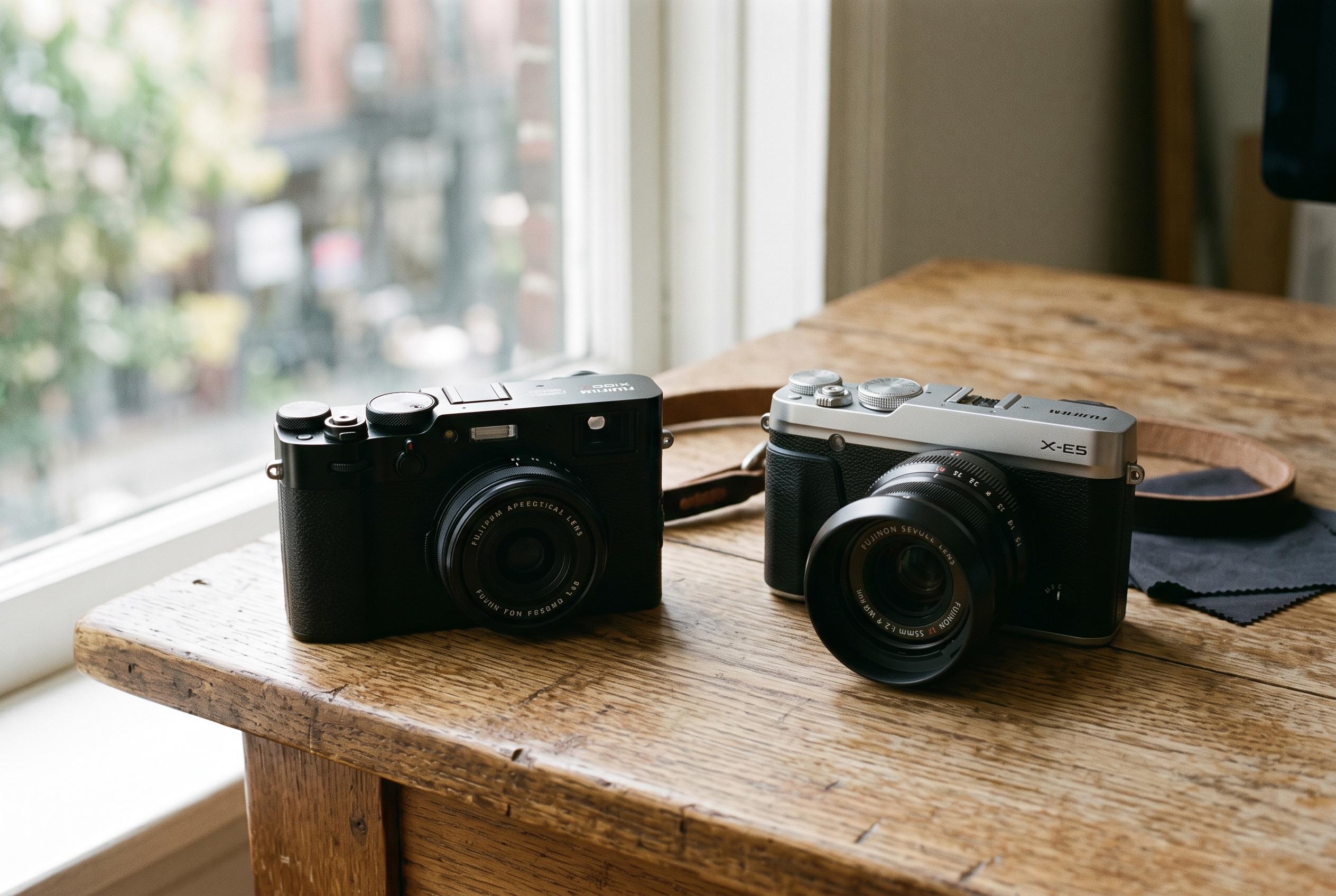

Fujifilm’s new X100VI offers a purpose-built, simplified experience with a fixed lens and leaf shutter, challenging the more versatile X-E5 with its broader lens ecosystem and adaptable design, highlighting a key split in the compact-camera market.
Mitch Lally’s comparison of Fujifilm’s X100VI and X-E5 comes down to a familiar camera choice: convenience versus flexibility. After spending two days with the X100VI on a trip, he concluded that its appeal is not simply the 40-megapixel sensor shared with the X-E5, but the way Fujifilm has paired that sensor with a fixed 23mm f/2 lens and a leaf shutter. In practice, that makes the X100VI feel like a purpose-built, carry-anywhere camera rather than a body that needs planning around it.
What stood out to Lally was how much the fixed lens shapes the shooting experience. The 35mm-equivalent view is broad enough for street, travel and documentary work, while the fast aperture gives a shallow depth of field when needed and enough flexibility to stop down for more depth. The leaf shutter also matters for flash use, because it allows faster sync speeds than many conventional focal-plane shutter systems. Fujifilm itself positions the X100VI as a compact, weather-resistant camera for travel and street photography, and that design intent is central to its appeal. The camera’s hybrid viewfinder and optional conversion lenses add some versatility, but the core proposition remains the same: one lens, one field of view, fewer decisions.
Lally’s preference nevertheless leans towards the X-E5, and the reason is straightforward. The X-E5 uses Fujifilm’s X-mount, which opens the door to a far wider set of lenses and shooting styles. Reviews and product specifications describe it as a compact rangefinder-style body with the same 40.2-megapixel X-Trans CMOS 5 HR sensor, X-Processor 5 and in-body image stabilisation, plus support for 6.2K video. That means it can be configured as a small everyday camera or built out with primes and zooms as needs change. Lally points to an inexpensive Viltrox 25mm f/1.7 as a favourite and notes that a Sigma 17-40mm f/1.8 gives him a range the X100VI cannot match.
The comparison reflects a broader split in the compact-camera market. Buyers drawn to the X100VI, and to rivals such as Ricoh’s GR series, often want the discipline of a fixed lens and the simplicity of always knowing what focal length is on the camera. Others want one body that can grow with them, especially if they are not already carrying a separate full-frame system for paid work. In that context, both Fujifilm cameras make sense. The X100VI is the stronger choice for photographers who value immediacy and a singular shooting experience. The X-E5 is the more adaptable tool for those who want one small body to cover more situations.
Disclaimer: This content is intended for informational purposes only. Readers are advised to exercise their own judgement, conduct due diligence, or consult a qualified expert before acting on any information provided.