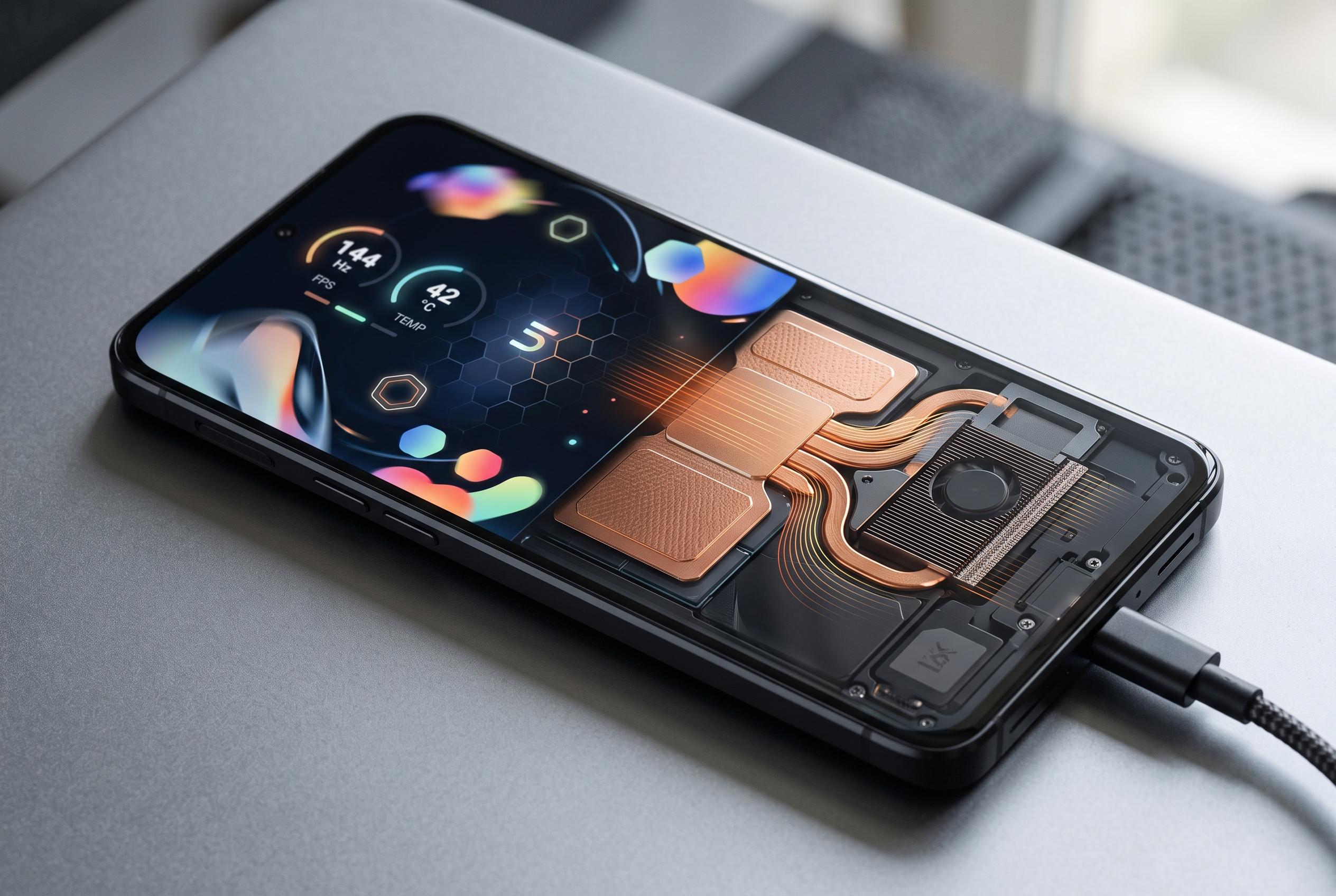

The latest flagship gaming smartphones, including the REDMAGIC 11 Pro and ASUS ROG Phone 9 Pro, are pushing beyond traditional performance with sophisticated cooling systems and ultra-fast screens, reshaping the mobile gaming landscape.
Mobile gaming has evolved into a demanding test of a phone’s design, not just its chipset. Fast processors help, but they do not guarantee smooth play over a long session. Heat build-up, refresh rate, touch response, battery size and software tuning all shape the result, which is why the best gaming phones are often the ones that keep performance stable rather than merely peaking briefly. Tom’s Hardware has also shown, through a modder’s experiment with a Snapdragon 8 Elite handset, how much thermal limits can constrain mobile chips when they are pushed like desktop hardware.
For players who want the most specialised device, the REDMAGIC 11 Pro stands out. It combines Qualcomm’s Snapdragon 8 Elite Gen 5 with up to 24GB of LPDDR5T memory and 1TB of UFS 4.1 Pro storage. Its cooling setup, which includes liquid cooling, a large vapour chamber and a 24,000rpm fan, is clearly aimed at sustained load rather than compact design. The 6.85-inch AMOLED screen runs at up to 144Hz, while 520Hz shoulder triggers and a 7,500mAh battery reinforce its gaming-first brief.
The ASUS ROG Phone 9 Pro remains the closest rival for serious mobile gamers. Android Central’s February 2026 guide placed it at the top of its list, while Android Authority and Tom’s Guide also singled it out as the best gaming phone in their recent round-ups. The phone uses Qualcomm’s Snapdragon 8 Elite platform, an Adreno 830 GPU and up to 24GB of LPDDR5X memory, with a 6.78-inch AMOLED panel that can reach 165Hz in standard settings and 185Hz in Game Genie. That combination, plus ASUS’s gaming software and controls, makes it a natural choice for competitive play.
For people who want flagship power without a gaming-heavy look, the Samsung Galaxy S26 Ultra and OnePlus 13 are stronger all-rounders. Samsung pairs the Galaxy S26 Ultra with the Snapdragon 8 Elite Gen 5 for Galaxy, a 6.9-inch QHD+ Dynamic AMOLED 2X display with adaptive 120Hz refresh and a redesigned vapour chamber. Samsung says the new cooling system improves thermal performance by 21%. The OnePlus 13 uses the Snapdragon 8 Elite, up to 16GB of LPDDR5X memory and a 6,000mAh battery, giving it the sort of endurance and display quality that suits long play sessions as well as everyday use.
Xiaomi’s 15 Ultra completes the group with another Snapdragon 8 Elite flagship. Its 6.73-inch WQHD+ AMOLED screen supports a 120Hz refresh rate and up to 300Hz touch sampling, while LPDDR5X memory and UFS 4.1 storage help it keep pace under load. With a 5,410mAh battery and 90W wired charging, it offers a useful balance of speed and practicality. Taken together, these phones show that gaming performance is no longer defined by one component alone. The best choice depends on whether a buyer wants a dedicated gaming machine or a premium handset that can also handle games well.
Disclaimer: This content is intended for informational purposes only. Readers are advised to exercise their own judgement, conduct due diligence, or consult a qualified expert before acting on any information provided.