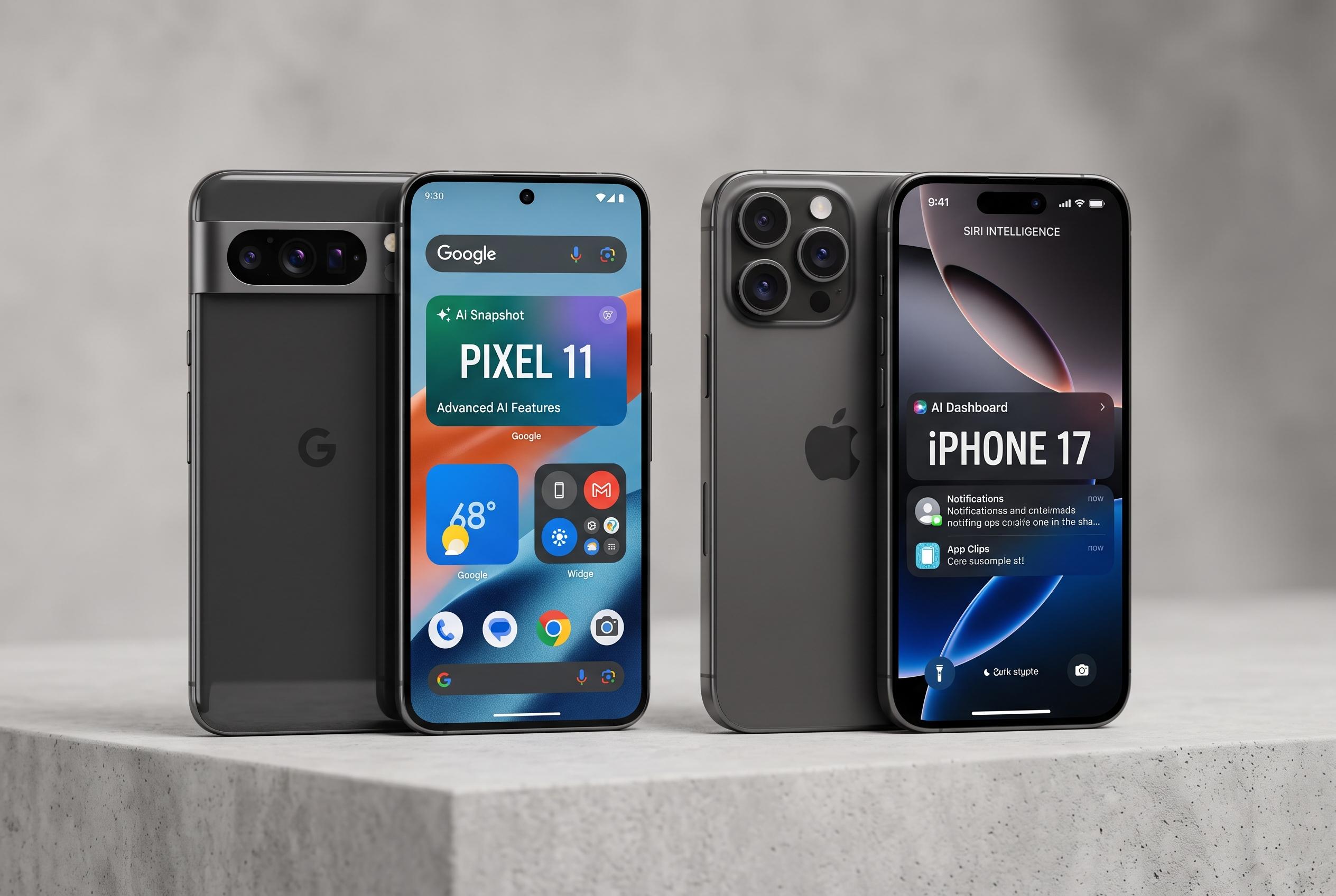

The Pixel 11 and iPhone 17 target mid-range flagship buyers, but differences in design, camera tech, and AI features reveal distinct brand philosophies ahead of their release.
Google’s Pixel 11 and Apple’s iPhone 17 are aimed at buyers who want a flagship phone without stepping up to the most expensive model in each company’s range. On paper, the comparison is close, but the differences are clear: Apple’s phone is cheaper, lighter and stronger on video capture, while Google’s handset leans harder into AI features and longer optical zoom. Apple’s support material confirms the iPhone 17 sits on a 6.3-inch Super Retina XDR display with the A19 chip, while PhoneArena’s device profiles place the Pixel 11 in the same size class with Tensor G6 and a triple-camera setup.
The iPhone 17 is the more compact device. Apple lists it at 5.89 inches long and 6.24 ounces, while the Pixel 11 is slightly taller and substantially heavier at 6.9 ounces, according to PhoneArena. Both are rated for dust and water resistance, but the physical feel will favour the iPhone for users who want a lighter handset in daily use. Apple also uses Ceramic Shield 2 on the front, while Google’s model is expected to use Gorilla Glass Victus 2.
Display quality is a narrower contest. Both phones use 6.3-inch OLED panels with peak brightness around 3,000 nits, but Apple’s higher-resolution screen gives it the sharper presentation. The iPhone 17 supports ProMotion up to 120Hz and an always-on display, while the Pixel 11’s panel is described as running between 60Hz and 120Hz. For most buyers, that means both should feel fast and bright outdoors, though Apple holds the edge for detail.
Cameras show the sharpest difference in philosophy. Apple fits two 48-megapixel rear cameras and relies on sensor cropping for a 2x optical-quality zoom, whereas Google’s handset adds a dedicated telephoto lens with 5x optical zoom and much greater reach overall. Apple counters with a higher-resolution front camera and a stronger video package, including Dolby Vision recording and features such as Cinematic mode and Action mode. Google’s approach is more about computational photography, with tools such as Super Zoom and HDR processing.
Performance and connectivity also split along familiar lines. Apple’s A19 chip should remain the faster general-purpose processor, while Google’s Tensor G6 is designed with AI workloads in mind and paired with more RAM. Apple’s support page also confirms Wi-Fi 7, Ultra Wideband and Apple Intelligence integration on the iPhone 17, whereas Google’s reported Pixel 11 specification sheet points to Wi-Fi 6E, Thread and a stronger emphasis on Gemini-based features. Price is another advantage for Apple: the iPhone 17 starts at $799, compared with $899 for the Pixel 11, although the Google phone begins with 256GB of storage like the iPhone and includes a broader colour range.
Disclaimer: This content is intended for informational purposes only. Readers are advised to exercise their own judgement, conduct due diligence, or consult a qualified expert before acting on any information provided.