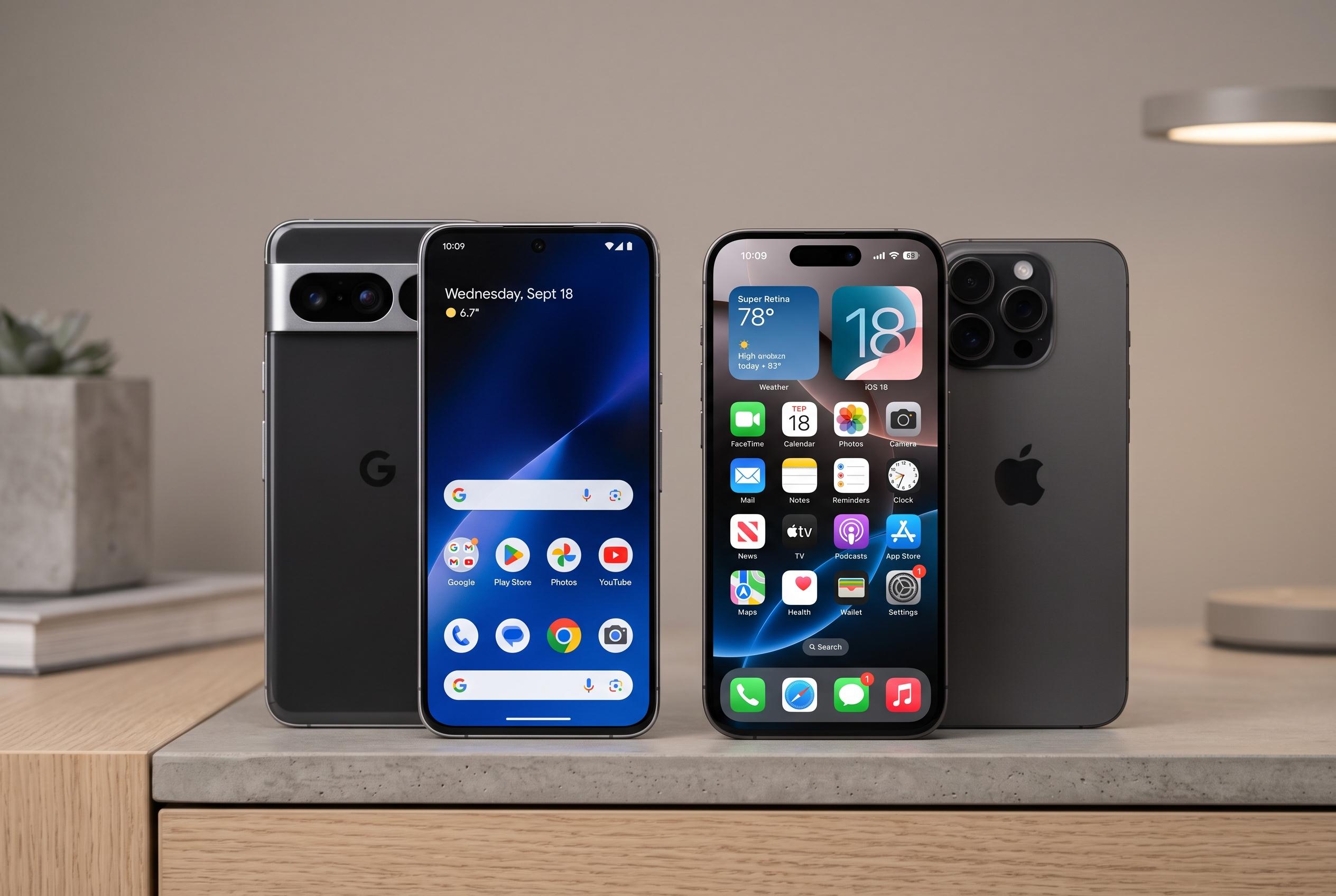

The Pixel 11 Pro arrives in India as a competitive alternative to the iPhone 17 Pro, offering superior display brightness, advanced AI, and a more affordable price point for premium users debating between the two flagship devices.
Google’s Pixel 11 Pro arrives in India as a direct challenger to Apple’s iPhone 17 Pro, and the two phones aim at the same buyer: someone wanting a compact premium handset with top-tier display quality, strong cameras and advanced on-device intelligence. TV9 Hindi’s comparison shows that the choice is less about one model being universally better and more about which ecosystem, camera philosophy and price point matters most.
On paper, the two devices are closely matched in size and weight, but they differ in presentation and display tuning. Both use a 6.3-inch OLED panel with a 120Hz refresh rate, yet Google gives the Pixel 11 Pro a higher-resolution Super Actua display and a claimed peak brightness of 3,600 nits. Apple’s Super Retina XDR panel on the iPhone 17 Pro is rated at 3,000 nits outdoors, which still places it among the brightest phone screens available. The Pixel also retains Google’s familiar horizontal camera bar and Gorilla Glass Victus 2 with an aluminium frame.
Camera hardware is where Google makes its strongest pitch. According to TV9 Hindi’s specifications, the Pixel 11 Pro uses a 50-megapixel main camera, a 48-megapixel ultrawide lens and a 48-megapixel telephoto unit with 5x optical zoom, while Apple offers three 48-megapixel rear cameras, including a telephoto lens with 4x optical zoom. Google also claims up to 120x zoom through its Pro Zoom feature, although that kind of reach depends heavily on software processing and cannot always match true optical detail. For selfies, the Pixel carries a 42-megapixel front camera with a 103-degree field of view, compared with Apple’s 18-megapixel Centre Stage camera.
The performance story is more nuanced. Apple’s A19 Pro chip pairs a six-core CPU, six-core GPU and a 16-core Neural Engine, while Google’s Tensor G6 is positioned around artificial intelligence rather than raw benchmark leadership. TV9 Hindi reports that Google says the Tensor G6 delivers 50% more TPU computing power than the previous generation, with a particular emphasis on AI tasks. Both phones also use vapour-chamber cooling to manage heat under sustained workloads. Apple continues to tie the iPhone 17 Pro closely to iOS and Apple Intelligence, while Google builds the Pixel 11 Pro around the Gemini ecosystem, including Gemini Nano, Circle to Search and Live Translate.
Battery and security follow the same split. Apple claims up to 33 hours of video playback for the iPhone 17 Pro, while Google says the Pixel 11 Pro lasts more than 30 hours and includes a 4,850mAh battery. The Pixel also supports Google’s PixelSnap magnetic accessory system, based on Qi2.2, with wireless charging up to 25W. For authentication, Apple uses Face ID, while Google combines fingerprint unlock and face unlock. The Pixel additionally includes Titan M3 security hardware, and both phones carry IP68 protection against dust and water.
Pricing may be the most practical difference for many buyers in India. The iPhone 17 Pro starts at ₹1,34,900 for the 256GB model, while the Pixel 11 Pro starts at ₹1,19,999 for the same storage tier, making Google’s device ₹14,901 cheaper at the entry level. The Pixel also offers a 512GB variant at ₹1,34,999. Colour choices differ too: Apple sells the phone in Cosmic Orange, Deep Blue and Silver, while Google offers Canyon, Olive, Fog and Obsidian.
For buyers already invested in Apple’s wider ecosystem, the iPhone 17 Pro remains the more obvious fit. For those who prioritise a brighter display, a more aggressive camera specification, broader AI features and a lower starting price, the Pixel 11 Pro looks like the sharper value proposition. In the end, the better choice depends on whether performance, photography, artificial intelligence, or ecosystem integration matters most.
Disclaimer: This content is intended for informational purposes only. Readers are advised to exercise their own judgement, conduct due diligence, or consult a qualified expert before acting on any information provided.