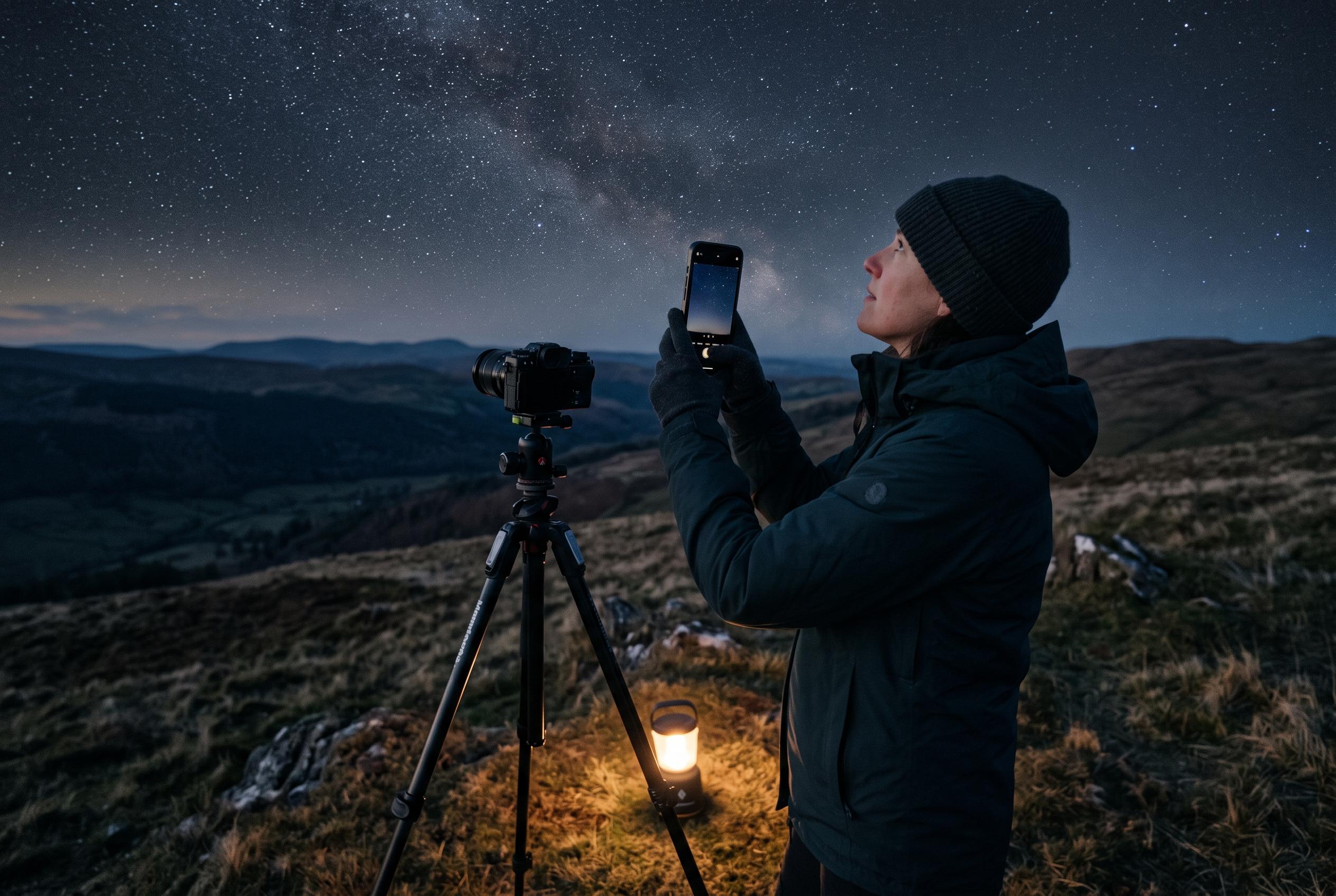

Google’s latest flagship phone, the Pixel 11 Pro XL, demonstrates remarkable capabilities in astrophotography, rivaling dedicated night-sky cameras, according to recent tests, signalling a major shift in mobile night photography.
Google’s latest flagship phone is being pitched as a serious night-sky tool, and a recent Tom’s Guide test suggests that claim is not far-fetched. In a direct comparison between the Pixel 11 Pro XL and OM System’s OM-3 Astro, the phone delivered strikingly capable astrophotography with very little effort, while the dedicated camera still offered the more refined result for enthusiasts who are prepared to work for it.
The appeal of the Pixel lies in how little the photographer has to think about. Once the handset is mounted on a tripod and switched to Night Sight, it automatically moves into Astrophotography mode when it detects that it is stable. Tom’s Guide said the result is a simple one-tap workflow that hides the processing burden inside Google’s software, and Google claims the updated Night Sight engine can capture images up to 4.5 times faster than earlier generations. That speed matters because astrophotography is usually limited by long exposures, careful focus and patient handling of noise.
By contrast, the OM System OM-3 Astro is a purpose-built camera with the sort of features that appeal to serious night photographers. According to OM System’s product information, the camera uses a modified IR-cut filter designed to improve capture of Hydrogen alpha light, supports Starry Sky AF and Live Composite, and carries IP53 weather sealing. DPReview and other specialist publications have described it as a mirrorless body tuned for astrophotography rather than general use, with custom modes intended to make night-sky imaging more practical without removing the need for photographic judgement.
That difference in philosophy was visible in the results. Tom’s Guide found that the Pixel’s images were exceptionally clean and bright, with Google’s processing lifting detail from a dark sky and preserving foreground elements such as trees and clouds with surprising clarity. The trade-off was a somewhat flattened look, with a greyed sky and the unmistakable signature of heavy computational photography. The OM System camera produced a more dramatic image, with stronger contrast, a deeper teal-toned sky and sharper stars, although the long exposure used in the test introduced some motion blur in the foreground.
Tom’s Guide also noted another advantage of the Pixel: it creates a short time-lapse clip automatically alongside the still image. That makes the whole process almost effortless for casual users. Producing the same kind of sequence with a dedicated camera would require an intervalometer, a long frame sequence and additional editing in desktop software. In the end, the OM-3 Astro appears to remain the better choice for photographers seeking the richest optical output and the greatest control, but the Pixel 11 Pro XL shows how far smartphone astrophotography has come. For many users, it now offers an image-making experience that is impressively close to specialist gear, without the cost, weight or complexity.
Disclaimer: This content is intended for informational purposes only. Readers are advised to exercise their own judgement, conduct due diligence, or consult a qualified expert before acting on any information provided.