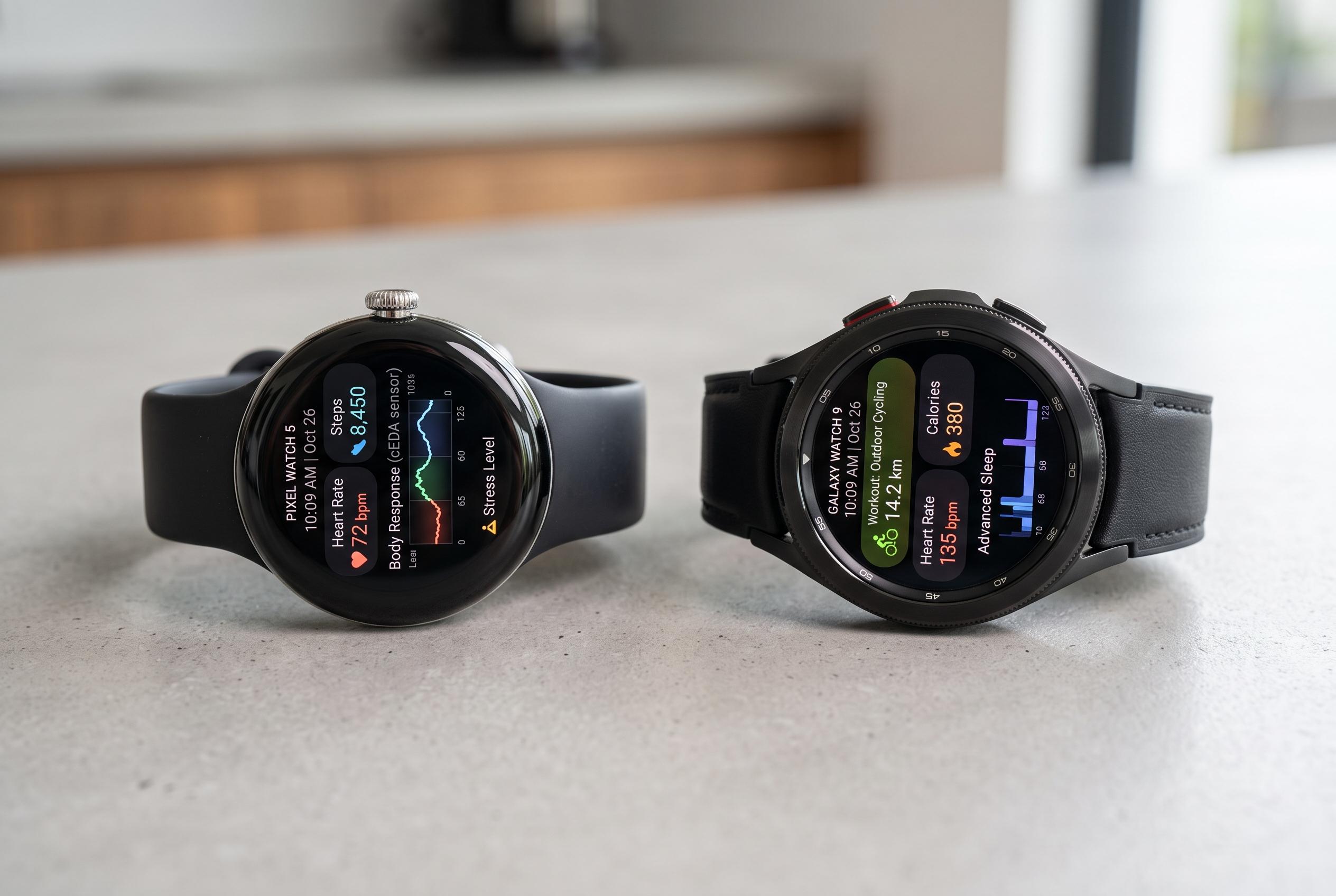

Google’s Pixel Watch 5 and Samsung’s Galaxy Watch 9 share features but emphasise different strengths, reflecting distinct priorities in design, health, and software integration.
Google’s latest Pixel Watch and Samsung’s newest Galaxy Watch arrive with many of the same headline claims, yet they remain built around different priorities. Both run Wear OS 7, both use bright 3,000-nit AMOLED panels and both support dual-frequency GPS. According to the supplied product materials and recent launch coverage, the real split is in emphasis: Google is leaning harder into software, safety and endurance, while Samsung is offering more health hardware, a tougher shell and a closer tie to its own phone ecosystem.
On design, the contrast is immediate. The Pixel Watch 5 keeps the familiar domed, pebble-like form, with a recycled aluminium case and curved Gorilla Glass 5. Samsung’s Galaxy Watch 9 uses a flatter cushion-style body, armour aluminium and sapphire crystal. Samsung also claims MIL-STD-810H durability on top of 5 ATM and IP68 resistance, which makes it the more robust-looking watch on paper. Google’s watch is lighter in the smaller size, but Samsung’s case sits flatter and should be easier to shield from knocks.
Inside, the balance is less straightforward. Samsung has moved to Qualcomm’s Snapdragon Wear Elite, a 3nm five-core chip, while Google uses the Snapdragon W5 Gen 2 Accelerated with a Cortex-M55 co-processor. Google has also doubled storage to 64GB and raised RAM to 3GB, compared with Samsung’s 32GB and 2GB. That gives the Pixel more headroom for future Wear OS features and on-device AI tasks, even if Samsung’s processor looks stronger on raw silicon.
Battery life may be the clearest practical divider. The smaller versions are broadly similar in quoted runtime, but the larger Pixel Watch 5 is positioned as the endurance leader. Google says the 45mm model can last up to 40 hours with always-on display enabled and up to 72 hours in Battery Saver mode, while Samsung’s larger model is quoted at up to 30 hours with always-on display and up to 40 hours with it off. Google also claims much faster charging, with the Pixel reaching around 50% in 15 minutes, versus about 30 minutes for Samsung.
GPS and training tools also point the watches in different directions. Samsung offers dual-frequency L1 and L5 positioning, but Google says the Pixel Watch 5 uses extra mapping and atmospheric data to improve track accuracy in dense or difficult environments. Samsung counters with a deeper fitness stack, including body composition via bioelectrical impedance, Running Coach, Daily Cardio Load and broader health scoring. Google, by contrast, is focusing more on guided strength sessions, workout logging and Health Coach features, some of which require a Google Health Premium subscription.
Health sensing is where the two platforms diverge most sharply. Samsung’s BioActive sensor enables body composition estimates and, in supported markets, blood pressure trend analysis after cuff calibration, along with sleep-apnoea risk detection. Google does not offer body composition, but it adds cEDA-based body-response tracking and a new Health Guardian layer that tracks trends such as blood pressure, sleep breathing quality and insulin resistance over time. Those Google features are framed as wellness insights rather than clinical measurements, so they should not be mistaken for medical diagnostics.
Safety is another area where Google appears to be pushing harder. The Pixel Watch 5 builds on loss-of-pulse detection and satellite-related capabilities with breathing emergency detection, designed to identify a serious drop in oxygen saturation combined with other sensor signals. Samsung, meanwhile, keeps its focus on conventional health monitoring and broader fitness tooling. The result is a simple split: the Galaxy Watch 9 looks like the more complete measurement device, while the Pixel Watch 5 is the more intervention-led one.
The software experience is now closer than it once was. Both watches run Wear OS 7 and include Gemini, Google Maps, Gmail, Messages and the usual third-party app support. Samsung layers One UI 9 Watch on top, while Google stays closer to stock Wear OS. That makes the choice less about basic app access and more about ecosystem fit. Samsung still works best with Galaxy phones, especially for its more advanced health functions, whereas the Pixel Watch 5 is the cleaner option for most other Android users.
For buyers, the decision comes down to priorities. The Galaxy Watch 9 is the better choice for those who want tougher hardware, more health sensors and the deepest Samsung integration. The Pixel Watch 5 is stronger for users who value battery life in the larger model, more storage, more memory, tighter Google services and fewer ecosystem restrictions. In practice, both are serious Wear OS watches, but they serve different kinds of Android owners.
Disclaimer: This content is intended for informational purposes only. Readers are advised to exercise their own judgement, conduct due diligence, or consult a qualified expert before acting on any information provided.