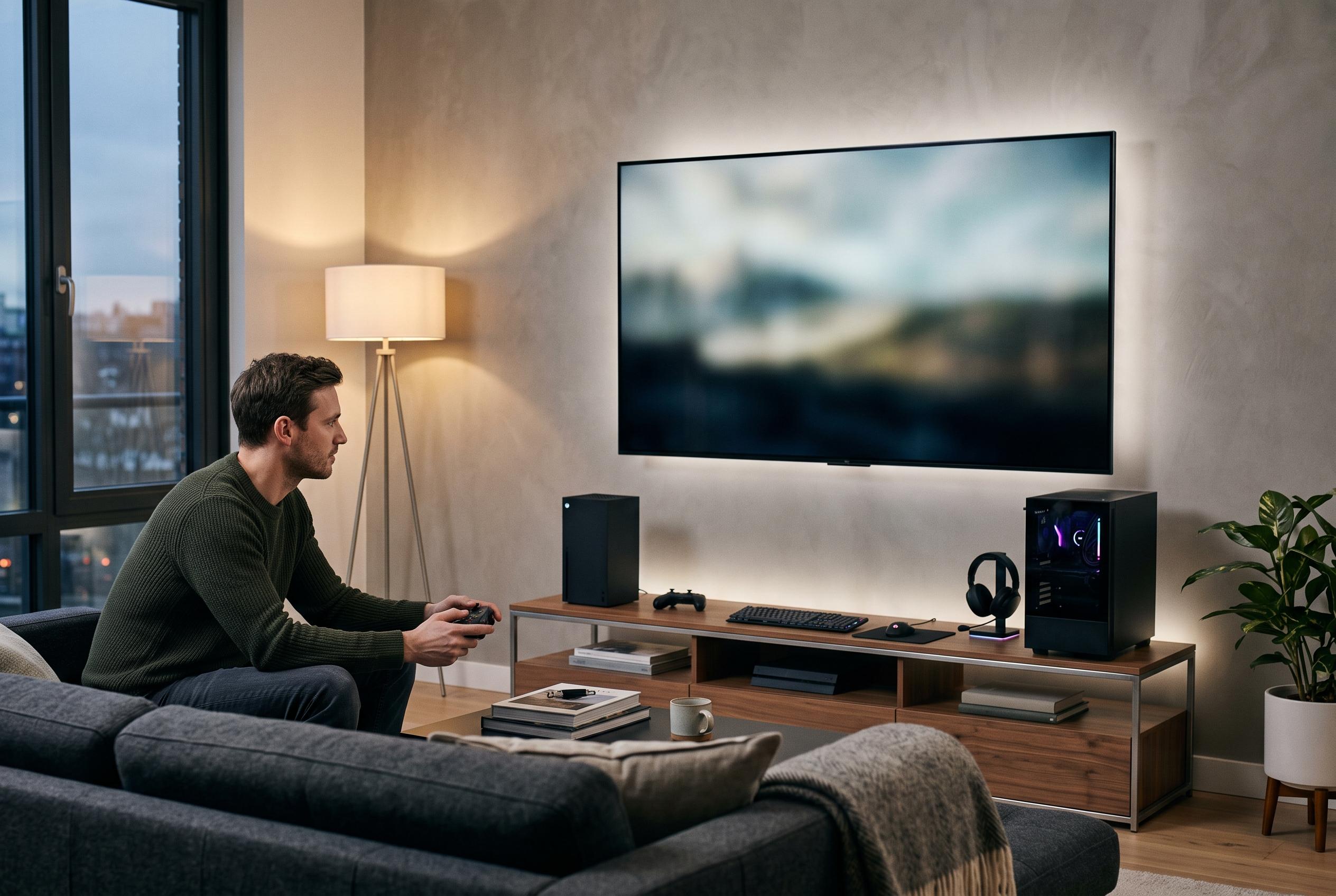

The Hisense U7 stands out for PC and console gaming, while Sony’s BRAVIA 3 II offers the clearest PlayStation 5 match and other rivals trade speed for picture quality or value.
An 85-inch television can be excellent for gaming, but only if the specification sheet matches the console or PC it is meant to serve. At this size, the most relevant features are a native 120Hz refresh rate or higher, variable refresh rate, auto low latency mode and HDMI 2.1 support. The best results come from sets that state those capabilities plainly, rather than relying on broad marketing language about gaming. Recent buyer guides from Tom’s Guide and TechRadar also point to the same pattern: the strongest large-format gaming TVs are those that combine high refresh rates, modern HDMI support and, where possible, stronger local dimming or OLED-level contrast.
The clearest all-round gaming choice in this group is the Hisense 85-inch U7 Series MiniLED ULED 4K Google TV. Hisense says the set has a native 165Hz refresh rate, VRR up to 330Hz, four HDMI 2.1 ports, ALLM and AMD FreeSync Premium Pro. It also claims up to 3,000 local dimming zones and peak brightness of up to 3,000 nits, which puts it well ahead of most rivals on paper for both motion handling and HDR impact. Tom’s Guide similarly highlights the U7SG’s 165Hz panel, HDMI 2.1 support and 2.1.2-channel sound system as standout features for a large-screen gaming display.
For PlayStation 5 owners, Sony’s BRAVIA 3 II is the more direct fit. Sony says the 85-inch model has four HDMI 2.1 ports that support 4K at 120fps, VRR and ALLM, which is the cleanest match in this line-up for current-generation console gaming. It also includes PS5-specific features such as Auto HDR Tone Mapping and Auto Genre Picture Mode. That makes it less aggressively specified than the Hisense for PC gaming, but more explicitly aligned with Sony’s console ecosystem and easier to evaluate for buyers who want the relevant features stated in one place.
Sony’s BRAVIA 7 is the better choice for buyers who are prioritising picture technology over gaming numbers. The set uses a Mini LED QLED panel with XR Backlight Master Drive and Sony’s XR Processor, and the company also lists the same PS5-focused extras found on the BRAVIA 3 II. What it does not state as clearly is almost as important: the published specification is silent on native refresh rate, VRR, ALLM and HDMI 2.1. That makes it a stronger premium viewing option than a clearly defined gaming pick, even if the Mini LED hardware should be appealing in a bright room.
The remaining two sets split the difference between value and brand preference. TCL’s T7 is positioned as the value play, with a 144Hz native refresh rate, Game Accelerator 288 VRR, Dolby Vision support and four HDMI inputs including one with eARC. Samsung’s M80H also states 144Hz and VRR, while adding Mini LED backlighting, AI Mode, Supersize Picture Enhancer and the NQ4 AI Gen2 processor. Neither model is as explicit as the Sony BRAVIA 3 II about HDMI 2.1, and neither is as fast on paper as the Hisense U7, but both still offer credible large-screen gaming specifications for buyers who are balancing size, price and brand preference.
Disclaimer: This content is intended for informational purposes only. Readers are advised to exercise their own judgement, conduct due diligence, or consult a qualified expert before acting on any information provided.