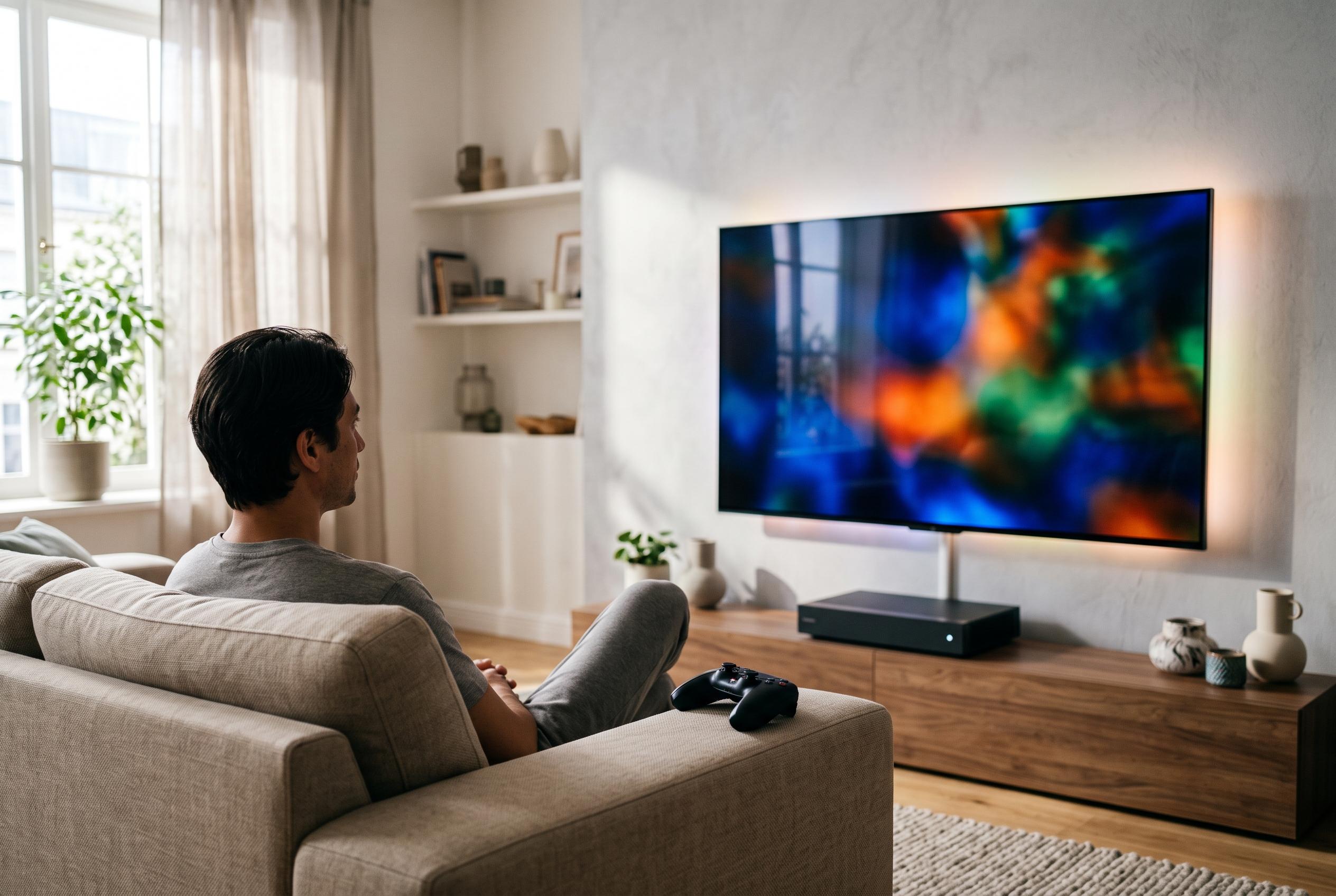

Hisense’s new UR8S RGB Mini LED TV offers a significant step forward in LCD technology, combining high brightness, vivid colours, and extensive gaming features, bringing it nearer to OLED performance for brighter living rooms.
Hisense’s UR8S RGB Mini LED TV is one of the clearest signs yet that LCD still has room to move. The set is built around a backlight system that uses separate red, green and blue LEDs rather than the white or blue backlights found in conventional Mini LED televisions. In practice, that is meant to deliver brighter highlights, more saturated colour and better control over contrast without giving up the brightness that makes LCD useful in sunlit rooms.
The result is a television that, by most accounts, comes much closer to OLED than a standard LCD can manage. Reviewers have praised its restrained blooming, strong black levels and effective anti-reflection coating, while noting that the panel still looks substantial rather than ultra-thin. Hisense’s own product information says the 75-inch model uses a 52mm chassis, a central stand and a 180Hz panel, and outside the UK it is sold with a wide range of HDR formats and a Devialet-tuned 2.1.2 speaker system.
What makes the UR8S especially relevant is not just its picture quality, but how complete the specification is. Across the reviews, the set is described as having four HDMI 2.1 inputs, VRR support, ALLM and gaming features that make it unusually well equipped for consoles and PCs. Some testers have measured refresh support up to 4K at 180Hz and 1080p at 330Hz, while hisense markets the model as a gaming-friendly set with broad HDR compatibility and a fast panel. That places it firmly in the premium living-room category rather than as a niche experiment.
There are, however, limits to the technology. TechRadar said the UR8’s colour performance did not fully match expectations for an RGB Mini LED set, even though its measured colour gamut was strong, and noted that darker scenes could still drift towards grey under some conditions. That is important because it shows the gap to OLED has narrowed, but not disappeared. The technology improves colour volume and brightness, yet the most demanding viewers may still prefer self-emissive panels for absolute black control in a dark room.
Even so, the UR8S looks like a practical answer to a problem many households actually have. What Hi-Fi? and other reviewers noted that the screen copes well with reflections and high ambient light, which makes it better suited to bright lounges than many glossy OLED rivals. The wider industry significance is clear: RGB Mini LED is no longer just a spec-sheet curiosity, but a credible attempt to combine the strengths of high-brightness LCD with much of the contrast discipline that has made OLED the reference point for the last decade.
Disclaimer: This content is intended for informational purposes only. Readers are advised to exercise their own judgement, conduct due diligence, or consult a qualified expert before acting on any information provided.