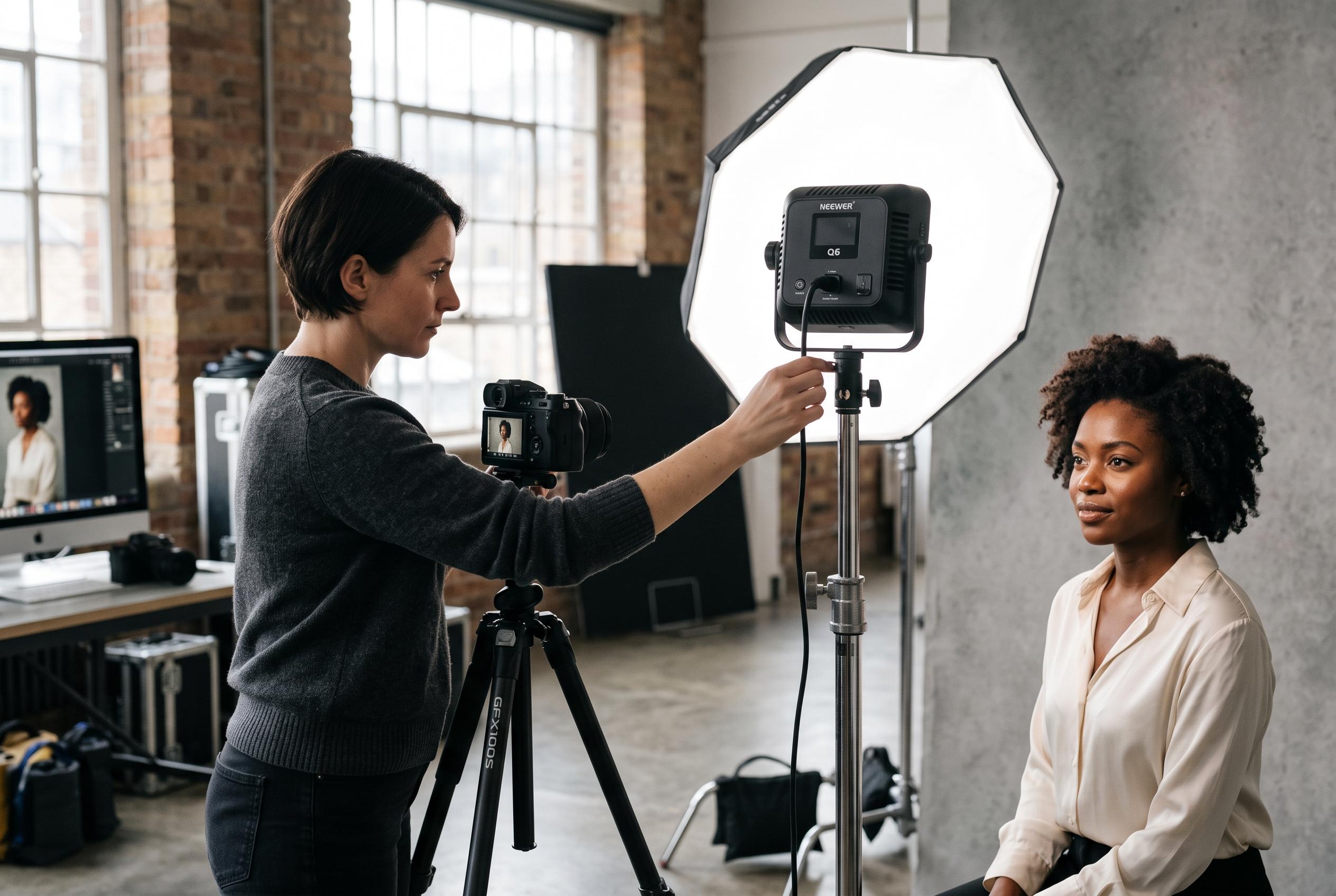

A comparative analysis of Neewer Q6’s hybrid light reveals its growing role in portraiture, balancing continuous light benefits with flash’s power, despite current limitations in frictionless use.
The practical gap between continuous light and flash in portraiture is narrower in the frame than it is on set. In a small studio, either can produce a polished head-and-shoulders image. The difference is what the photographer must do to get there. Reviews of the Neewer Q6, the hybrid light used in Jiggie Alejandrino’s latest comparison, suggest that its built-in 30W modelling lamp is useful mainly indoors and at close range, while the 600Ws flash head operates in a completely different class of output. Amateur Photographer put that bluntly, describing the modelling light as only 5% of the flash’s output, and PetaPixel reached a similar conclusion in its own studio and daylight tests, where continuous light demanded far slower shutter speeds and lost authority once the sun entered the equation.
That matters because Alejandrino’s test is deliberately controlled. He keeps one body, one modifier and one position, switching only the light mode on a single unit. Independent reviews show why that is a fairer comparison than pitting a studio strobe against a separate LED panel. Digital Camera World reported that the Q6 supports high-speed sync up to 1/8000 sec, uses the Bowens mount for full-size modifiers and ships with a stand adaptor, while Amateur Photographer noted a variable-colour modelling lamp spanning 2700K to 6500K and a claimed 400 full-power flashes from its 3000mAh battery. In other words, this is not a pocket flash pretending to be a video light. It is a battery-capable studio head with a preview lamp attached.
Where continuous light still makes its strongest case is workflow. In a 2022 Fstoppers article, Usman Dawood said he had shifted much of his portrait work towards continuous lighting because mirrorless cameras and electronic viewfinders let him judge exposure before taking the shot, reducing the need for repeated test frames. Alejandrino’s use of Evoto pushes the same idea further into software. According to Evoto’s own documentation, its tethered mode can pull images directly to a desktop, mobile device or iPad, apply presets, retouch portraits, remove blemishes and update edits in real time. The company also says photographers can compare RAW and edited views side by side as they shoot. For client-facing portrait sessions, that is a material advantage: the subject and photographer can see a near-finished result immediately, rather than imagining what the strobe will look like after import and retouching.
Flash, though, remains the tool with headroom. Digital Camera World’s field test found the Q6 capable of shooting at f/2.8 in bright sunlight with the sun acting as backlight, using the Q Pro trigger to enable high-speed sync and push the shutter as far as 1/8000 sec. SonyAlpha.blog went further in a daylight portrait test from October 2025, saying that even at f/1.2 the subject fell into deep shadow without flash, and that the Q6 could then light the subject strongly enough to hold a dark, dramatic background. That review also described the use of a variable ND filter to return to 1/250 sec flash sync while keeping a wide aperture: at a lighter ND setting, 1/16 power was enough, while at a denser setting the flash had to be pushed to full power.
That outdoor behaviour is consistent with broader comparison tests. PetaPixel’s side-by-side shoot used the same position, subject and framing for continuous light and strobe. In the studio, the continuous setup needed 1/25 sec, which the authors described as extremely slow. Outside, they said the LED frame lacked some “snap”, while the strobe version gave more control over the face and let them darken the background with a faster shutter. In harsh backlight, the authors said they simply could not get enough output from the LED because of the sun, whereas the strobe restored a defined highlight on the face. The article’s conclusion was equally direct: for stills, learn strobes; for hybrid stills and video, constant light offers flexibility.
The more interesting question, then, is not whether the two technologies can produce similar portraits under favourable conditions. It is whether a combo unit genuinely replaces one with the other. The supporting reviews suggest not quite. Amateur Photographer found that correct white balance on the Q6 mattered more than a camera’s default flash preset, noting that Neewer specifies 5700K while the reviewer’s Lumix bodies assumed 5950K in flash mode. Adjusting to the lower figure, the review said, made colour correction noticeably easier. The same piece also noted a mode designed to preserve colour accuracy at the cost of a slightly longer flash duration. Digital Camera World, meanwhile, praised the light’s power and flexibility but reported occasional misfires until the trigger’s transmission-distance setting was changed from 1-100m to 0-30m, and said a reset was sometimes needed when controls became unresponsive. So the Q6 appears capable, but not frictionless.
That leaves the flash-versus-continuous argument in a more realistic place than the usual online shouting match. Continuous light makes composition, exposure judgement and live client review easier, especially when paired with tethered software that retouches on arrival. Flash still offers lower ISO, faster shutter speeds, stronger subject separation and a far better chance of controlling daylight, even after the losses that come with high-speed sync. Alejandrino’s comparison is useful because it strips away brand tribalism and shows the issue as working photographers actually face it: not as a battle over image quality alone, but as a choice between immediacy and raw lighting authority.
Disclaimer: This content is intended for informational purposes only. Readers are advised to exercise their own judgement, conduct due diligence, or consult a qualified expert before acting on any information provided.