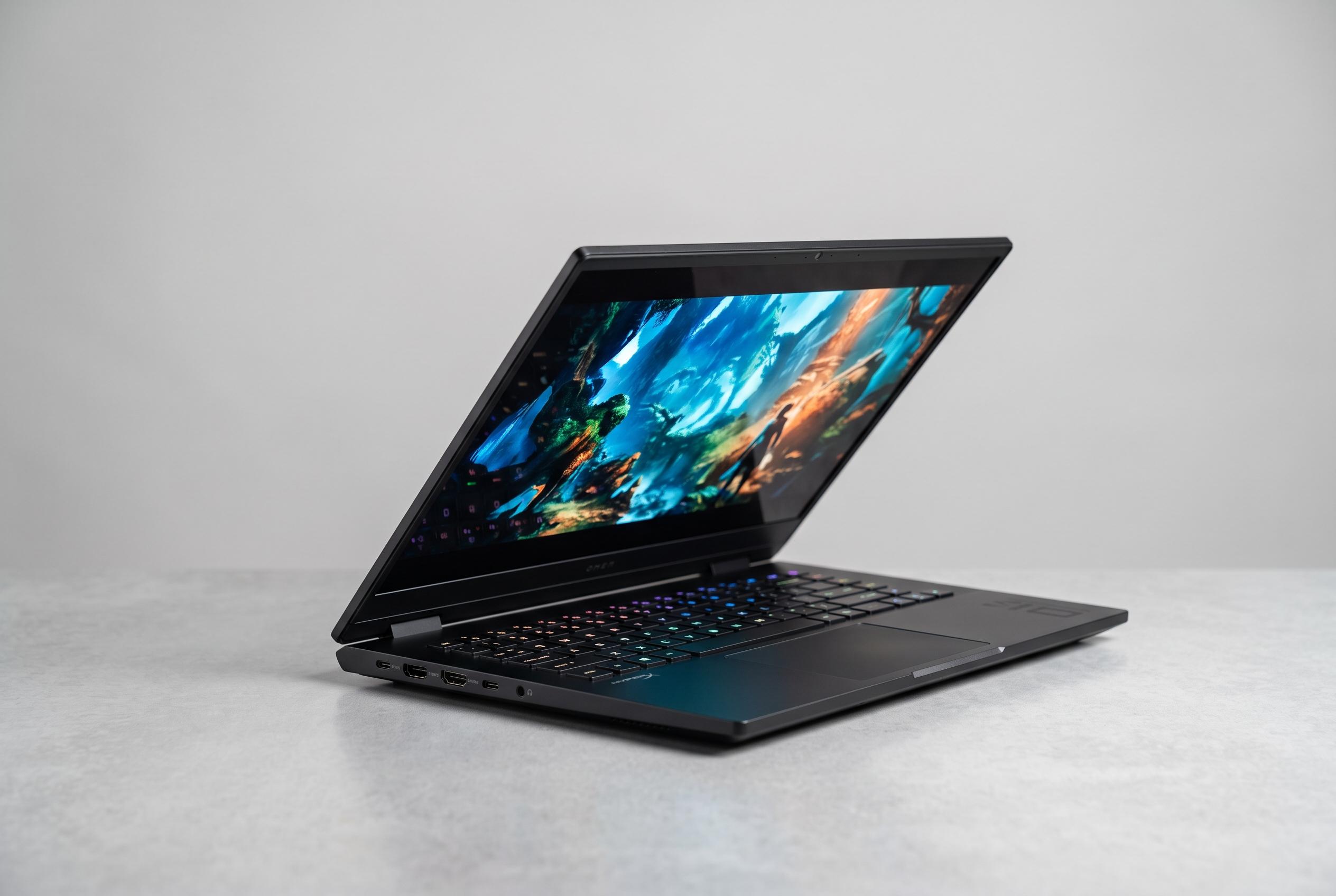

The HyperX Omen Max 16 offers premium design and powerful components, but its gaming performance and battery life reveal significant gaps, challenging its high-end appeal.
Tom’s Hardware’s review of the HyperX Omen Max 16 presents a machine that looks, on paper, like a serious desktop replacement but does not always behave like one. The model tested by the publication cost $4,699.99 and paired Intel’s Core Ultra 9 290HX Plus with Nvidia’s GeForce RTX 5090 Laptop GPU, 32GB of DDR5-6400 memory and a 2TB PCIe 5.0 SSD. At 6.56 pounds, it is clearly built to live on a desk rather than in a backpack, yet Tom’s Hardware found that its gaming results often lagged behind slimmer rivals with less imposing power targets. Tom’s Guide, by contrast, was more positive about the same platform, praising its RTX 5090 performance, OLED panel and cooling behaviour, while still noting the weight and price.
Design is one of the Omen Max 16’s more convincing areas. Tom’s Hardware described the aluminium chassis as restrained rather than showy, with a matte black finish, subdued branding and only modest RGB accents. Connectivity is strong, with two Thunderbolt 4 ports, two USB-A ports, HDMI 2.1, a 2.5GbE Ethernet port and a 3.5mm audio jack. PCWorld also highlighted the broad port selection, although it found the exterior styling unremarkable. HP’s own material frames the design as premium and durable, but the overall impression from third-party reviews is that the laptop is practical rather than distinctive.
The performance picture is mixed. In Tom’s Hardware’s tests, the Omen Max 16 trailed competitors in several games, including Shadow of the Tomb Raider, Cyberpunk 2077, Red Dead Redemption 2 and Borderlands 3, although it led in Far Cry 6. The publication also reported that Battlefield 6 averaged about 100 to 110 frames per second at native resolution with DLSS Quality and frame generation enabled. Productivity results were stronger, with respectable Geekbench, storage and Handbrake scores, but still not enough to establish a clear advantage over other high-end gaming laptops using similar hardware. Tom’s Guide and PCWorld were both more upbeat on raw CPU and GPU capability, suggesting that the machine can deliver top-tier numbers in the right conditions, even if Tom’s Hardware found its consistency lacking.
The display is a clear strength. Tom’s Hardware measured the 16-inch, 2,560×1,600 OLED panel at 240Hz as both bright and colour-rich, with wide gamut coverage and enough luminance to remain usable outdoors. The keyboard also earned praise for its quiet, springy feel and per-key RGB lighting. But the touchpad was only adequate, the stereo speakers were seen as under-specified for a laptop at this price, and the 1080p webcam disappointed in difficult light. Battery life was another weak point: Tom’s Hardware recorded 5 hours and 7 minutes, far behind some rivals, and other reviews likewise called out short endurance. The result is a laptop with strong fundamentals but an uneven value case, especially when competing models offer better battery life, lighter builds or more polished extras for roughly the same money.
Disclaimer: This content is intended for informational purposes only. Readers are advised to exercise their own judgement, conduct due diligence, or consult a qualified expert before acting on any information provided.