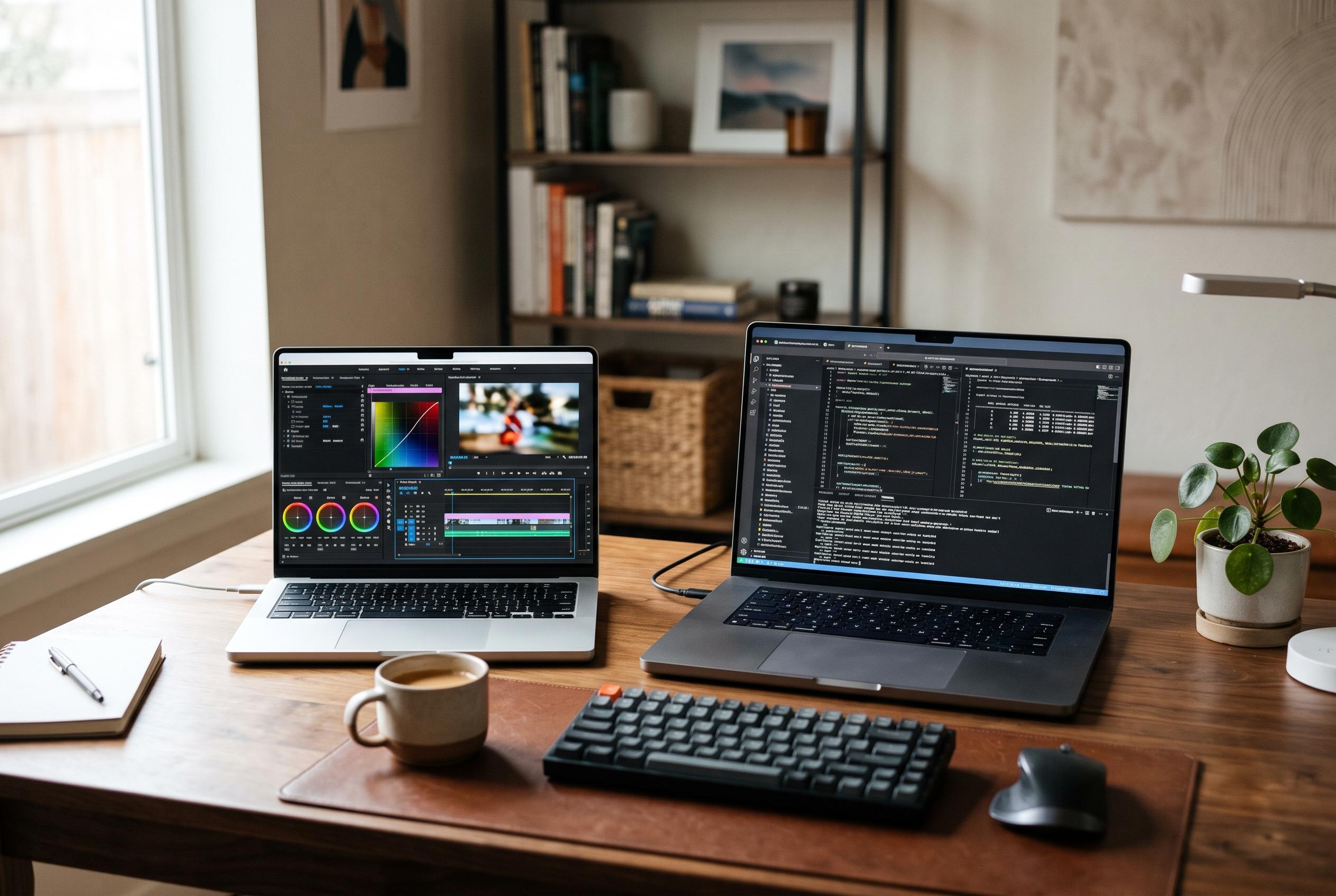

Apple’s MacBook Pro 16-inch prioritises battery life, colour-critical video work and polish, while ASUS’s ProArt P16 uses NVIDIA CUDA, larger memory options and an open Windows platform to target AI and developer workloads.
At the very top end of the laptop market, the choice is no longer about thinness alone or whether a machine can handle everyday office work. It is about which platform better supports serious creator and developer workloads: local AI models, high-resolution video timelines, 3D rendering, and sustained use away from a desk. In this comparison, Apple’s MacBook Pro 16-inch with M5 Max is pitched as the more refined machine for colour-critical production and battery life, while ASUS’s ProArt P16 with NVIDIA’s RTX Spark aims to win over users who need CUDA acceleration, larger memory configurations and a more open hardware platform.
The ASUS machine is the more obviously ambitious compute platform. Reviews from Windows Central, Tom’s Guide and Engadget describe the ProArt P16 as a premium creator workstation built around NVIDIA’s RTX Spark N1X, with a 20-core CPU, a Blackwell-based GPU and up to 128GB of unified memory. That combination gives it a strong case for developers working with local AI inference, machine learning pipelines and tools that depend on CUDA support. It also offers a vivid OLED display, pen input, a strong port selection and support for expandable storage, which makes it more flexible for mixed production workflows than many thin-and-light rivals.
Apple’s answer is more specialised, but it remains formidable. The MacBook Pro’s tandem OLED PROLED XDR panel is positioned as a reference-grade screen, with exceptionally high brightness, deep contrast and touch support for gesture-based editing. Apple’s own hardware approach also favours media work that is tightly integrated with the platform, especially ProRes and ProRes RAW editing. For video professionals, the practical advantage is less about raw component counts and more about how smoothly the system handles large timelines, external storage and colour-managed output without sacrificing battery performance. In that respect, the MacBook Pro keeps its long-standing lead in mobile post-production.
The more interesting divide appears in local AI work. The ASUS model’s strengths are tied to NVIDIA’s software ecosystem, where frameworks such as PyTorch, TensorRT-LLM, vLLM and ComfyUI can take direct advantage of CUDA and Tensor cores. That matters for users running diffusion pipelines, agent-based workflows or large language models locally. Apple’s M5 Max counters with a highly integrated memory architecture and strong efficiency, which helps with larger context windows and responsive text inference, but the broader tooling advantage still sits with NVIDIA on Windows. Several reviews suggest the ProArt P16 is especially compelling for creators who want one machine for AI, graphics and development work without relying as heavily on cloud services.
Battery life and portability remain decisive separators. The MacBook Pro is built to run for long periods away from mains power while preserving performance, which makes it especially attractive for travel, location editing and client-facing work. The ASUS machine is still impressively slim for the hardware inside it, but reviewers note that heavy AI or graphics workloads can drain it quickly, with endurance falling well short of Apple’s best-case figures. The result is a familiar trade-off: Apple offers the cleaner all-round mobile studio, while ASUS delivers the more adaptable and experimentally powerful workstation for users who can live with greater power draw and a more Windows-dependent ecosystem.
For most creators, the MacBook Pro remains the safer premium purchase if the priority is display accuracy, video editing, battery life and a quieter overall workflow. For developers, AI practitioners and technical users who want native CUDA support, larger memory options and more upgrade flexibility, the ProArt P16 is the more practical specialist machine. The two laptops are therefore not direct substitutes so much as different answers to the same question: whether a mobile workstation should optimise for polish and endurance, or for raw AI and developer throughput.
Disclaimer: This content is intended for informational purposes only. Readers are advised to exercise their own judgement, conduct due diligence, or consult a qualified expert before acting on any information provided.