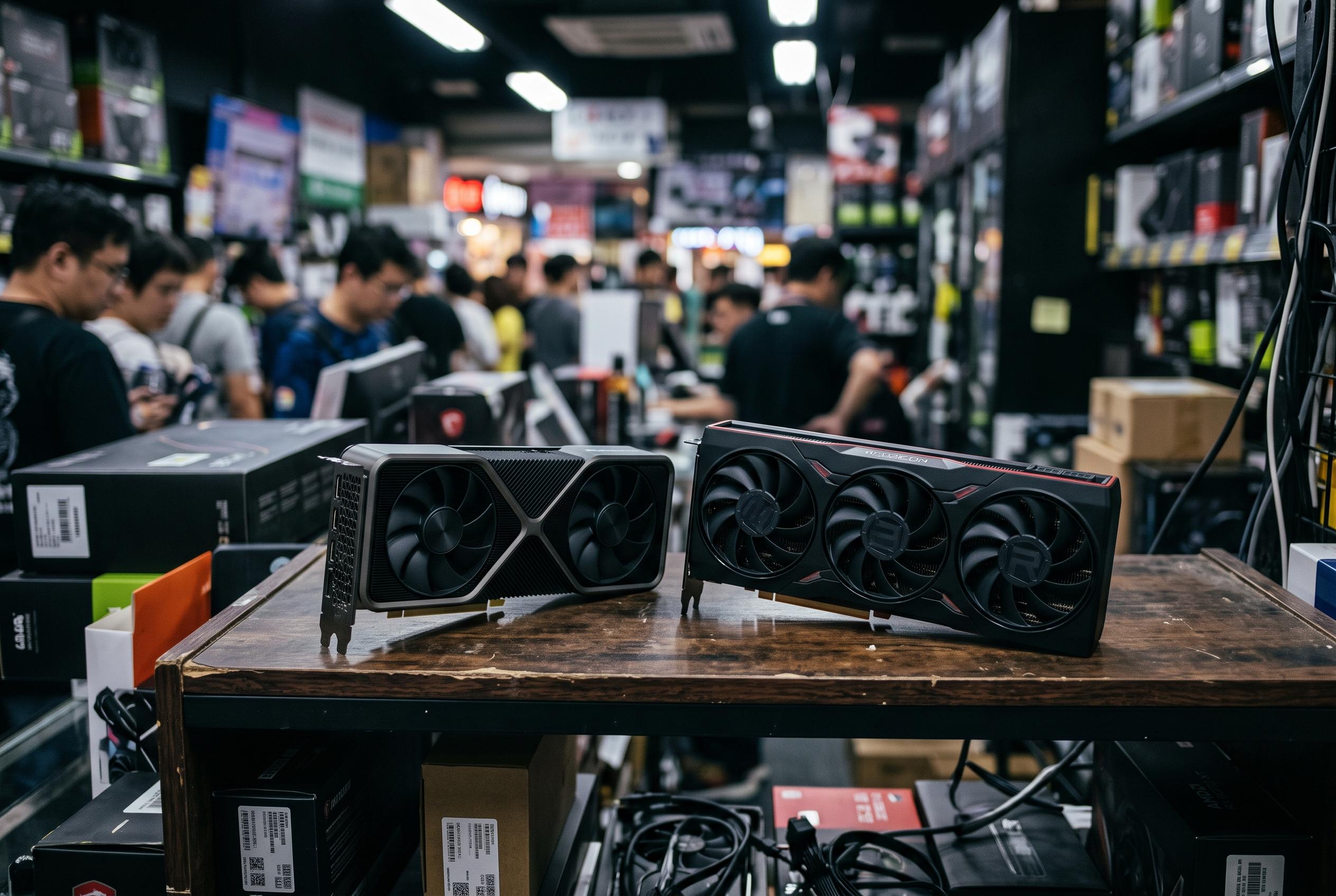

Prices of Nvidia’s RTX 5060 Ti 16GB and AMD’s RX 9070 XT have converged unexpectedly, revealing a broken market where mid-range cards now sell at premium levels, challenging traditional value hierarchies.
As of 5 September 2026, one of the strangest price overlaps in the graphics-card market is between products that were launched for entirely different tiers. PC Gamer’s live retail tracker shows the GeForce RTX 5060 Ti 16GB still commonly listed at about $760 to $780 in the US at Amazon, Newegg and Best Buy, while the Radeon RX 9070 XT is sitting broadly in the $740 to $750 range, with some listings a little higher. A lone Walmart listing for the Nvidia card at $569.99 suggests abrupt retailer-to-retailer swings rather than a clean return to normal pricing.
That overlap matters because these cards were not designed to meet in the same bracket. Nvidia launched the RTX 5060 Ti 16GB at $429, while AMD set the RX 9070 XT at $599. TechSpot said at the end of August that the RTX 5060 Ti 16GB and even the RTX 5070 were both hovering around the same level as the RX 9070 XT, which it called “pretty crazy” given the performance difference. The same report said the plain RTX 5060 had drifted up towards RX 9060 XT 16GB pricing, showing that the mismatch is not limited to one unlucky model.
In raw gaming terms, that is a difficult position for the RTX 5060 Ti 16GB to justify. Hardware Unboxed’s 52-game comparison, cited by Runet via IXBT News, put the RX 9070 XT 62% ahead on average at 1440p and 71% ahead at 4K. ComputerBase’s results point in the same direction. In Indiana Jones and the Great Circle with ray tracing at 2560 x 1440, its table shows the RX 9070 XT at 93.6fps, the RX 9070 at 86.7fps and the RTX 5060 Ti 16GB at 60.2fps. At 1080p in the same title, the RX 9070 scored 78.0fps against 52.2fps for the Nvidia card.
That does not mean the 5060 Ti 16GB has no case at all. ComputerBase also logged it at 88.3fps in a 1080p native ray-tracing pass of the same game, just behind the RX 7700 XT at 88.6fps, which helps explain why some buyers still want Nvidia’s software stack and feature set. But the pricing has badly eroded that argument. PC Gamer reported on 18 August that the cheapest new RTX 5060 Ti 16GB it could find was an MSI Shadow card at $780, while an RTX 5070 was available for $763 and an RX 9070 XT for $720. At that point, the problem was no longer close competition. It was that the slower card had become the expensive one.
Figures from Tom’s Hardware suggest the issue is structural, not anecdotal. Using Newegg median prices, the publication said the RTX 5060 Ti 16GB climbed from $569.99 in June to $804.99 in August, a 39% jump. Over the same period, the RTX 5070 rose from $659.99 to $899.99, up 36%, and the RTX 5060 moved from $369.99 to $469.99, up 27%. Tom’s added that the RTX 5070 had been one of the last models kept near its MSRP by pressure from AMD’s RX 9070, but that support had weakened, pushing the 5070 towards roughly $850 to $900 at the midpoint.
TechSpot’s broader international survey paints the same picture with more context. Across 10 countries, it said the overall GPU market was running about 28% above launch MSRP on average once the extreme RTX 5090 was excluded, and that some models were now 40% to 50% above where they should be. The publication calculated the RTX 5060 Ti 16GB at 70% above MSRP in the US and 53% above its list price globally. By comparison, the RX 9070 XT was up 12% across the regions TechSpot tracks and only 8% above its February level. AMD is hardly cheap, but Nvidia’s middle tier has moved much further out of shape.
GPU Drip’s August index reaches much the same conclusion from a different angle. It said the RTX 5060 Ti 16GB went from +14.0% in July to +44.1% in August, with its lowest observed price rising from $489 to $618 and July’s improvement completely reversed. The RX 9070 XT moved from +10.2% to +16.9%, and its low rose from $659.99 to $699.99. The mismatch is also visible in Britain. PC Gamer’s UK tracker lists the RTX 5060 Ti 16GB at £579.99 on Amazon and £599.99 at Scan, while the RX 9070 is £589.98 and the RX 9070 XT has been seen at £679.99.
For buyers, the practical consequence is that the sensible alternatives now sit elsewhere in the stack. PC Gamer’s current US watch puts the RX 9060 XT 16GB at about $469.99 and describes it as broadly competitive with the RTX 5060 Ti 16GB outside ray tracing, while the RX 9070 GRE at $529.99 is presented by both PC Gamer and Tom’s Hardware as the more rational mid-range buy if supply holds. Unless a purchaser specifically needs Nvidia’s CUDA ecosystem, DLSS features or another part of its software package, the present street prices leave the RTX 5060 Ti 16GB looking less like a value-oriented 16GB option and more like a clear sign that the GPU market’s internal pricing logic has broken down.
Disclaimer: This content is intended for informational purposes only. Readers are advised to exercise their own judgement, conduct due diligence, or consult a qualified expert before acting on any information provided.