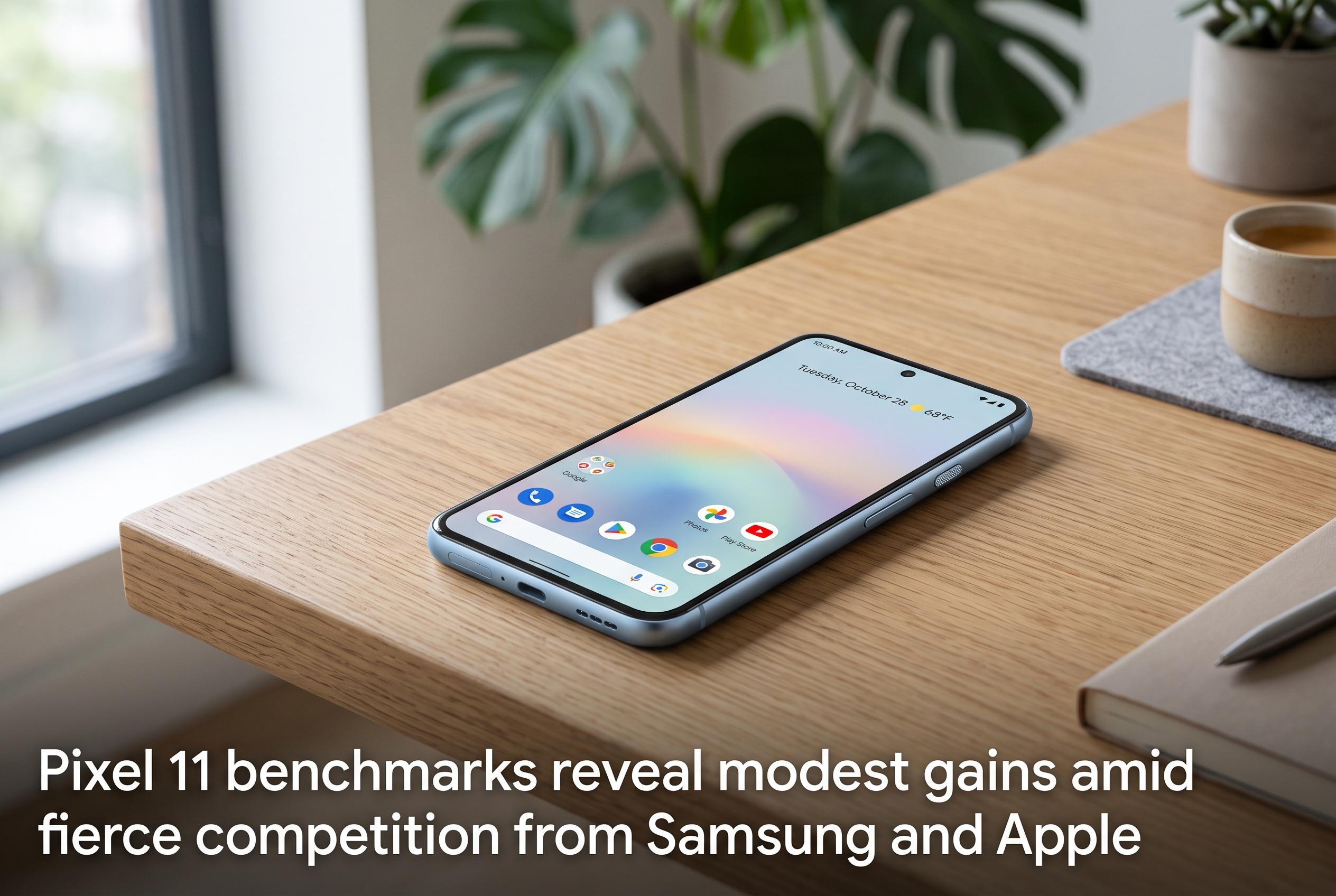

Early Geekbench 7 results place the Pixel 11 slightly ahead of its predecessor but trailing behind Samsung and Apple flagships, highlighting incremental improvements alongside ongoing performance gaps.
Google’s Pixel 11 series will reach buyers on 20 August, but the first benchmark figures are already shaping the discussion around the phone’s real-world performance. Early Geekbench 7 results suggest the base Pixel 11 is roughly 16% faster in single-core testing and 14.6% faster in multi-core work than the Pixel 10, which is a meaningful improvement, even if it does not close the gap with the fastest rivals. Google has moved the range to its Tensor G6 chip, a straightforward generational upgrade over last year’s Tensor G5.
That still leaves the Pixel behind key competitors on raw CPU scores. In the figures circulating online, the Samsung Galaxy S26 scores higher in both single-core and multi-core tests, while the iPhone 17 extends that lead further. The gap is particularly wide in multi-core performance, where Samsung’s result is far ahead of Google’s. Benchmarks for the Galaxy S26 Ultra also place it above the Pixel 11 Pro XL, reinforcing the view that Google has improved its own hardware without matching the top-end performance of Apple and Samsung.
There is also a broader technical context to the Tensor G6 story. Google has confirmed that the chip is built on TSMC’s 3nm process, not the 2nm node that had been rumoured earlier. That matters because it means Apple may still be first to a 2nm smartphone chip with the iPhone 18 Pro. Even so, Google says Tensor G6 brings faster web browsing, quicker app launches, stronger TPU performance and improved image processing, alongside the Titan M3 security chip.
For buyers, the performance gains arrive alongside a higher entry price. The standard Pixel 11 starts at $899, but the base 128GB option has gone, so the starting point is now 256GB. Android Central notes that the new phone keeps a similar overall design and display to the Pixel 10, while adding better wireless charging, refined camera features and new AI tools. That makes the Pixel 11 a more convincing upgrade for older devices than for current Pixel 10 owners, who already have a handset that will continue to receive long software support.
Disclaimer: This content is intended for informational purposes only. Readers are advised to exercise their own judgement, conduct due diligence, or consult a qualified expert before acting on any information provided.