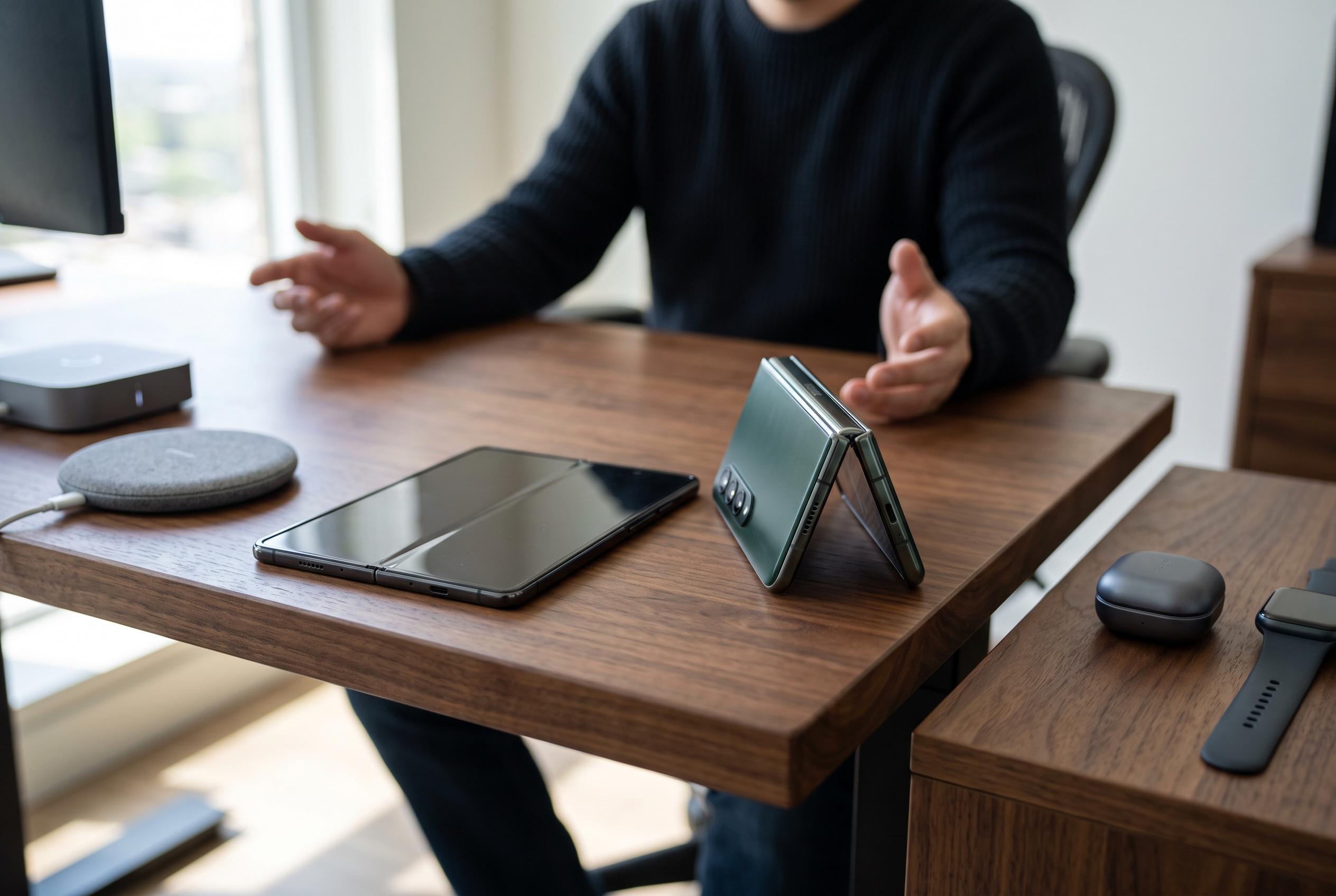

Samsung and Apple venture further into flagship foldables, each emphasising distinct features , from slim design and display finesse to rugged build and ecosystem integration , as prices diverge significantly.
Samsung and Apple have now pushed foldables into more familiar flagship territory, but they are still chasing different priorities. The Galaxy Z Fold8, launched on 7 August 2026, is built around a lighter body and a wider internal canvas, while the iPhone Duo, announced on 9 September 2026, leans on a more rugged seal, deeper integration with Apple’s ecosystem and a higher starting price. Both are clearly premium devices, but they are not aimed at exactly the same buyer.
On construction, Samsung has focused on keeping the Fold8 relatively slim and manageable at 201g, with a glass back, aluminium sides and IP48 resistance. Apple, by contrast, has given the iPhone Duo titanium edges, a glass rear and IP68 protection, which is the stronger water-and-dust rating on paper. The Duo is also the heavier handset at 254g, and its folded dimensions make it the bulkier device in a pocket.
The displays are close in size but not in intent. Samsung’s 7.6-inch foldable panel uses a 4:3 shape that, according to What Hi-Fi, reduces black bars in video playback and makes the inner screen feel more tablet-like. Apple’s inner panel is also 7.6 inches, but with a taller resolution and a slightly different emphasis on refinement, antireflective treatment and Dolby Vision support. Both panels refresh at 120Hz and reach 3,000 nits of peak brightness, while the outer screens are similarly close in size at 5.5 inches for the Fold8 and 5.4 inches for the Duo.
Under the bonnet, the two phones take different routes to the same goal: top-end performance. Samsung’s foldable uses Qualcomm’s Snapdragon 8 Elite Gen 5 in the material provided by Oficina da Net, although other launch coverage describes the chip as part of the new Snapdragon 8 Gen 5 family. Either way, it is paired with up to 16GB of RAM in broader coverage and is aimed squarely at heavy multitasking and gaming. Apple’s A20 Pro, meanwhile, is described by Tom’s Hardware as the company’s first 2-nanometre smartphone chip, with gains in CPU, graphics and memory bandwidth over the previous generation.
Camera hardware also reflects the two brands’ different philosophies. The Galaxy Z Fold8 uses two 50-megapixel rear sensors and 10-megapixel selfie cameras for both the outer and inner displays, with video capture reaching 8K at 30 frames per second. The iPhone Duo counters with a 48-megapixel main camera, a 48-megapixel ultra-wide camera and a selfie camera on the outside, while the inner camera sits beneath the display. Apple’s machine, however, has a stronger video specification on paper, with 4K recording at up to 120 frames per second.
Battery and software continue the split. Samsung lists a 4,800mAh cell with 45W wired charging, 20W wireless charging and reverse wireless charging, and it ships with One UI 9 based on Android 17, alongside a promise of seven years of updates. Apple does not disclose the battery capacity of the Duo, but says 50 per cent charge is possible in around 20 minutes with a 60W adapter or better. It also supports 25W MagSafe and Qi2 wireless charging, runs iOS 27 and benefits from Apple’s long, though unofficial, support record.
Price is the biggest divider. In Brazil, the Galaxy Z Fold8 starts far below the iPhone Duo, with local pricing reported from R$12,599 and street prices already lower in some stores, while the Apple foldable arrives at R$21,999. That gap matters because the two phones both offer flagship performance, fast screens and current-generation connectivity, including Wi-Fi 7, Bluetooth 6.0, 5G, NFC, UWB and stereo speakers. For buyers outside Apple’s ecosystem, the Samsung is the more pragmatic choice; for those already tied to Apple devices, the Duo’s tighter integration may justify the premium.
Disclaimer: This content is intended for informational purposes only. Readers are advised to exercise their own judgement, conduct due diligence, or consult a qualified expert before acting on any information provided.