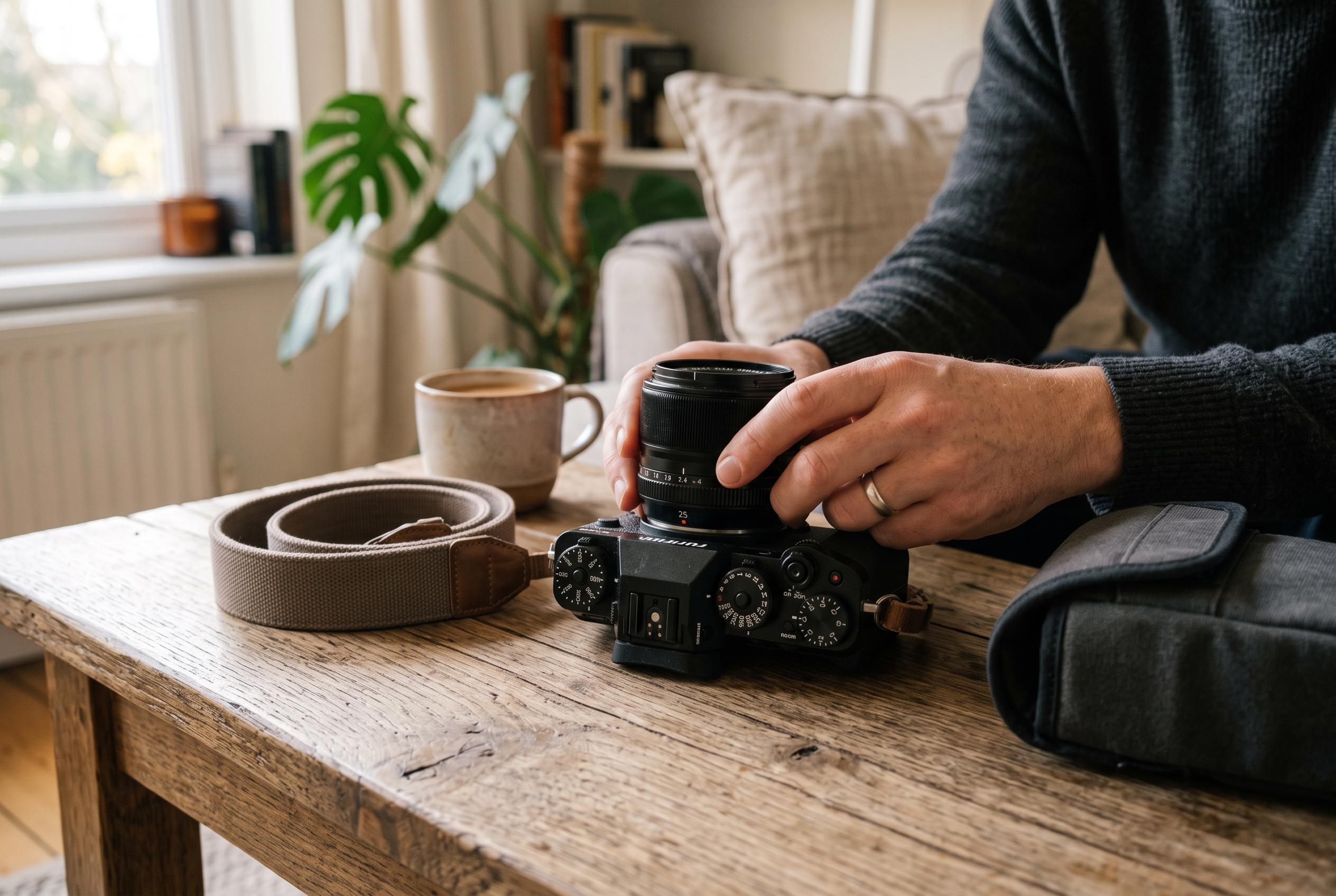

A new wave of compact full-frame cameras like Canon’s EOS R8 Mark II, Sony’s a7C II, Nikon’s Z5II, and Panasonic’s Lumix S9 offers diverse options for enthusiasts, with design choices prioritising different compromises to suit varied shooting needs.
The latest wave of compact full-frame cameras is not simply a race to make bodies smaller. It is an attempt to decide which compromises matter least. Canon’s EOS R8 Mark II, Sony’s a7C II, Nikon’s Z5IIC and Panasonic’s Lumix S9 all sit in the same broad category, yet they are aimed at rather different buyers. As Julia Trotti’s field tests show, the important questions are not just about resolution or autofocus features, but about grip depth, viewfinder choice, shutter design and how well each body balances with genuinely small lenses.
In practical use, the lightest camera is not always the one that feels easiest to live with. Trotti found that the Canon and Nikon, despite being the heaviest of the four, were the most comfortable to hold because both have deeper grips. The Panasonic is the most extreme interpretation of minimalism: it is the smallest body here, it has almost no grip, and it relies on an add-on accessory if the user wants more purchase. All four use a single UHS-II card slot, which places them firmly in enthusiast territory rather than professional redundancy. Only the Canon and Sony include a viewfinder, only the Canon adds a joystick, and the Lumix is the only one without weather-sealing or a hot shoe.
Price broadly tracks the amount of body attached to each system, but not perfectly. The Sony is the most expensive, with the Canon and Nikon in the middle and the Panasonic usually the cheapest, although Trotti notes that launch timing and regional pricing can change that order. The a7C II is also the only model here that departs from a 24-megapixel class sensor, using 33 megapixels instead, which gives more cropping headroom at the cost of larger files. Independent comparisons have also tended to place the Sony ahead on ergonomics and overall versatility, while the Canon is often described as a strong portable option with newer video and handling refinements.
Shutter behaviour is one of the clearest dividing lines. The Nikon is the only camera in this group with a full mechanical shutter, while the Panasonic uses an electronic shutter only. That makes the S9 silent and mechanically simple, but it also raises the risk of banding under artificial light and rolling-shutter distortion on fast movement. The Canon and Sony rely on electronic first-curtain shutters, which reduce but do not eliminate those problems. For anyone who shoots indoors under LEDs or fluorescent lighting, or who regularly photographs quick action, that difference matters more than a few grams on a specification sheet.
The broader trend behind these cameras is clear enough: manufacturers increasingly assume that many buyers now compose on the rear screen, as they do on a phone. That is why viewfinder-less full-frame bodies have become more common, following Sony’s ZV-E1, Panasonic’s S9 and Nikon’s viewfinder-less Z5IIC sibling. For casual use, the trade-off can make sense. For bright daylight, subject tracking and steadier hand-held shooting, an eye-level finder still has a real advantage. Trotti also stresses that autofocus performance depends on the lens as much as the body: newer lenses with fast linear or VCM motors can keep up with moving subjects far better than older designs, even when mounted on capable modern cameras. Her video tests also point to useful differences in video capability, from Canon’s full-width 4K 60p to Panasonic’s open-gate 6K and Nikon’s N-RAW support.
For buyers weighing a small full-frame camera, the real decision is therefore less about which model is “best” in the abstract and more about which compromises fit the way they actually shoot. The Canon and Nikon are the most reassuring in the hand. The Sony remains the most rounded all-rounder for many photographers. The Panasonic is the most compact and the most stripped back. None of them is a universal answer, but each makes a different argument about how little a full-frame camera can be while still being genuinely useful.
Disclaimer: This content is intended for informational purposes only. Readers are advised to exercise their own judgement, conduct due diligence, or consult a qualified expert before acting on any information provided.