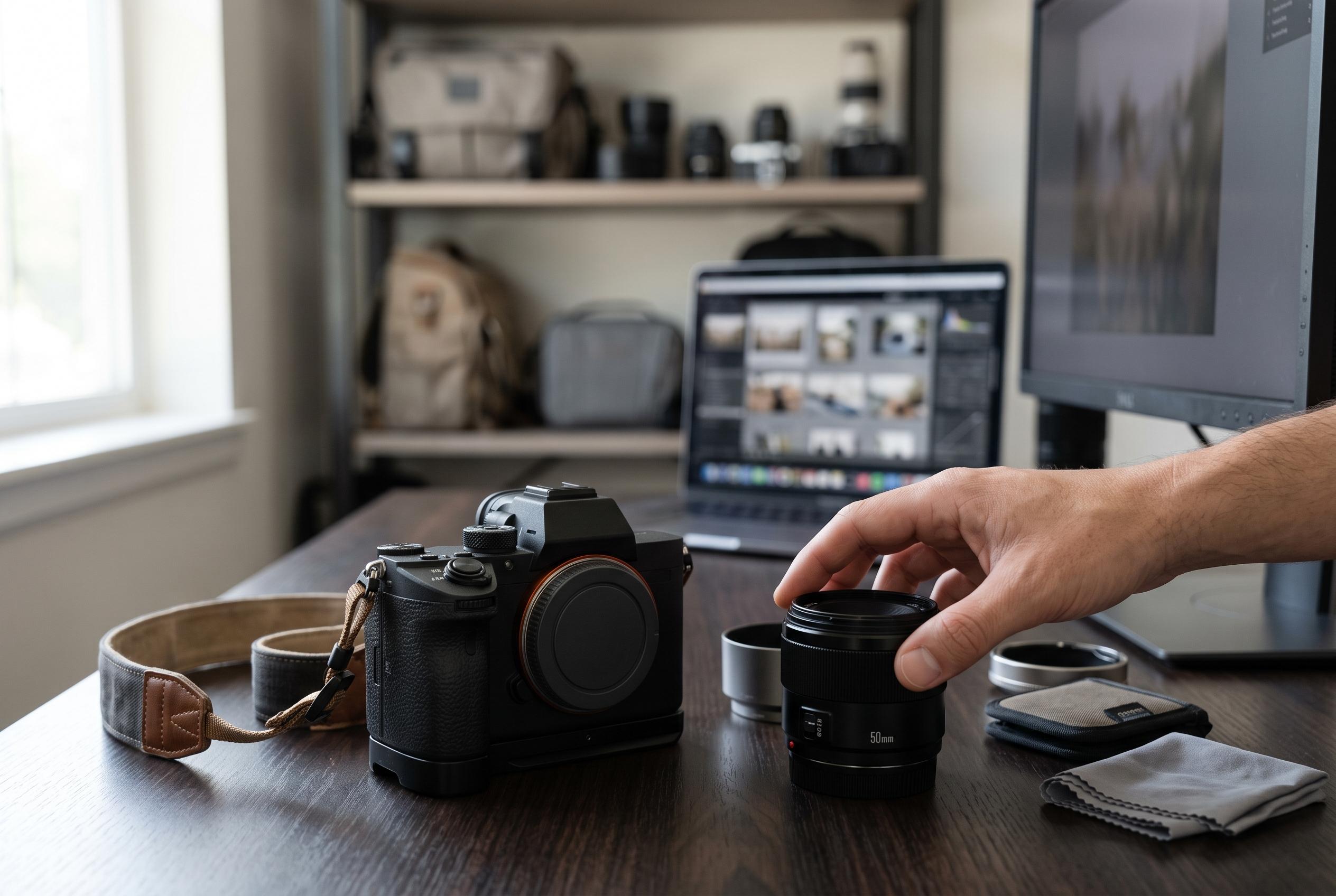

The Sony a7R VI introduces a 66.8-megapixel sensor and competitive pricing, prompting photographers to reconsider the value of premium flagship bodies amidst evolving mid-range options.
Sony’s new a7R VI has reopened an uncomfortable calculation for hybrid shooters: it offers a 66.8-megapixel sensor and comes in around $3,000 below the flagship a1 II. In Mike North Borders’ review for Fstoppers, that price gap becomes more than a spreadsheet exercise; it is a question of whether a top-end body is still worth the premium when a cheaper model now covers much of the same ground.
Borders frames the comparison through his own purchase of the a1 II last year, which he bought to replace an ageing a7R IV because he needed one body for both stills and video. Sony’s later release of the a7 V, followed by the a7R VI, has narrowed the distance between the mid-tier and flagship lines. To test the new camera properly, he took it into a difficult night-time street event filled with smoke, crowds, fences and moving cars.
The strongest case for the new model is battery life. Borders says he shot roughly 2,000 images and used only 15 per cent of the charge, then later remained at 96 per cent after nearly 1,500 frames in cold conditions. That matters because the a7R VI is also built for speed, with 30 frames per second burst shooting, pre-capture and the same broad AI autofocus approach found in Sony’s faster bodies. Independent reviews from DPReview, TechRadar and Digital Camera World have similarly singled out the camera’s high resolution, dependable autofocus and class-leading image quality, while noting that its speed comes with the usual trade-offs of a high-resolution sensor.
In practice, Borders found the autofocus held up in smoke and other conditions that would normally cause hunting, and he said he could not detect a meaningful difference versus the a1 II in the field. The larger gain was flexibility: he showed an ISO 5,000 frame that could be heavily cropped while still preserving readable detail, from lettering on the car to marks on a helmet visor. That ability to reframe after the fact is now one of the most obvious reasons to buy a high-resolution full-frame camera, particularly for events, motorsport and other situations where the photographer cannot always move closer. Recent lens-and-body tests from TechRadar also suggest the a7R VI is especially effective when paired with long telephoto optics, where cropping headroom becomes part of the workflow rather than a fallback.
The a7R VI is not an outright replacement for the a1 II. Borders says banding can appear under certain artificial lights because the sensor reads more slowly from top to bottom, and fast panning still favours the flagship’s stacked sensor. The electronic shutter also tops out at 1/16,000 of a second, compared with 1/32,000 on the a1 II. His conclusion is measured rather than absolute: for resolution, battery life and most autofocus work, the a7R VI looks exceptional, but photographers who depend heavily on fast rolling-shutter behaviour may still find the a1 II the safer tool.
Disclaimer: This content is intended for informational purposes only. Readers are advised to exercise their own judgement, conduct due diligence, or consult a qualified expert before acting on any information provided.