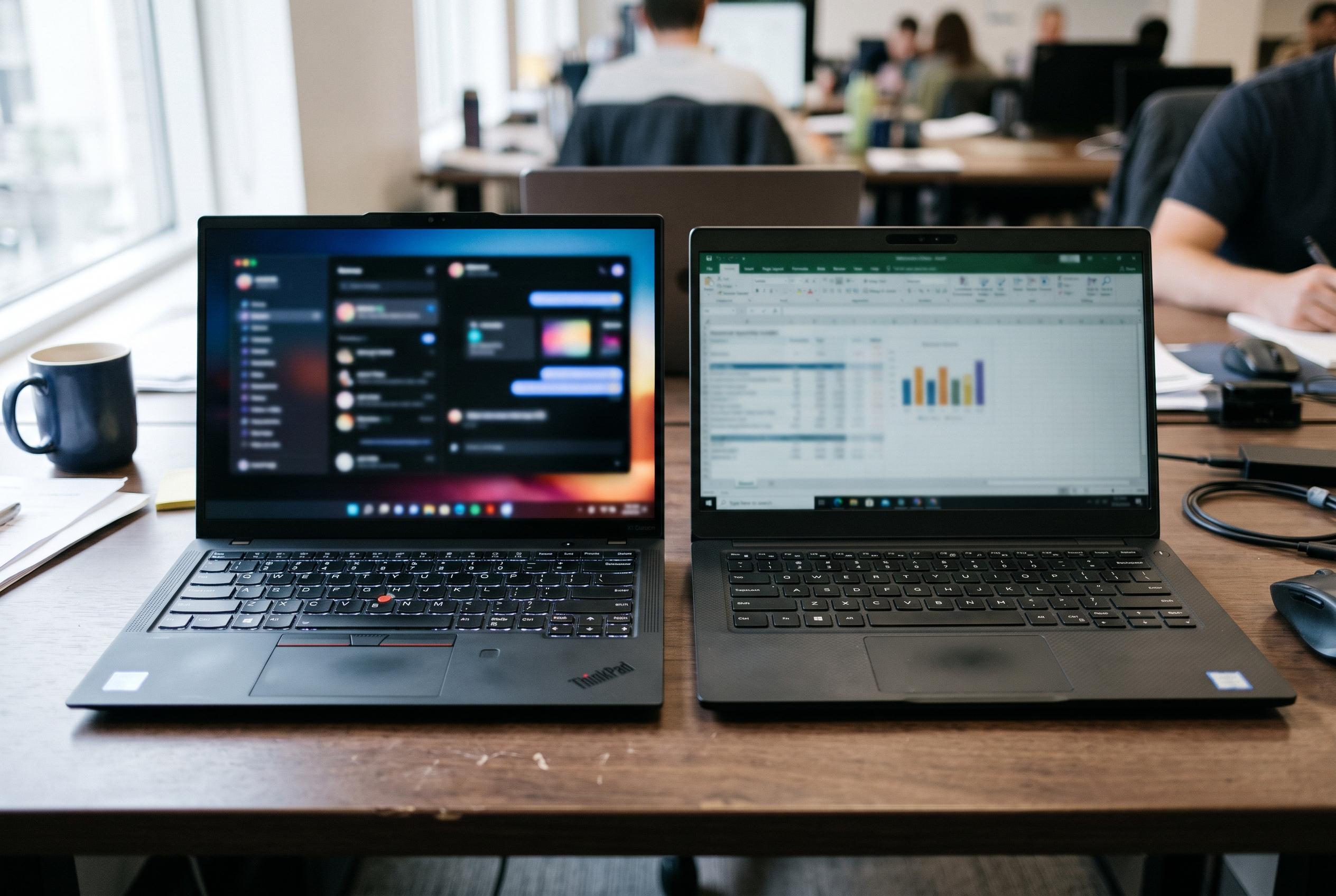

Lenovo’s ThinkPad T14 Gen 7 wins a tight comparison with Dell’s Pro 5 14, combining a sharper OLED display, classic ThinkPad controls and easier servicing, while Dell counters with longer battery life and stronger integrated graphics.
Lenovo and Dell remain two of the most important names in commercial PCs, and their latest 14-inch mainstream business machines show why the segment still matters. While consumer PC demand has been constrained by high memory prices, corporate buyers continue to refresh fleets on a predictable three-to-five-year cycle, giving vendors a steadier source of revenue. In that context, the ThinkPad T14 Gen 7 and the Dell Pro 5 14 sit close to the centre of the market, aimed at organisations that want dependable hardware rather than flashy design.
The two laptops follow broadly similar design principles, with understated black finishes and a strong emphasis on practicality. Dell offers an optional aluminium lid, while Lenovo uses a carbon- and glass-fibre construction throughout. The Dell machine is slightly larger and heavier, but also thinner. On connectivity, upgrade options and security features, the pair are closely matched. Lenovo, however, keeps a few classic ThinkPad advantages: a user-replaceable keyboard, the red TrackPoint and dedicated mouse buttons. Dell counters with a larger touchpad, but it does not offer the same familiar control scheme that many long-time business users still prefer.
Display choice is where Lenovo pulls ahead. Notebookcheck’s review of the ThinkPad T14 Gen 7 highlighted an optional 2.8K OLED panel at 2,880 x 1,800, a specification Dell does not match on the Pro 5 14. The Dell unit tested by Notebookcheck used a basic WUXGA IPS panel at 1,920 x 1,200, although the Pro 5 line can be ordered with WUXGA OLED or 2.5K IPS options. Even so, the ThinkPad’s higher-resolution OLED screen gives it the clearer edge for image quality, especially for users who spend long hours reading documents or working with visual material.
Performance is much closer. Both review samples used Intel Panther Lake processors, with Lenovo’s ThinkPad T14 Gen 7 fitted with a Core Ultra 366H and Dell’s Pro 5 14 using a Core Ultra X7 368H. According to Notebookcheck, CPU performance was effectively level, while the Dell chip delivered the stronger integrated graphics result, as expected. The Dell system ran noticeably louder under load, but thermal behaviour was similar in both machines. Battery life favoured Dell, helped by a more frugal screen and a larger 70Wh battery, compared with the 60Wh pack in the tested ThinkPad. Lenovo does offer a 75Wh option, which should narrow that gap for buyers who prioritise endurance.
Overall, the comparison is unusually close, with each notebook making a strong case for deployment in business fleets. Yet Notebookcheck still gave the ThinkPad the advantage, largely on the strength of its keyboard, pointing device and display. That judgement is consistent with other recent coverage of the T14 Gen 7, which has praised its repairability and straightforward servicing, including praise for its modular design and easy disassembly. Dell’s Pro 5 14 may not be as distinctive, but it remains a credible alternative for organisations that value balanced performance and longer runtime over the ThinkPad’s more characterful input experience.
Disclaimer: This content is intended for informational purposes only. Readers are advised to exercise their own judgement, conduct due diligence, or consult a qualified expert before acting on any information provided.