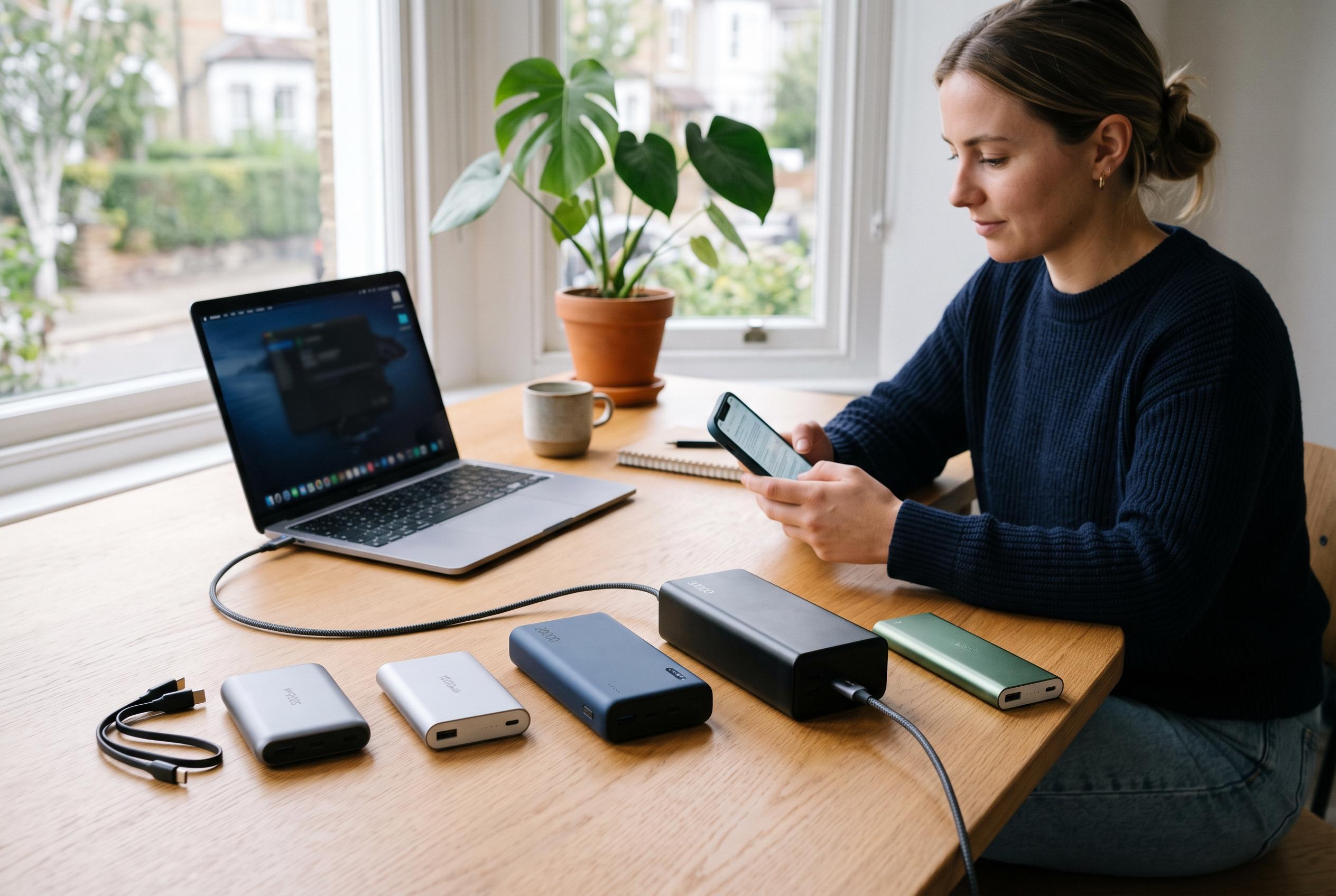

The best portable chargers are no longer simply the biggest: output wattage, portability and USB-C Power Delivery are reshaping how buyers choose between compact phone chargers and laptop-ready battery packs.
USB-C power banks have become a practical accessory for anyone relying on phones, tablets or laptops away from a wall socket. The appeal is straightforward: a single charging standard, faster replenishment and a broader choice of capacities than older battery packs. In the ranking provided by Digitechbytes, the INIU 10,000mAh 45W model is presented as the strongest all-rounder because it combines a small footprint with high output, while slimmer options such as Anker’s PowerCore Slim 10000 suit daily carry and larger units such as Anker’s 25,000mAh pack are aimed at longer journeys. Independent buying guides from PowerBank Guide, Mint and Gadget CEO point to the same market shift: the most useful USB-C power banks now tend to sit in the 10,000mAh to 25,000mAh range and support USB-C Power Delivery for faster, more reliable charging.
What matters most in this category is not just headline capacity, but how that capacity is delivered. The Digitechbytes guide stresses the same core criteria used by most current reviews: battery size, charging speed, portability, durability and extra features such as built-in cables or multiple ports. That view is echoed elsewhere. PowerBank Guide and Gadget CEO both place USB-C PD at the centre of modern buying decisions, while Mint specifically highlights higher-capacity models for laptop users who need sustained output rather than occasional phone top-ups. In practical terms, the best choice depends on whether the buyer wants a compact emergency charger, a daily carry accessory or a unit that can handle a notebook computer as well as smaller devices.
The strongest compact models trade endurance for convenience. Slim 10,000mAh packs are easier to carry in a pocket or small bag, and they suit commuters, students and travellers who mainly need one or two phone charges. By contrast, larger battery banks are better for people who spend long days away from mains power or travel with several devices. Mint’s laptop-focused guide underlines a key point often missed by casual buyers: a power bank may have a large capacity and still be unsuitable for a laptop if its output is too low. For that reason, wattage matters as much as capacity, particularly when a USB-C port is expected to charge tablets or notebooks rather than just handsets.
There are also clear trade-offs between speed, heat and longevity. Higher wattage usually means faster charging, but it can also increase heat generation and raise the cost of the unit. That is why several guides, including Juicemyjunk’s review round-up, frame the purchase decision as a balance between performance and portability rather than a search for the largest number on the box. Build quality matters as well. Reinforced shells, decent thermal design and properly finished cables are more likely to survive regular travel than cheaper plastic alternatives. Built-in cables are convenient, but they are only worthwhile if the connector and wire are robust enough to withstand repeated bending.
Taken together, the available reviews point to a clear pattern. Buyers who want a dependable everyday charger should look first at a compact 10,000mAh USB-C Power Delivery model. Those who need to charge laptops or keep multiple devices running through the day should move up to higher-capacity packs with stronger output, even if they are heavier. The most sensible choice is rarely the biggest or the fastest power bank on the shelf; it is the one that matches the user’s devices, charging habits and tolerance for extra bulk.
Disclaimer: This content is intended for informational purposes only. Readers are advised to exercise their own judgement, conduct due diligence, or consult a qualified expert before acting on any information provided.