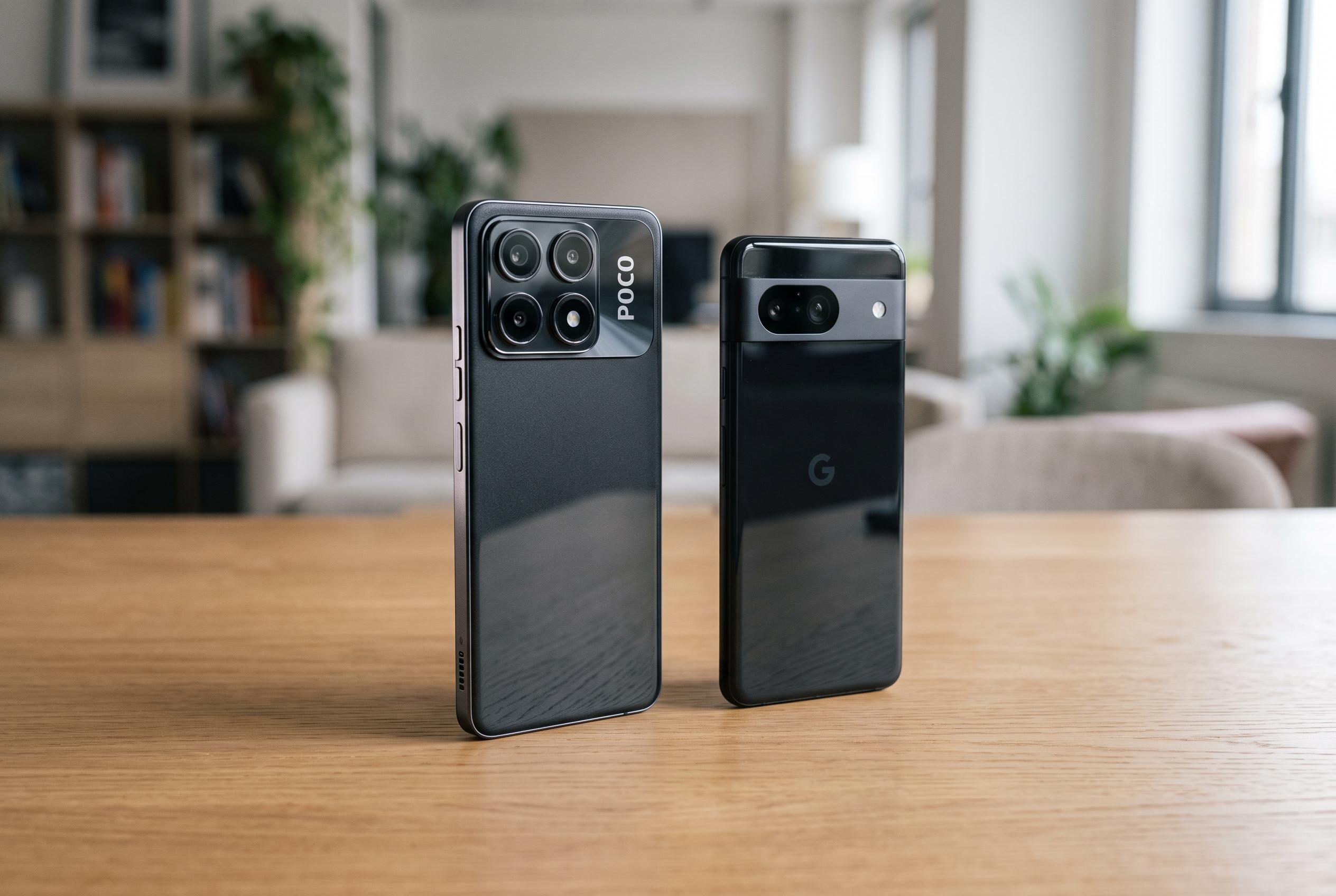

Xiaomi’s Poco X8 Pro Max and Google Pixel 10a spotlight evolving mid-range smartphone strategies, with Xiaomi prioritising raw hardware and Galaxy-level performance, while Google emphasises software refinement and long-term support, reshaping the budget flagship landscape.
Google’s mid-range phones have long earned a reputation for balance, but Xiaomi’s latest Poco model is putting that claim under pressure. On paper, the Poco X8 Pro Max brings the sort of hardware that is increasingly rare at this price, while the Pixel 10a leans on software polish, camera processing and longer support rather than raw specification. Recent reviews from Android Central and TechRadar echo that split, with Google’s handset positioned as the more restrained but better-finished option, and Xiaomi’s as the more aggressive value play.
The contrast begins with design. Android Central says the Pixel 10a has launched with a largely familiar look, a slightly thicker body than the Pixel 9a and a lighter overall feel, while keeping an IP68 rating and recycled materials in the construction. Frandroid’s comparison frames it as the more compact and understated device, with a flat back and no prominent camera island, making it easier to handle. The Poco X8 Pro Max, by contrast, is larger, heavier and more overtly gaming-oriented, with a 6.83-inch display, RGB accents and a more muscular frame.
Display quality is one of the Poco’s strongest arguments. Frandroid reports a 6.83-inch AMOLED panel with very high HDR brightness, while the Pixel 10a uses a smaller 6.3-inch OLED screen that is still bright but less expansive. TechRadar’s review of the Pixel 10a suggests the screen is competent rather than transformative, which fits the broader picture of a phone that refines rather than reinvents. For users who want a larger panel for video, gaming and split-screen use, the Poco has the more obvious advantage.
Software is where Google still separates itself. TechRadar highlights that the Pixel 10a offers Google’s clean Android experience and AI-assisted features, while Frandroid notes a seven-year update commitment for the Pixel, compared with four years for the Poco. The Xiaomi phone runs HyperOS 3 over Android 16, and TechRadar says it comes with bloatware that many users will want to remove, although it also adds gaming tools and customisation options. That makes the Pixel the safer long-term choice for buyers who value simplicity, security and longevity.
Performance and battery life tilt the contest back towards Xiaomi. Frandroid describes the Poco X8 Pro Max as running on MediaTek’s Dimensity 9500s, with enough headroom for demanding games at high frame rates, while the Pixel 10a uses Google’s Tensor G4, which is adequate for daily use but less ambitious under heavy load. Beebom’s review of the Poco also points to flagship-grade performance and strong endurance, and Frandroid says its 8,500mAh battery can last well over a day and recharge at 100W. The Pixel’s 5,100mAh cell is modest by comparison, although it does support wireless charging, which remains a practical advantage.
Photography follows the same pattern of trade-offs. Frandroid says the Poco’s 50-megapixel main camera is bright and detailed in daylight, while the Pixel 10a relies on Google’s image processing to deliver richer colours, stronger contrast and better low-light results from its 48-megapixel sensor. The Pixel also appears to hold up better in ultra-wide and zoom use, even if digital zoom remains limited on both phones. In practical terms, the Poco is the more convincing all-round hardware package, but the Pixel still looks like the better camera phone for people who value consistency and processing over specification.
For most buyers, the choice comes down to priorities. The Poco X8 Pro Max is the stronger option for gaming, endurance and sheer hardware value. The Pixel 10a is the more balanced phone, with better software support, a cleaner interface and a more confident photographic output. That leaves Xiaomi with the sharper bargain, but Google with the more rounded mid-range handset for users willing to pay more for refinement.
Disclaimer: This content is intended for informational purposes only. Readers are advised to exercise their own judgement, conduct due diligence, or consult a qualified expert before acting on any information provided.