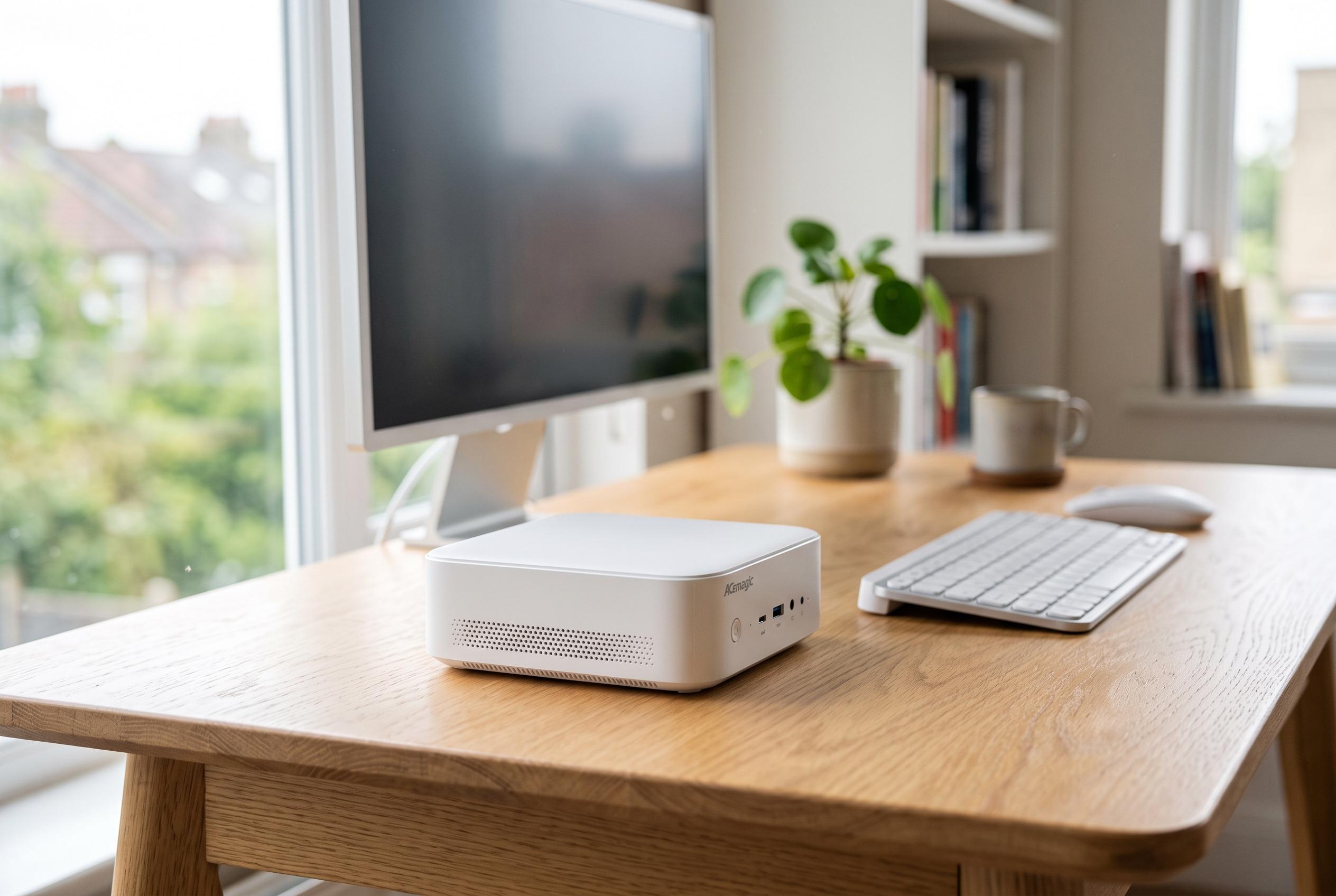

As new Wildcat Lake mini PCs like ACemagic’s Kron Mini K5 arrive, they prove that cost-effective, compact Windows desktops prioritise responsiveness and essential connectivity over raw power, with premium features still appealing to niche users.
CNX Software’s Windows testing of ACemagic’s Kron Mini K5 lands at an awkward but revealing moment for Intel’s new Wildcat Lake platform. The machine appears to confirm that the Core 3 304 is already good enough for the kind of work many mini PCs actually do: office applications, web use, multiple displays and media playback. What the broader review picture adds, however, is that this is a category defined less by outright speed than by compromise. Wccftech frames the same processor in Beelink’s EQi as a chip for “regular office, business, and productivity tasks”, while Minimachines argues Wildcat Lake should feel more comfortable than the Alder Lake-N and Twin Lake boxes it replaces. Zelpio reaches a similar conclusion, describing the segment as well suited to everyday computing, media playback and light productivity.
That context matters because Beelink has effectively set the bar for what a richly equipped Core 3 304 system can look like. Across reviews by Wccftech and TechRadar, and on Beelink’s own product page, the EQi pairs the five-core processor with a compact 126 x 126 x 44.2mm chassis, dual Thunderbolt 4 ports at 40Gbps, dual Ethernet including 10GbE and 2.5GbE, triple-display support and an internal 85W power supply that removes the usual external brick. Beelink also advertises Wake-on-LAN and a 32dB noise level. In other words, the most interesting Wildcat Lake design so far has not been about making an inexpensive processor look fast, but about surrounding it with workstation-style connectivity.
ACemagic’s approach is plainer, but not bare-bones. Retro Handhelds’ review of a higher-spec K5 variant built around the Core 5 320 shows what the chassis itself is trying to offer: HDMI 2.0, DisplayPort 1.4 and USB-C DisplayPort for triple 4K at 60Hz, Wi-Fi 6, Bluetooth 5.2, a 2.5GbE port and dual M.2 2280 expansion slots. Nick measured the K5 at 128mm square and 41mm high, with a 436g weight, which puts it in the same physical class as the Beelink. The difference is not whether ACemagic understands the brief; it is where the company has chosen not to spend. There is no Thunderbolt 4 and no 10GbE, but the essentials for a compact multi-monitor Windows desktop are still there.
The more interesting trade-off lies inside. Minimachines was notably sceptical about the Beelink entry model, warning that soldered LPDDR5 memory and integrated UFS 3.1 storage made it poorly suited to long-term upgrades. TechRadar and Beelink’s own listing complicate that picture by describing multiple versions, including fixed 16GB LPDDR5 models and separate DDR5 configurations at 24GB and 32GB, with support rising to 64GB in the socketed variant. They also agree on dual M.2 slots, though the second slot runs with fewer PCIe lanes. ACemagic, by contrast, looks more conservative on I/O but cleaner on storage in the reviewed K5 family. Retro Handhelds’ sample used a 512GB NVMe drive rather than UFS, alongside soldered LPDDR5-6400 memory and two further M.2 expansion paths.
In day-to-day use, the supporting reviews all point in the same direction: Wildcat Lake is about responsiveness, not muscle. Wccftech says the Core 3 304 is enough for ordinary productivity but plainly not a gaming processor. TechRadar found Beelink’s machine unexpectedly sharp in Microsoft Office, Lightroom and browser work, even if graphics performance remained limited. Zelpio’s figures tell a similar story, with Geekbench 7 scores of 2,150 single-core and 5,685 multi-core, and a Fire Strike score of 1,948, enough to sit ahead of older Intel N305-class hardware without pretending to threaten mainstream Ryzen mini PCs. Against that backdrop, CNX Software’s verdict on the Kron Mini K5 makes sense: strong enough for a general-purpose Windows desktop, smooth on high-resolution video, and clearly built for low-power usefulness rather than demanding 3D work.
The AI angle is more tentative. TechRadar notes Beelink’s claim of 24 TOPS across CPU, GPU and NPU, which is the sort of number now appearing in almost every Wildcat Lake sales pitch. Retro Handhelds is more valuable because it tests the claim in practice. Using the more capable Core 5 320 version of the K5, Nick reported local language-model generation at 17.1 tokens per second, with CPU use hovering between 12-15% and memory staying below 60%. Even so, his conclusion was cautious. He wrote that the hardware was so new that anyone buying in should be specifically interested in a small Windows-based local LLM machine, adding that he would take a “wait and see” approach before making a major purchase. That scepticism is important: the NPU is real, but the software case is still catching up.
Thermals and acoustics may prove the more practical separator. On Beelink’s side, Wccftech describes “whisper-quiet cooling” and says the CPU stayed below 25W, while TechRadar repeatedly returns to the near-silent character of the EQi in office use. Beelink’s own 32dB claim, though a marketing figure rather than an independent measurement, points in the same direction. CNX Software’s ACemagic testing tells a different story. Its Kron Mini K5 sample appears to push the processor harder and then pay for that decision with thermal throttling under sustained load and more noticeable fan noise. For short bursts that may be a fair exchange. For longer renders, sustained AI work or anyone sensitive to acoustics, the Beelink philosophy looks better judged.
Price is where the equation becomes messy. TechRadar put the Beelink EQi at $509 in early August, and Minimachines translated the July entry price to roughly €464 including VAT. Wccftech, meanwhile, argued that DRAM and NAND shortages were inflating the whole class and that such machines would look more sensible at $300-$350. Beelink’s own store now shows the Core 3 304 EQi at $629, which underlines how fluid this part of the market remains. In that light, the roughly $400 positioning of ACemagic’s Kron Mini K5 is understandable. It offers the shape of a modern Wildcat Lake mini PC without chasing every premium interface. Buyers who need silent running, Thunderbolt 4 and 10GbE should still look at Beelink. Buyers who simply want a compact Windows 11 desktop for office work, video and cautious AI experimentation may find ACemagic’s simpler specification closer to the real sweet spot.
Disclaimer: This content is intended for informational purposes only. Readers are advised to exercise their own judgement, conduct due diligence, or consult a qualified expert before acting on any information provided.