

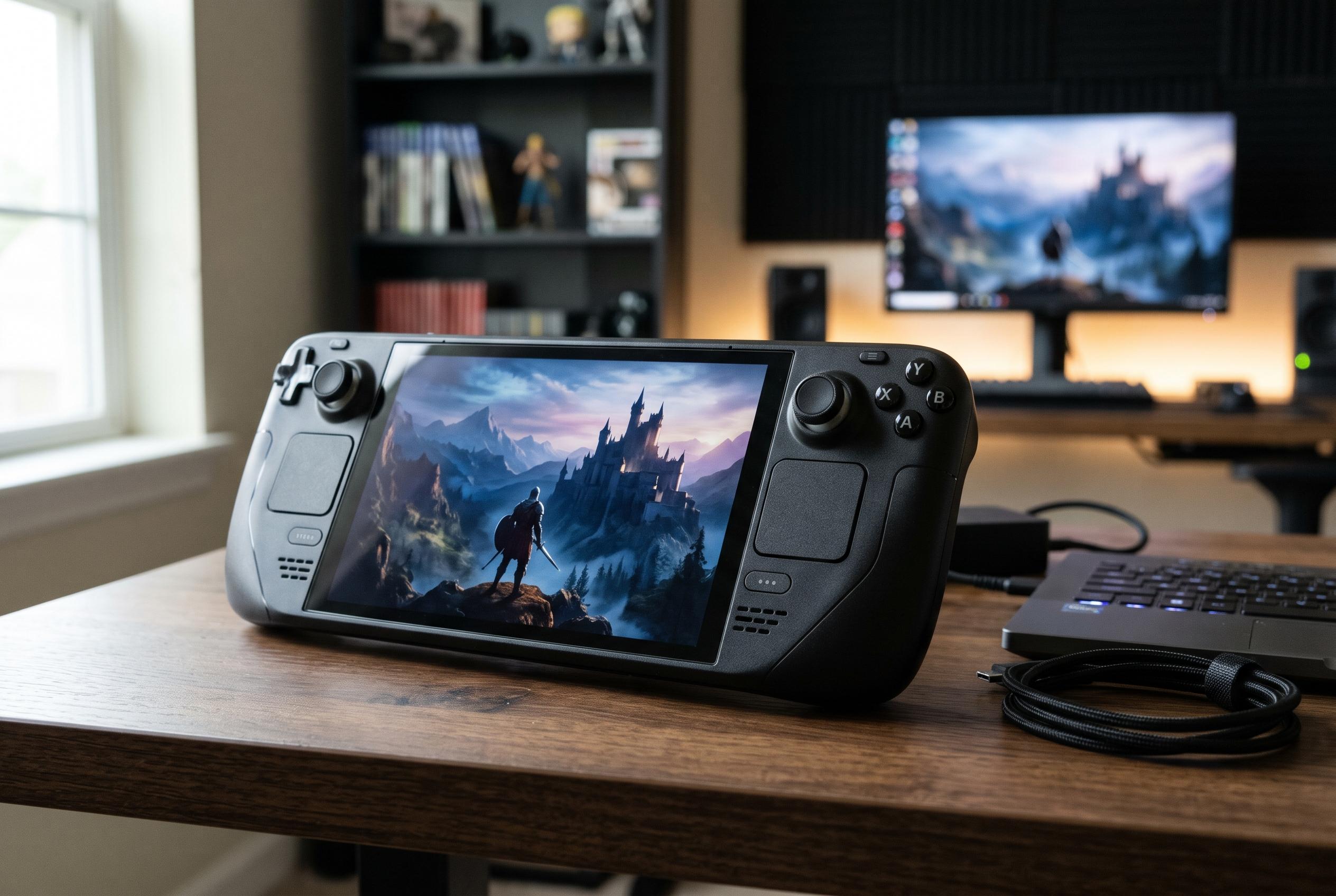

The Windows gaming handheld pairs an ambitious Intel-powered spec sheet and customisable controls with an 860g chassis and battery life of about 100 minutes under heavy gaming.
Acer’s Predator Atlas 8 enters the Windows handheld gaming market with a clear ambition: to deliver desktop-style performance in a portable shell, while still offering the controls and connectivity expected by demanding PC players. According to Geeky Gadgets, the device is positioned as a serious rival to the Steam Deck and Asus ROG Ally, but it does not try to win on lightness or endurance. Its appeal rests instead on a mix of premium hardware, customisable inputs and a specification sheet that is unusually ambitious for a handheld. The trade-off is equally clear: this is a large machine, and its size is likely to matter as much as its performance for many buyers.
At the centre of the design is an 8-inch 120Hz display with a 16:10 WUXGA format, which Acer says is protected by Gorilla Glass Victus with DXC. The company also promotes variable refresh rate support, while reviewer impressions have described the screen as bright and well suited to fast-moving games. That matters because this is not an OLED panel, so users looking for the deepest blacks and strongest contrast will need to temper expectations. The chassis is built with durability in mind, but the machine’s 860g weight is the most obvious reminder that this is a relatively heavy handheld. Textured side grips are intended to improve comfort, yet the bulk remains a practical limitation for players who want a device they can carry for long periods.
Performance is a major part of the Atlas 8’s pitch. Acer and Intel say the handheld uses an Intel Arc G3 Extreme platform with Arc B390 graphics, and the company has tied the device to XeSS 3 features, including upscaling and frame generation. Independent hands-on coverage from Tom’s Guide suggests the hardware is strong enough to keep games playable at 1200p with demanding visual settings, while Windows Central reported that the device was shown alongside competing Intel-powered handhelds during demonstrations. Acer also includes several power modes, allowing users to shift between quieter operation and higher performance. That flexibility should help the device adapt to different games, although it is still better suited to balanced settings than to always chasing the highest image quality.
The control layout is one of the Atlas 8’s more distinctive features. Acer has fitted TMR thumbsticks, Hall-effect triggers and programmable macro buttons, all of which are aimed at improving precision and longevity. The company also folds in an Xbox-style interface for easier access to Game Pass and other Windows gaming services, reinforcing the idea that this is meant to feel more console-like than a conventional mini-PC. Review coverage has generally been positive about the feel of the controls, although some early impressions have noted that not every button is equally satisfying in use. Even so, the overall package is clearly designed to appeal to players who care about responsiveness and customisation as much as raw specification.
Cooling and battery life are where the compromises become harder to ignore. Acer says the Atlas 8 uses a dual-fan AeroBlade system to keep temperatures in check, and that should help it sustain performance under load. But review reports also note that the fans can become audible when the device is pushed hard. Battery capacity is listed at 80Wh, yet the practical result reported by Geeky Gadgets is only around 100 minutes of heavy gaming, which places it behind some rivals in real-world endurance. For users who mostly play near a charger, that may be acceptable. For anyone who expects a handheld to last through long sessions away from mains power, it is a significant limitation.
Connectivity is one of the Atlas 8’s strongest areas. Acer and Intel both highlight Thunderbolt 4, Wi-Fi 7 and broad expansion support, while Acer also includes a 1TB SSD as standard in its product positioning. That gives the device a future-facing specification set that should suit a library of modern PC games and fast external storage accessories. Taken together, the Predator Atlas 8 looks like a capable handheld with genuine enthusiast appeal: powerful, feature-rich and well connected, but also heavy and not especially long-lasting. For buyers who want maximum portability, that balance may be hard to justify. For those who prioritise performance, control precision and a high-end feature set, it is a compelling entry in an increasingly crowded category.
Disclaimer: This content is intended for informational purposes only. Readers are advised to exercise their own judgement, conduct due diligence, or consult a qualified expert before acting on any information provided.



