
Apolosign has launched a multifunctional 32-inch smart portable TV that blends display, Android functionality, and mobility, offering new opportunities for flexible display deployment in professional environments.
Apolosign’s 32-inch Smart Portable TV occupies a category of its own: part display, part Android device, part movable meeting aid. In practice, it is closer to a wheeled smart screen than a conventional television, and that is exactly why it makes sense for classrooms, reception areas, training rooms and other shared spaces where a fixed screen is inconvenient. The company markets it as a family and entertainment hub as well, but the clearest case for it remains professional and semi-professional use. Reuters-style reviews from TechRadar and AppleInsider describe the same core proposition: a large, battery-powered touchscreen that trades raw performance for flexibility.
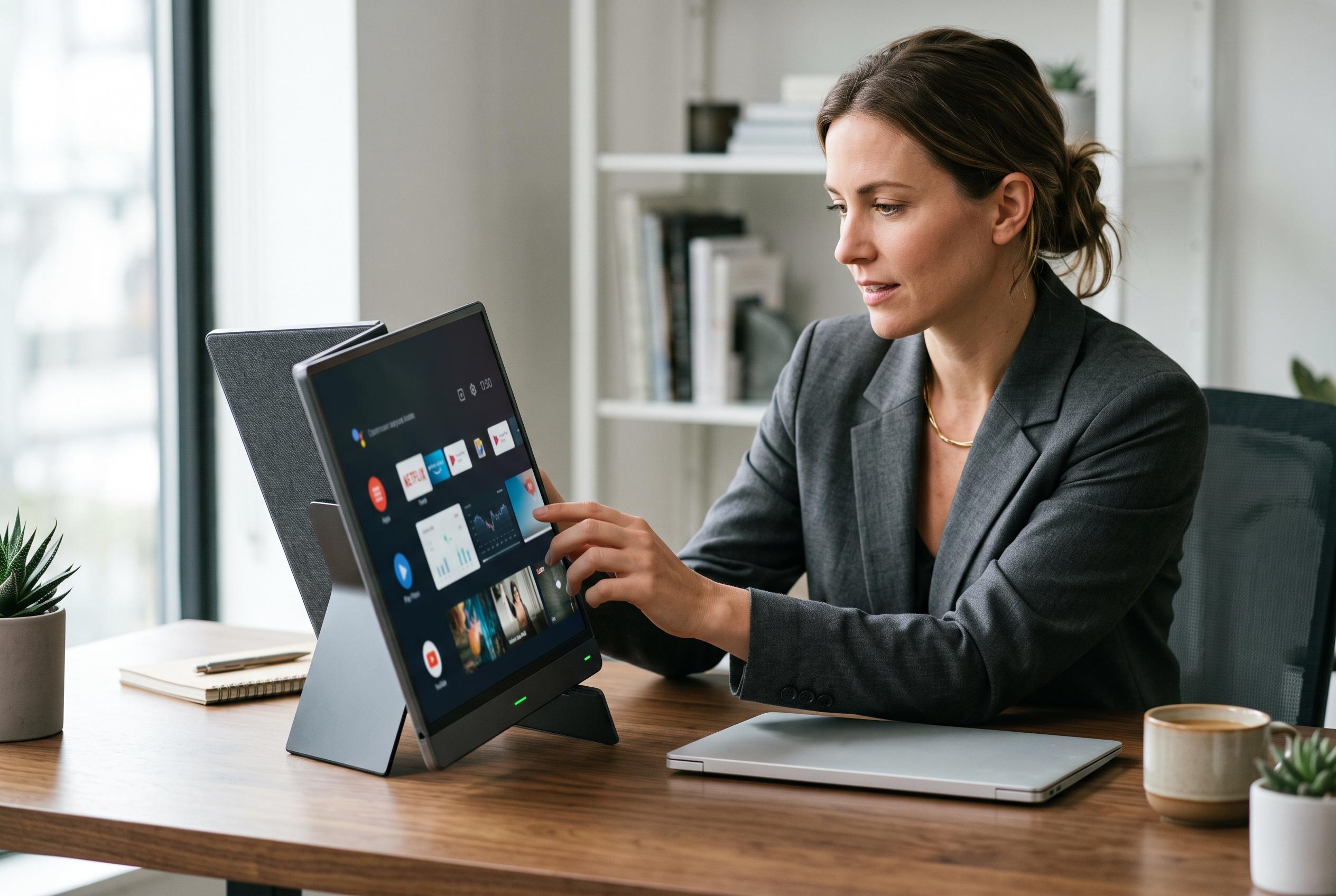
The hardware is built around a 32-inch VA LCD panel with 4K resolution, 10-point touch, 300 nits of brightness and a claimed 3,000:1 contrast ratio on the Ultra HD model. Apolosign says the unit runs Android, with 16GB of memory presented as 8GB of physical RAM plus 8GB of virtual memory, and 256GB of storage on the 4K version. TechRadar and AppleInsider both note the Rockchip RK3576 processor, Wi-Fi 6, Bluetooth 5.3 and a 15,000mAh battery, while the company highlights USB-A, USB-C and HDMI connectivity, along with dual microphones, dual 5W speakers and an 8-megapixel camera.
The design is one of the product’s strongest elements. The off-white enclosure looks more like a piece of home furniture than AV equipment, and the wheeled stand gives it genuine room-to-room utility on hard floors. The screen can tilt, swivel and rotate into portrait mode, while the cable routing through the column keeps the floor clear. That said, TechRadar notes that the fully assembled unit weighs about 22kg and is not something you would move casually, while the review unit described by MightyGadget required careful handling during assembly because the screen is awkward to mount.
Software is where the device earns its place. The Google-certified Android build brings proper access to the Play Store and mainstream streaming apps, which matters because the panel supports Widevine L1. That means services such as Netflix and Prime Video can run at full resolution, unlike on many cheaper Android signage products. The launcher is geared towards quick access to media, whiteboard functions, casting and productivity tools, making the screen useful for presentations, shared calendars and ad hoc collaboration as well as entertainment.
Performance, however, remains modest. Benchmarks cited by MightyGadget point to a machine that is adequate for streaming, note-taking and light browsing, but not for heavy multitasking or gaming. TechRadar reaches a similar conclusion, comparing the experience to that of a low- to mid-range tablet rather than a high-end smart display. In day-to-day use, the limitation is less about catastrophic slowdown than about hesitation: web pages take longer to load, and more demanding apps do not feel especially fluid.
Display quality is good enough for the product’s intended role, but not exceptional. The 4K panel looks sharp and the touch layer is responsive, yet brightness is limited and uniformity is not perfect, with the lower portion of the screen appearing darker on plain white backgrounds. That will matter in bright rooms, especially if the screen is expected to function as signage. Colour accuracy is fine for video and general use, but not ideal for creative work. The battery life claim of up to six hours also appears realistic only at moderate brightness; TechRadar found over eight hours in mixed use, while the battery is still best understood as a way to remove cable dependence rather than enable all-day untethered operation.
There are also a few clear compromises. AppleInsider and MightyGadget both highlight the lack of AirPlay support, which makes the device awkward for households or offices built around Apple hardware. The speakers are usable for speech, but not much more, and the camera arrangement is more practical in portrait than in landscape, which is an odd decision for a product aimed at video calls. Even so, the combination of touchscreen, battery, wheels and Google-certified Android remains unusual at this price. Apolosign’s own positioning suggests a broad consumer device, but the sharper value case is for organisations that need a screen they can move without re-installing anything each time.
Disclaimer: This content is intended for informational purposes only. Readers are advised to exercise their own judgement, conduct due diligence, or consult a qualified expert before acting on any information provided.