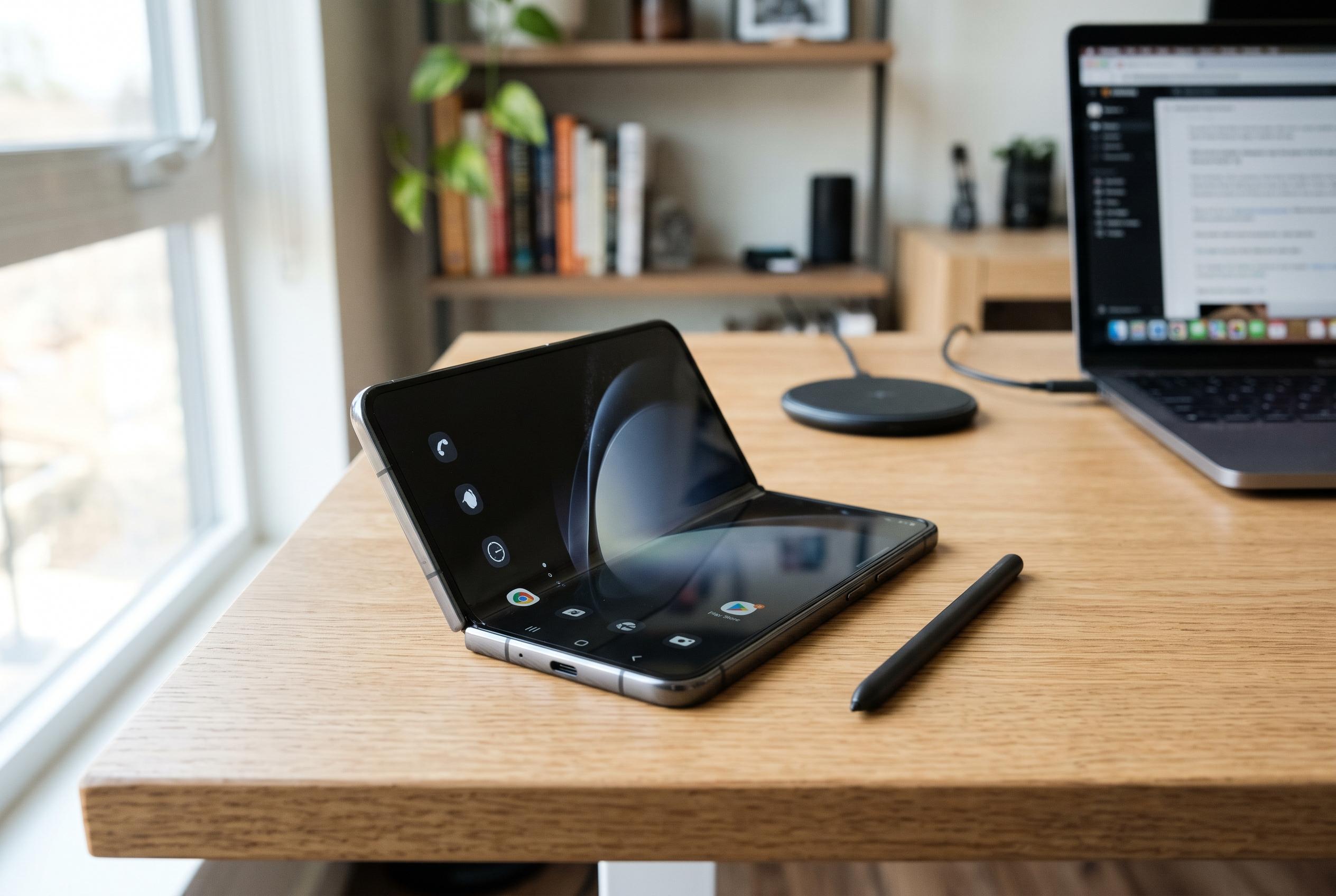

Hands-on testing suggests Apple’s debut foldable beats Samsung’s Galaxy Z Fold 8 on display refinement, durability, performance, battery life and stylus support.
Apple’s first foldable has arrived with a clear ambition: to make the category feel more finished, less experimental and easier to live with. According to Tom’s Guide’s hands-on review, that goal is already visible in the iPhone Duo, which is presented as a first-generation device that still manages to outclass Samsung’s Galaxy Z Fold 8 in several practical areas. The comparison matters because Samsung has had years to refine the foldable formula, yet Apple appears to have focused its debut on the weak points buyers notice most.
The most obvious advantage is the screen itself. Tom’s Guide says the Duo’s inner display has a crease that is far harder to detect than the Fold 8’s, and its anti-reflective nano-texture coating also cuts down glare far more effectively. In use, that makes the panel easier to read in bright conditions and gives the fold a flatter feel under the finger, which is exactly the kind of refinement that can make a foldable feel less like a compromise.
App behaviour is another area where Apple seems to have gained ground quickly. Tom’s Guide notes that a number of popular apps make stronger use of the Duo’s larger display than they do on Samsung’s foldable, where Android’s larger-screen software support remains uneven. Instagram is cited as one example of an app that can show video and comments side by side, suggesting Apple has already persuaded more developers to adapt their interfaces to the expanded canvas.
Apple has also brought its own version of split-screen folding behaviour to the device. Tom’s Guide describes a “Flex mode”-style layout that repositions controls and content when the phone is half-open, allowing video to sit on the upper half while playback controls move below. The result is a more polished use of the hinge position than the reviewer found on the Galaxy Z Fold 8, whose hinge was described as less cooperative when propped at intermediate angles.
Durability is a more measurable win. The iPhone Duo carries an IP68 rating, which means it is protected not only against water but also against dust ingress, while the Galaxy Z Fold 8 is rated IP48. That difference matters for a foldable, where fine particles are one of the most persistent long-term risks. Tom’s Guide argues that the tighter seal on Apple’s device should offer greater reassurance for buyers concerned about wear from everyday use.
Performance also appears to favour Apple by a significant margin. Tom’s Guide says the Duo’s A20 Pro chip beats the Fold 8 in Geekbench’s single-core and multi-core tests, and pulls further ahead in sustained graphics workloads. In the publication’s 3DMark Solar Bay Unlimited test, the Duo averaged 62.3 frames per second versus 47.35fps for Samsung’s phone, a gap large enough to be noticeable in demanding games and extended workloads alike.
Battery life is the other area where Apple’s foldable stands out. Although the two phones have very similar battery capacities, Tom’s Guide reports that the Duo lasted 13 hours and 20 minutes in its custom battery drain test, compared with 10 hours and 6 minutes for the Galaxy Z Fold 8. That is a substantial real-world advantage, especially for a device category known for heavy power demands from large internal displays.
Finally, Apple has given the Duo an input advantage that Samsung no longer matches in the same way. Tom’s Guide says Apple Pencil USB-C support adds note-taking, sketching and markup capabilities that remain especially useful on a device with a large folding screen. Samsung, by contrast, has removed S Pen compatibility from the Fold 8’s main display in the interests of making the handset thinner and lighter, a trade-off that leaves Apple with more flexibility for users who still want stylus support.
Disclaimer: This content is intended for informational purposes only. Readers are advised to exercise their own judgement, conduct due diligence, or consult a qualified expert before acting on any information provided.