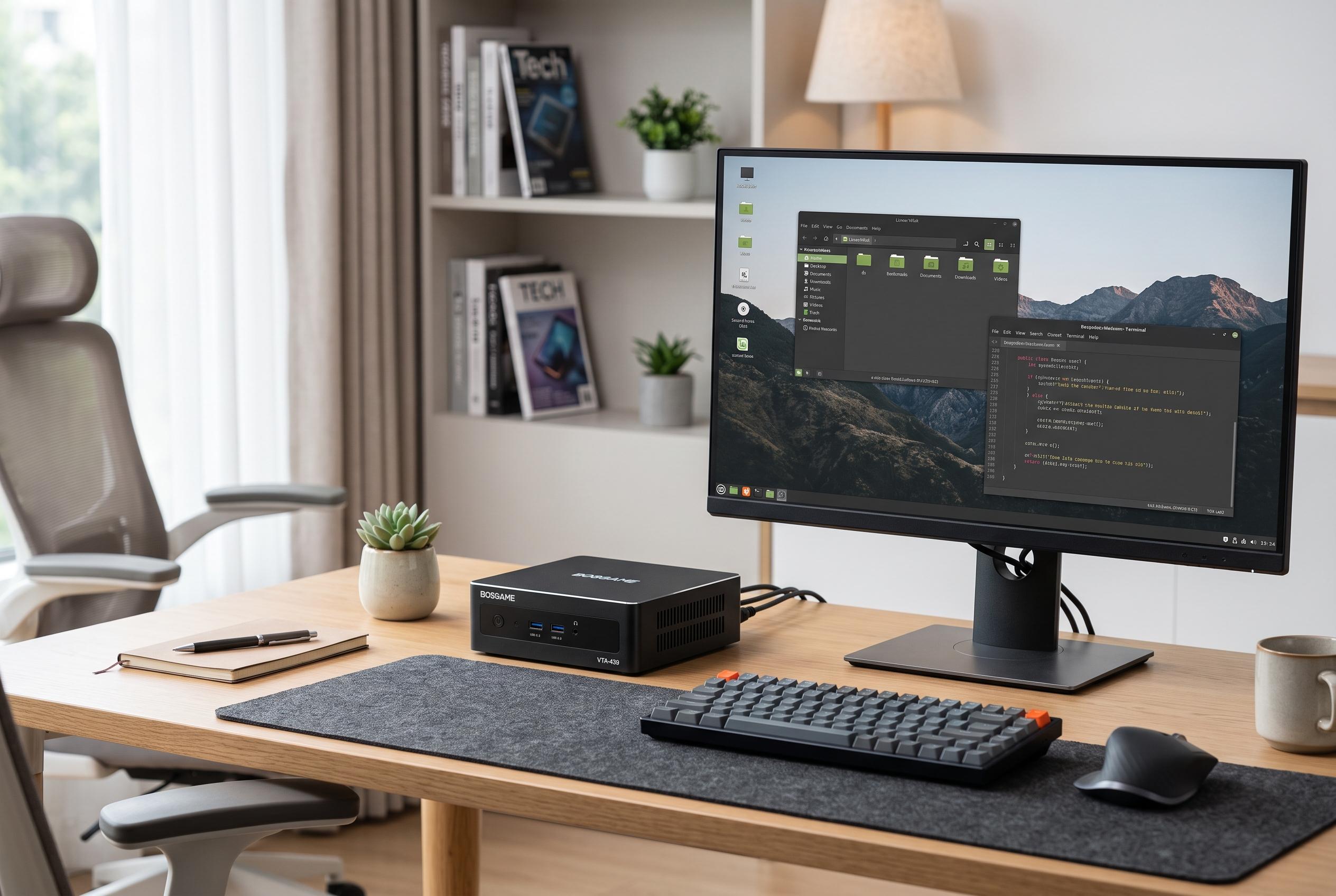

Taran Rampersad reviews the Bosgame VTA-439, highlighting its robust build, Linux compatibility, and suitability for local AI inference, gaming, and compact workstation use.
Taran Rampersad says the BOSGAME VTA-439 has proved to be a capable small-form-factor machine for Linux, gaming and local AI work, with the unit arriving in sound condition despite signs that customs had inspected the outer packaging. He describes the chassis as solidly built, with straightforward access to the internals and a layout that favours practical use rather than cosmetic flourish.
His main reason for buying it was to explore local large language models, where he argues Linux has clear advantages over Windows in memory overhead and background load. That view is consistent with Phoronix’s review of the VTA-439, which found the system well suited to Linux and highlighted its Ryzen AI 9 HX 470 processor, 32GB of DDR5-5600 memory, 1TB NVMe storage and upgrade paths for both RAM and SSD capacity. Phoronix also noted dual 2.5G Ethernet ports and Wi-Fi 7 support, both of which strengthen its case as a compact workstation.
Rampersad first backed up the factory Windows 11 installation, a process he says was slowed by setup prompts, updates and repeated consent screens. He then moved to Ubuntu 26.04 LTS, which he says installed cleanly and quickly. That experience mirrors LinuxLinks’ account of the same machine, which found Ubuntu 24.04 LTS, Ubuntu 26.04 LTS and CachyOS all workable on the VTA-439 once Secure Boot was disabled in firmware, with networking and Bluetooth detected automatically.
After the operating system change, he added LibreOffice, Steam and Ollama, then tested the machine with Homeworld titles. He reports that the games ran without issue and that the cooling system only became audible intermittently. He also points out that the VTA-439’s OCuLink support gives it a direct PCIe-class connection for external graphics hardware, which makes the system more flexible than many mini PCs that rely only on USB4 or Thunderbolt-class links.
For the AI workload, Rampersad downloaded an Olmo-3 32B model and found that Ollama did not immediately make full use of the hardware. He adjusted software settings and firmware memory allocation to improve use of the integrated AMD graphics, which he says removed bottlenecks rather than adding raw speed. That emphasis on local inference matches BOSGAME’s own launch material and third-party coverage from PR Newswire and Technetbook, both of which frame the VTA-439 as a mini PC aimed at on-device AI tasks, with a 55 TOPS NPU based on AMD’s XDNA 2 architecture and support for models, transcription and other offline workloads.
Disclaimer: This content is intended for informational purposes only. Readers are advised to exercise their own judgement, conduct due diligence, or consult a qualified expert before acting on any information provided.