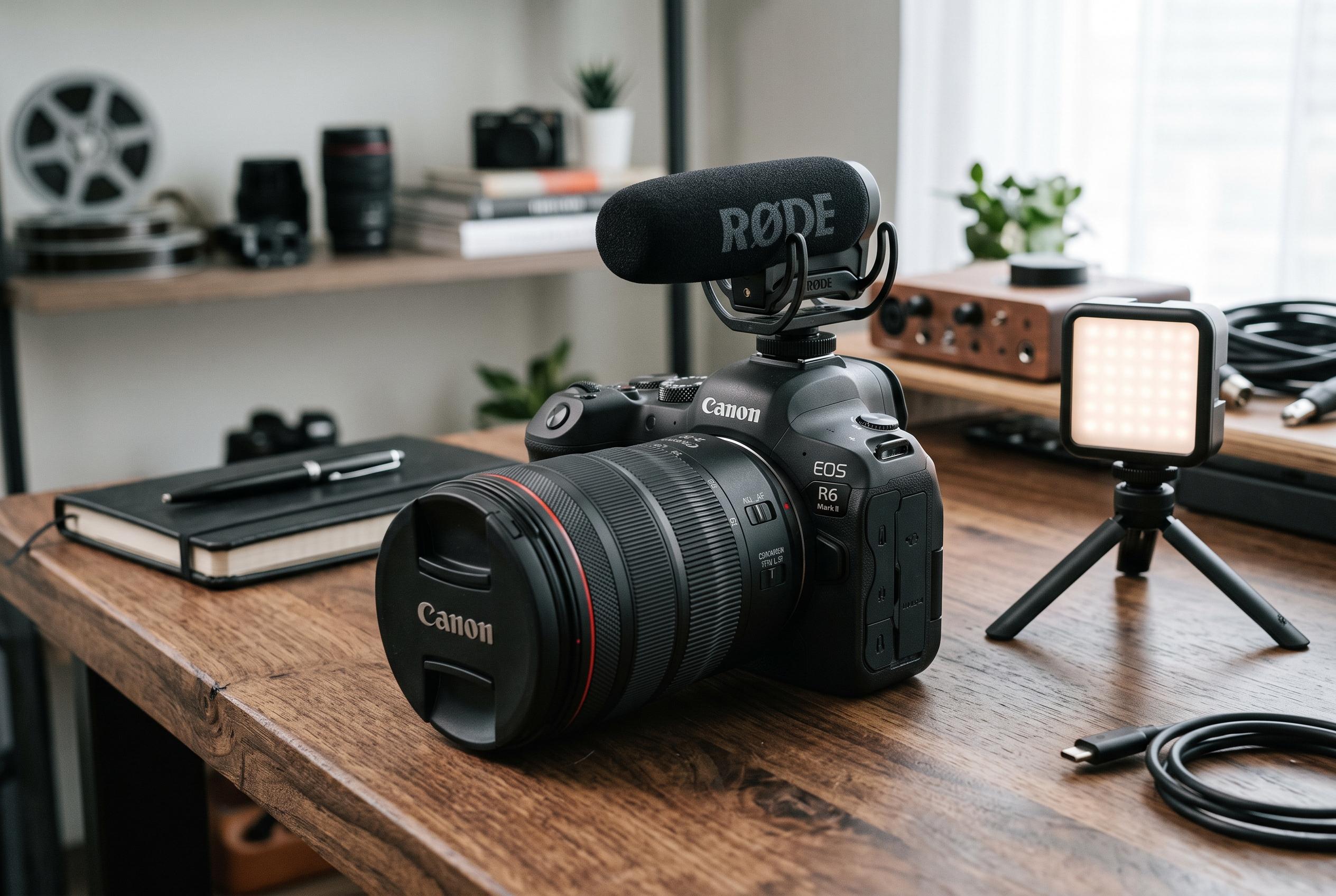

Canon’s new EOS R6 V bridges stills and videography with advanced 7K RAW recording, active cooling, and stabilisation, targeted at creators prioritising portable, high-quality video production.
Canon’s EOS R6 V is a deliberate step towards video-first creation, positioned between the stills-led EOS R6 Mark III and the more fully fledged Cinema EOS C50. Built around the same 32.5-megapixel full-frame sensor, it pares back some photographer comforts in favour of a boxier body, active cooling and a recording specification aimed at creators who need high-quality footage quickly. According to Canon’s launch details, the camera removes the electronic viewfinder and mechanical shutter to make room for a fan and a more compact cinema-style form factor.
The headline specification is its video capability. The R6 V offers 7K internal RAW recording, 3:2 open-gate capture and oversampled 4K at up to 120fps, with Canon also promising more than 15 stops of dynamic range. Reviewers have highlighted the practical value of open-gate recording for reframing in post and for producing vertical content for social platforms, while noting that the camera can also be used for slower, more considered productions thanks to its full-frame readout and high-data-rate codecs.
That video focus comes with clear trade-offs. There is no viewfinder and no mechanical shutter, which makes the R6 V less attractive for traditional stills work and for flash photography. Amateur Photographer said the rear screen is usable but not especially bright, which is a drawback in direct sunlight, while Computer Bild noted that photographers who rarely shoot video are better served by the EOS R6 Mark III, which retains the more conventional handling and larger viewfinder.
Where the R6 V appears strongest is in stabilisation and autofocus. Canon’s Dual Pixel CMOS AF II system is widely described as fast and dependable, with subject detection and eye tracking making it easy to keep a face sharp during vlogging or run-and-gun shooting. The in-body stabilisation is another major advantage over the Cinema EOS C50, and third-party reviews put the quoted compensation at up to 8.5 stops, which helps handheld work remain steady without immediately reaching for a gimbal.
The camera also looks well judged on connectivity and endurance. Canon includes CFexpress Type B and UHS-II SD card slots, a full-size HDMI port, USB-C, microphone and headphone sockets, and a front-mounted record button for easier self-shooting. The R6 V uses the LP-E6P battery, with Canon warning that older LP-E6 variants can restrict features, and the company quotes around 640 shots per charge. At $2,499, or £2,199.99 body-only, it lands in a competitive part of the market, undercutting some rivals while sitting close to other creator-focused full-frame models.
For buyers, the choice is therefore unusually clear. Photographers will usually still find the EOS R6 Mark III the more complete tool, while filmmakers and content creators are more likely to appreciate the R6 V’s cooling system, open-gate capture, RAW options and stabilised body. The main compromise is a dated screen and the absence of an EVF, but for users who value portability and video flexibility over conventional stills handling, the camera is one of Canon’s most focused hybrid designs to date.
Disclaimer: This content is intended for informational purposes only. Readers are advised to exercise their own judgement, conduct due diligence, or consult a qualified expert before acting on any information provided.