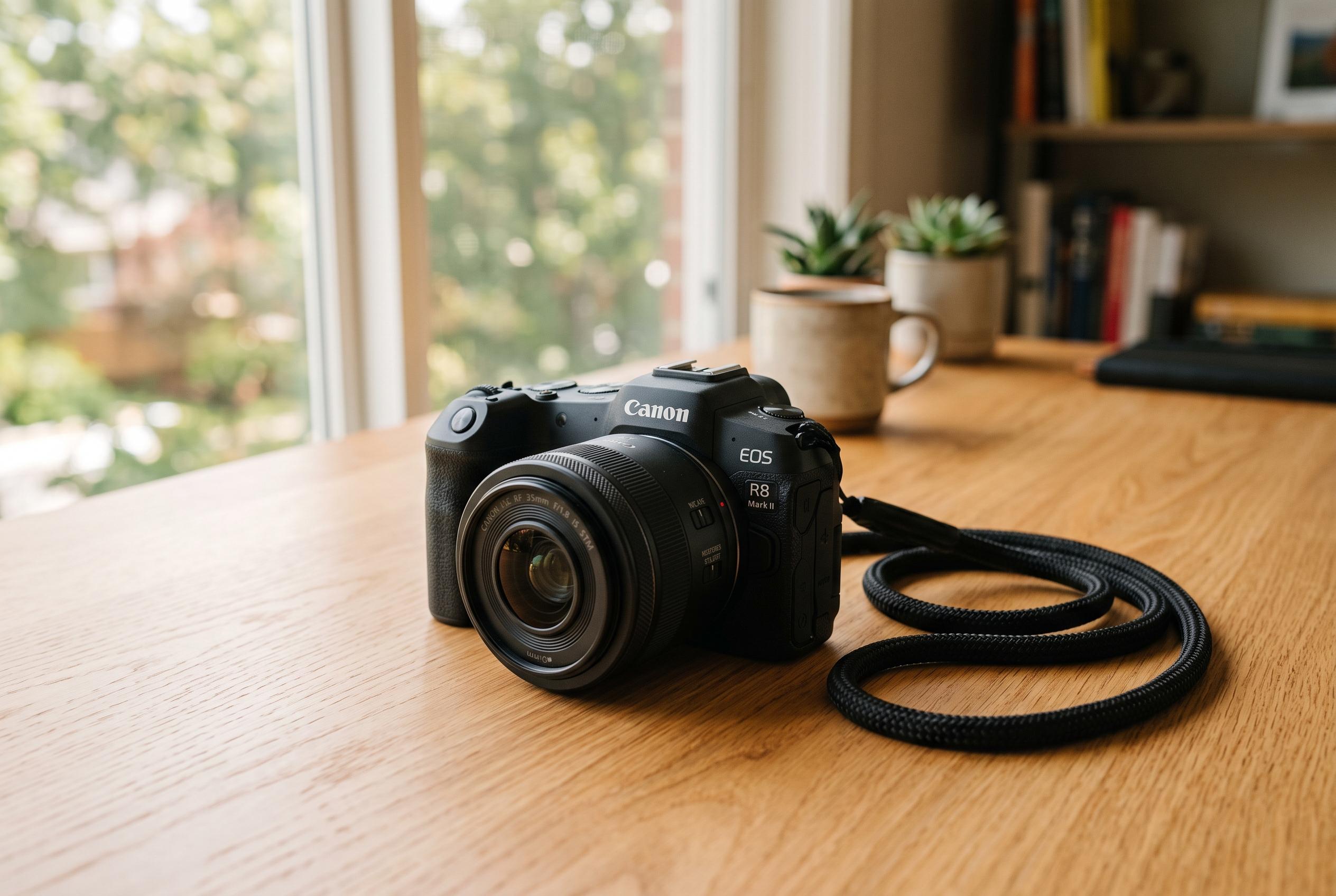

Canon’s EOS R8 Mark II offers significant upgrades over its predecessor, including in-body image stabilisation, improved autofocus, and enhanced video capabilities, positioning it as the most comprehensive compact full-frame camera in Canon’s lineup.
Canon’s EOS R8 Mark II is not a light refresh. It is a more substantial revision of the company’s compact full-frame line, aimed at photographers and creators who wanted the original model’s size without its missing stabilisation and control joystick. The new body keeps the 24.2-megapixel full-frame sensor and Digic X processor, but adds in-body image stabilisation, improved autofocus behaviour and a more usable control layout. Canon U.S.A. says the camera is the lightest EOS with IBIS, at about 1.2lb, while still offering a full-frame body small enough to appeal to hobbyists, advanced users and first-time full-frame buyers.
The biggest practical change is the addition of stabilisation. Canon rates the five-axis IBIS system at up to 7.5 stops in the centre of the frame, with peripheral suppression on wide-angle lenses, which directly addresses one of the original R8’s main weaknesses. The Mark II also adds an AF joystick, pre-continuous shooting and Canon’s Register people priority function, while autofocus now works down to EV -7.5. Canon says burst performance has improved too, with a 30% rise in uninterrupted RAW shooting and a 58% increase in JPEG shooting compared with the earlier body.
Video handling has also been widened. According to Canon’s announcement and reviews from Digital Camera World and DPReview, the R8 Mark II supports uncropped 6K oversampled 4K at up to 60p, uncropped Full HD 180p with audio support, and a Slow and Fast mode. It also adds more flexible white-balance tools, a tally light, a dedicated memory-card door and a C3 custom mode. Canon has even changed the exterior styling slightly, giving the body a more retro, rounded look and a new grip surface.
The original EOS R8 still has one clear advantage: price. The Mark II launches at around $1,899 body-only in the United States, while the earlier camera remains on sale at a lower level and may become more attractive when discounted. CameraLabs notes that the new model sits between the original R8 and the R6-series bodies, but also in a crowded segment where discounted rivals can sometimes match its price. That means buyers are no longer comparing it only with Canon’s own cameras, but also with older full-frame alternatives from Sony, Nikon and Panasonic.
Even so, the balance of value appears to favour the newer body for most people. The original R8 is lighter and cheaper, but the Mark II closes the most obvious gaps and adds enough operational improvements to make it the stronger all-round camera. For anyone who wanted the R8 concept with proper stabilisation, a joystick and better burst handling, the Mark II is the more complete package.
Disclaimer: This content is intended for informational purposes only. Readers are advised to exercise their own judgement, conduct due diligence, or consult a qualified expert before acting on any information provided.