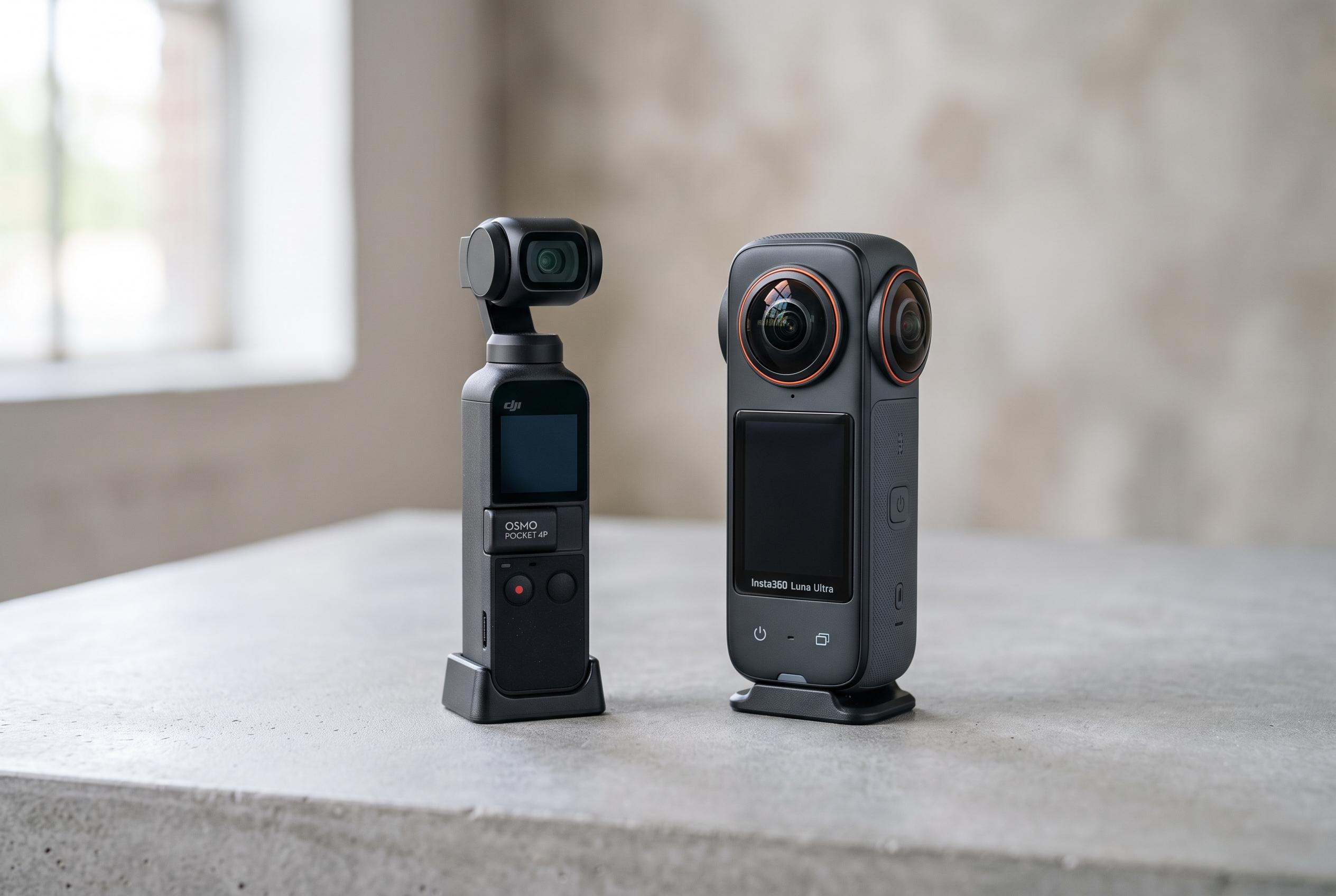

A detailed comparison between DJI’s Osmo Pocket 4P and Insta360’s Luna Ultra highlights that choice hinges more on workflow and ecosystem support than raw image capability, with recent updates and features redefining user preferences.
The latest head-to-head between DJI’s Osmo Pocket 4P and Insta360’s Luna Ultra suggests the choice is less about raw capability than workflow. In a comparison published by DroneXL, creator Jake Sloan said the two pocket gimbal cameras are closer in image quality than many buyers might expect, with the decision often hinging on colour pipeline, zoom behaviour, tracking and ecosystem support rather than one clear overall winner.
On image quality, both cameras appear strongest when used in their 10-bit log modes. Sloan said DJI’s D-Log and Insta360’s I-Log produce broadly similar results in standard use, with comparable dynamic range and broadly similar colour response once graded. He said the Pocket 4P pulls ahead in its D-Log 2 mode on the main 20mm camera, where highlight retention is noticeably stronger. That lines up with early reviews of the Pocket 4P, which described its 1-inch main sensor and LOFIC technology as a major step forward for compact-camera dynamic range.
The Insta360 camera still brings its own advantages. Gizmochina and Tom’s Guide both noted that the Luna Ultra is built around a dual-lens design, a detachable 2-inch touchscreen remote and an 8K recording option. Sloan said its HDR workflow with Dolby Vision also gives it a strong wide-dynamic-range option, even if he personally preferred DJI’s D-Log 2 for maximum grading latitude. In everyday shooting, however, he found the two cameras close enough that normal colour mode may be all most users need.
Slow motion is one of the clearest points of separation. Sloan said the Pocket 4P can shoot up to 4K at 240 frames per second, while the Luna Ultra tops out at 4K at 120fps and 1080p at 240fps. But he also pointed out an important limitation: the Pocket 4P cannot record slow motion in log mode, while the Luna Ultra can. For creators who want both grading flexibility and motion capture, that makes Insta360’s approach more practical, even if DJI has the higher headline frame rate.
The lens setup also shapes how each camera feels in use. DJI’s Pocket 4P uses a 20mm main camera and a 60mm telephoto lens, while the Luna Ultra pairs its main lens with a telephoto option of its own. Sloan said DJI’s wider aperture on the telephoto unit produces shallower depth of field, while Insta360’s optical choices are designed to keep the transition between lenses more balanced. Both cameras also support crop-based zoom steps, but he said the 1x and 3x views are where image quality remains most dependable.
For solo creators, handling may matter more than image theory. Reviews of the Luna Ultra praised its detachable screen as a wireless remote that makes framing easier when filming alone, while DJI’s ActiveTrack 8.0 and compact grip have been highlighted as strong advantages for handheld shooting. Sloan said both cameras track subjects well, but the Pocket 4P adds a subject-recognition trick that can help it follow a chosen person in a crowd. DJI also offers 103GB of internal storage, compared with 47GB on the Luna Ultra, which gives it more room if a memory card is left behind.
There are, however, trade-offs beyond imaging. Sloan said Insta360’s removable screen retains more on-camera control than DJI’s compact remote, while DJI’s FrameTap accessory reaches much farther at distance. He also praised Insta360’s included case and magnetic filter approach, while noting that DJI offers no similar protective carry solution. The biggest practical issue for US buyers remains availability: according to the comparison, the Pocket 4P is not officially sold in the United States, while the Luna Ultra is available there and globally.
For now, the verdict is straightforward. The Pocket 4P looks like the stronger choice for users who want DJI’s colour tools, longer reach through its wireless control system and the broadest dynamic range in its best log mode. The Luna Ultra appears better suited to creators who value an integrated, solo-friendly design, wider retail availability and the flexibility of slow motion in log recording. As Sloan put it, these are both highly capable pocket cameras, and the better buy depends less on specs than on how each one fits a creator’s working habits.
Disclaimer: This content is intended for informational purposes only. Readers are advised to exercise their own judgement, conduct due diligence, or consult a qualified expert before acting on any information provided.