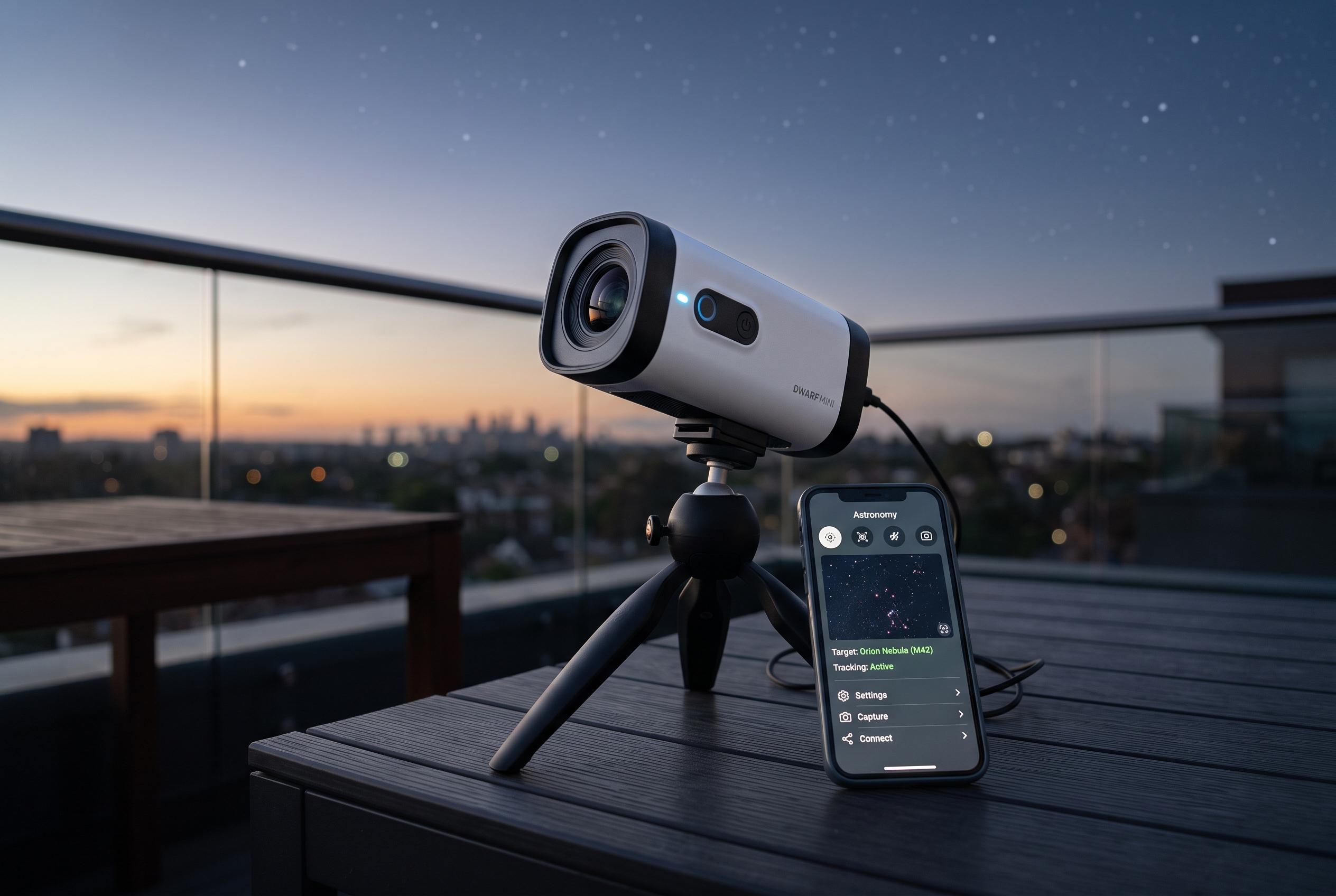

DwarfLab’s Dwarf Mini offers a compact, app-controlled telescope that broadens access to astrophotography and scenic viewing, combining portability with sophisticated imaging features for beginners and enthusiasts alike.
DwarfLab’s Dwarf Mini shows how far smart-telescope design has come in making amateur astronomy more accessible. Frandroid’s hands-on test describes a device that costs a little over €400, yet is small enough to carry almost anywhere and simple enough for newcomers to use without owning a full observatory’s worth of equipment. That positioning places it among a growing class of app-controlled telescopes aimed at people who want quick results rather than traditional manual observing. According to DwarfLab, the telescope is designed not only for astrophotography but also for birdwatching and scenic viewing, underlining how broadly the company wants to frame the product.
The Mini’s appeal starts with its size. Frandroid said the unit arrived in a remarkably small box and measured only 100.38 x 183.61 x 60.70 mm, which makes it far easier to transport than conventional telescopes. DwarfLab lists the device at 840g, and several reviews describe it as pocket-sized or flask-sized, a contrast with heavier entry-level astronomy kit that can be awkward to carry and set up. The package includes a USB-C cable, a cleaning cloth, a manual and, notably, a solar filter, which some rivals sell separately.
Operation depends on the DWARFLAB app, and that is where the product becomes more ambitious than a simple telescope. Frandroid found the pairing process easy, with no need to dig through the phone’s Wi-Fi settings, but the broader interface took some getting used to. The software offers guided sky searching, an atlas view, manual targeting and a range of capture modes for deep-sky objects, the Moon, the Milky Way and star trails. Live Science noted that the telescope automatically aligns itself with the sky before stacking short exposures into a progressively cleaner image, which is the core trick behind this product category.
The hardware is modest by the standards of larger telescopes, but it is unusually versatile for the price. Notebookcheck reported a Sony IMX662 sensor paired with a 150 mm telephoto lens, while the wide-angle module is used for landscapes, star trails and Milky Way shots. Frandroid said this dual-camera arrangement allows the Mini to handle a wide range of scenes, including solar photography with the supplied filter. The trade-off is clear: the optics are not large enough for serious planetary detail, so the telescope works best as an entry-level astrophotography tool rather than a replacement for more specialised equipment.
Image quality depends heavily on software processing. Frandroid found that single captures could look noisy and flat, but the built-in Stellar Studio retouching tools made a major difference, lifting contrast and sharpening detail. The app also supports longer sessions and multi-night stacking, which can produce much stronger results when many frames of the same target are combined. Wallpaper and Digital Camera World both highlighted stacking, 90-second exposures and sky-atlas guidance as key features, while Frandroid said the telescope can also create mosaics by sweeping across a wider section of sky.
There are limits, however, and battery life is one of the most obvious. DwarfLab says the internal battery lasts up to four hours, but Frandroid reported closer to three hours in real use, particularly when changing targets frequently. Notebookcheck similarly said the theoretical figure falls in longer stacking sessions, where the battery can run down after roughly two hours. That means the Mini is better suited to short observing sessions or to use with an external power source. Even so, for readers looking for an affordable first step into connected astronomy, the Dwarf Mini appears to offer a convincing balance of portability, automation and image quality for the money.
Disclaimer: This content is intended for informational purposes only. Readers are advised to exercise their own judgement, conduct due diligence, or consult a qualified expert before acting on any information provided.