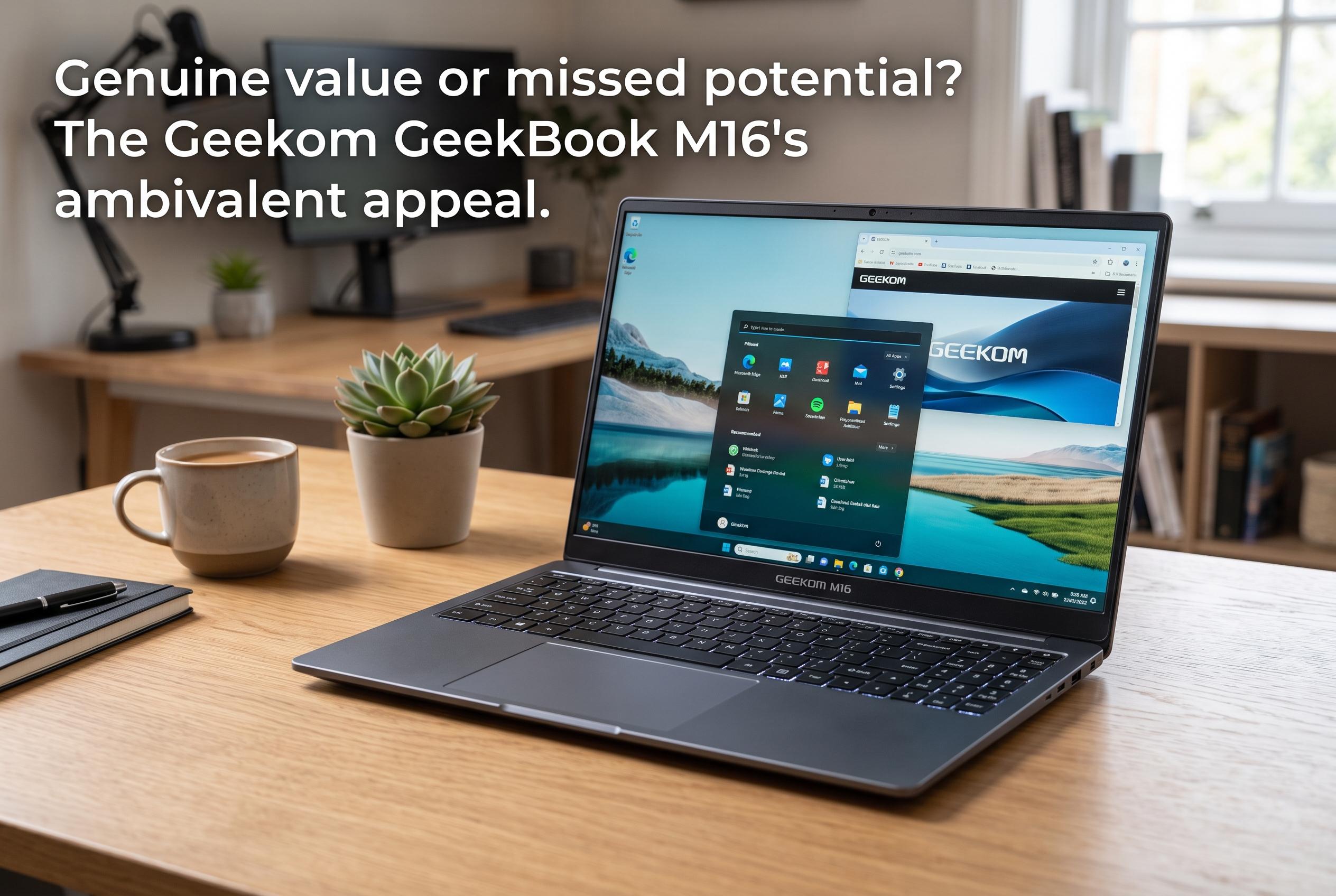

The Geekom GeekBook M16 offers strong battery life and decent performance for its price, but its display and upgrade limitations highlight its compromises, making it a cautious choice for productivity users.
Geekom’s GeekBook M16 is a reminder that a well-built 16-inch laptop can still miss the mark on fundamentals. In Igor’sLab’s test, the machine combined a carved aluminium chassis with an Intel Core Ultra 9 185H-class processor, 16GB of memory and a 512GB SSD, and it largely delivered where it mattered most: everyday speed, sensible acoustics and strong battery life. At a launch price of €729 for the reviewed configuration, it also sat well below some competing machines with similar hardware.
The chassis makes a solid first impression. The metal body feels restrained rather than flashy, the surface resists fingerprints well, and the keyboard includes backlighting plus a fingerprint reader in the power button. Geekom also supplies a useful USB-C dock with Ethernet, HDMI and pass-through charging, which partly offsets the lack of built-in wired networking. That omission is still difficult to justify on a 16-inch notebook, especially one aimed at productivity users.
The display is the most conflicted part of the package. The 16-inch 1,920 x 1,200 IPS panel is usable in daily work, but it ships with a very cool white point of around 9,600K and only 74.8% sRGB coverage, which leaves colours visibly off. After calibration, the panel improves sharply, reaching 95.5% sRGB with an average Delta E 2000 of 0.77, although some inaccuracies remain and the panel homogeneity is only satisfactory. Notebookcheck’s assessment is more favourable overall, but it similarly frames battery life and build quality as the key strengths rather than the screen.
Performance is competent rather than exceptional. The GeekBook M16 kept pace with comparable mini-PCs using the same processor, and it handled office workloads, media playback and light gaming without trouble. In Igor’sLab’s tests, Counter-Strike 2 averaged 127.47 fps and Grand Theft Auto V 134.67 fps under reduced settings, while Rainbow Six Siege X reached 66.34 fps. Thermals were less comfortable under sustained load, with CPU temperatures peaking at 103C, although the SSD stayed relatively cool at 43C and system noise remained moderate at up to 40.5dB(A).
Battery endurance is where the laptop looks strongest. Under Igor’sLab’s test conditions, which used media playback, 50% brightness and Wi-Fi, the machine lasted almost 17 hours. Notebookcheck reported similarly strong endurance from the 99.99Wh battery, describing the device as a compelling option for mobile productivity. That said, the M16 is still constrained by soldered memory, limited upgrade headroom and the absence of an integrated Ethernet port. Its appeal is clear: a decent-value, well-finished work laptop with excellent autonomy. Its weakness is equally clear: too much of the panel’s potential is left untapped at the factory.
Disclaimer: This content is intended for informational purposes only. Readers are advised to exercise their own judgement, conduct due diligence, or consult a qualified expert before acting on any information provided.