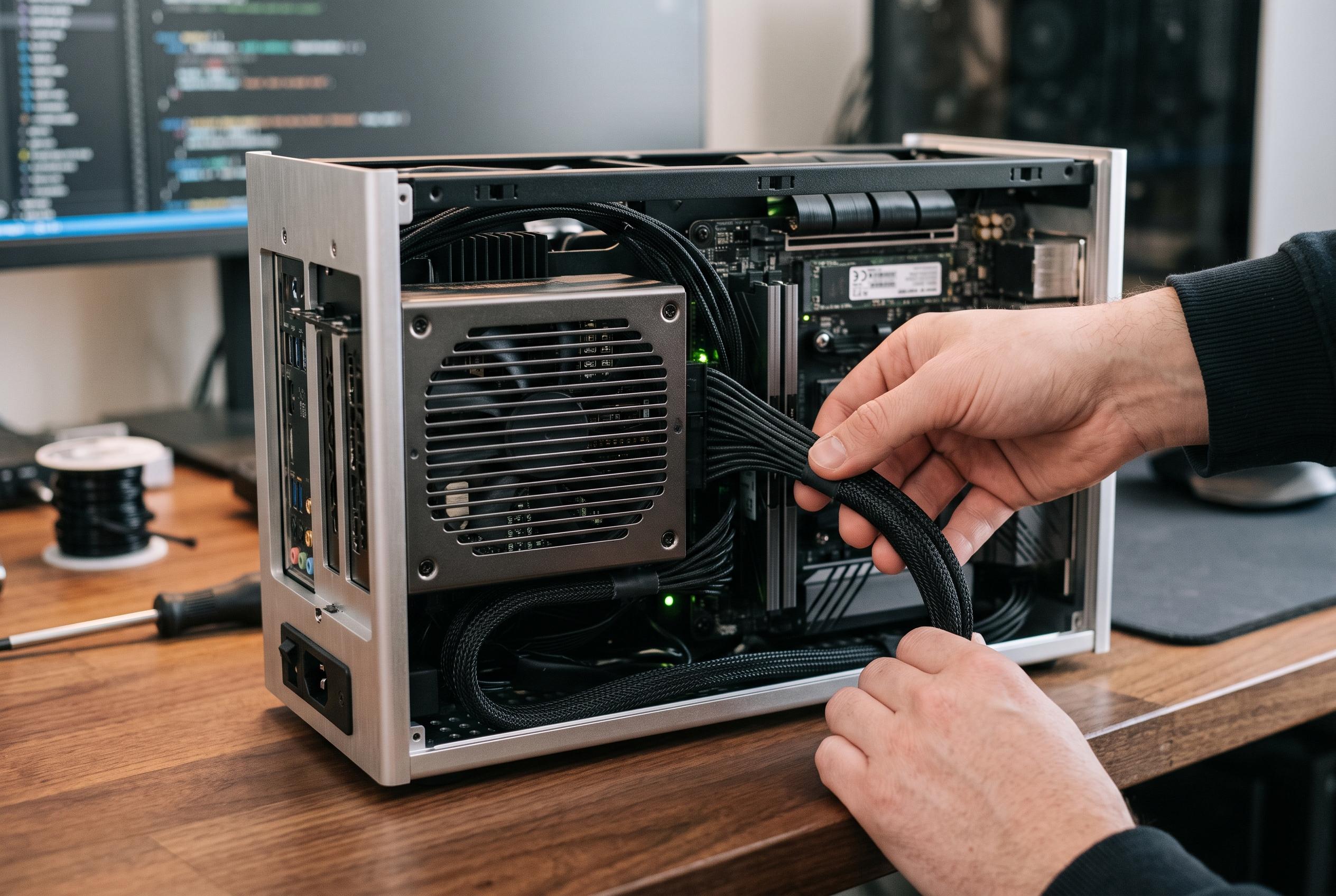

Gigabyte launches the Aorus P1600W, a compact, high-capacity, highly efficient power supply built with GaN technology and intelligent monitoring features, targeting enthusiast systems and AI workloads.
Gigabyte’s Aorus P1600W 80+ Titanium Modular PCIe 5.1 AI Top is the kind of power supply that is designed to be noticed. According to Gigabyte’s own launch materials, it delivers 1,600W in a 160mm enclosure and pairs ATX 3.1 and PCIe 5.1 support with 80 Plus Titanium efficiency, GaN-based power circuitry and real-time monitoring through an integrated LCD screen. TechTimes and KitGuru both noted that Gigabyte is positioning the unit for enthusiast systems and local AI workloads, where high output, compact dimensions and heavy-duty cabling all matter.
That compact format is one of the model’s defining traits. Lowyat reported that the Aorus P1600W keeps its footprint to 160mm despite its output, while Gigabyte says the design relies on gallium nitride components to improve power density and reduce heat. KitGuru added that the unit includes 100% Japanese capacitors, a 140mm double ball-bearing fan and a dust-clearing reverse-spin start-up mode. The same report also said the power supply is built with a full suite of protections, including over-current, over-voltage, under-voltage, short-circuit, over-temperature, over-power, no-load and surge protection.
The hardware package is clearly pitched above ordinary gaming use. Gigabyte’s press release said the Aorus P1600W is intended for enthusiast PCs and local AI systems, and the company and third-party reports say it can support multi-GPU configurations, including up to four graphics cards through native and adapter-based 16-pin cabling. TechTimes and TweakTown both highlighted the integrated full-colour LCD, which can show live power-draw data and other system information, while Gigabyte says users can customise the display through its Control Centre software or monitor consumption through its AI Top utility. That makes the screen more than a cosmetic flourish; it is also a practical diagnostic tool.
The review sample examined by MuyComputer appears to bear out that positioning. The publication said the unit felt unusually heavy and well built, with internal components visible through the ventilated base and a mirror-like side panel carrying the display. It also described a generous accessory bundle and a fully modular cable set with clearly marked connectors and wattage labels, which should simplify installation in high-end builds. The review further noted that the physical design combines subdued industrial finishes with RGB lighting, making the supply fit more naturally into showcase systems than a typical hidden PSU.
In testing, MuyComputer paired the power supply with a Ryzen 7 9800X3D and GeForce RTX 5090 FE system, a platform that is demanding enough to stress most consumer units. Under load in Cyberpunk 2077, the publication said whole-system draw peaked at 721W, leaving the Aorus P1600W working at well under half of its rated output. That operating range is important: the review found that noise remained almost imperceptible below roughly 800W, while efficiency sat near its best in the mid-to-high load band. It also reported ripple on the 12V rail staying below 30mV, which is a strong result and suggests very clean delivery for sensitive components.
Taken together, the evidence points to a power supply that is not merely specification-rich but genuinely well executed. Gigabyte has clearly built the Aorus P1600W to satisfy buyers who want top-tier efficiency, low electrical noise, strong thermal behaviour and serious headroom for future upgrades. The price is expected to be high, and the review itself acknowledged that, but it also argued that the unit makes sense for systems drawing 700W to 900W where silence and efficiency matter as much as raw capacity. For builders in that bracket, this is less a luxury indulgence than a technically credible flagship.
Disclaimer: This content is intended for informational purposes only. Readers are advised to exercise their own judgement, conduct due diligence, or consult a qualified expert before acting on any information provided.