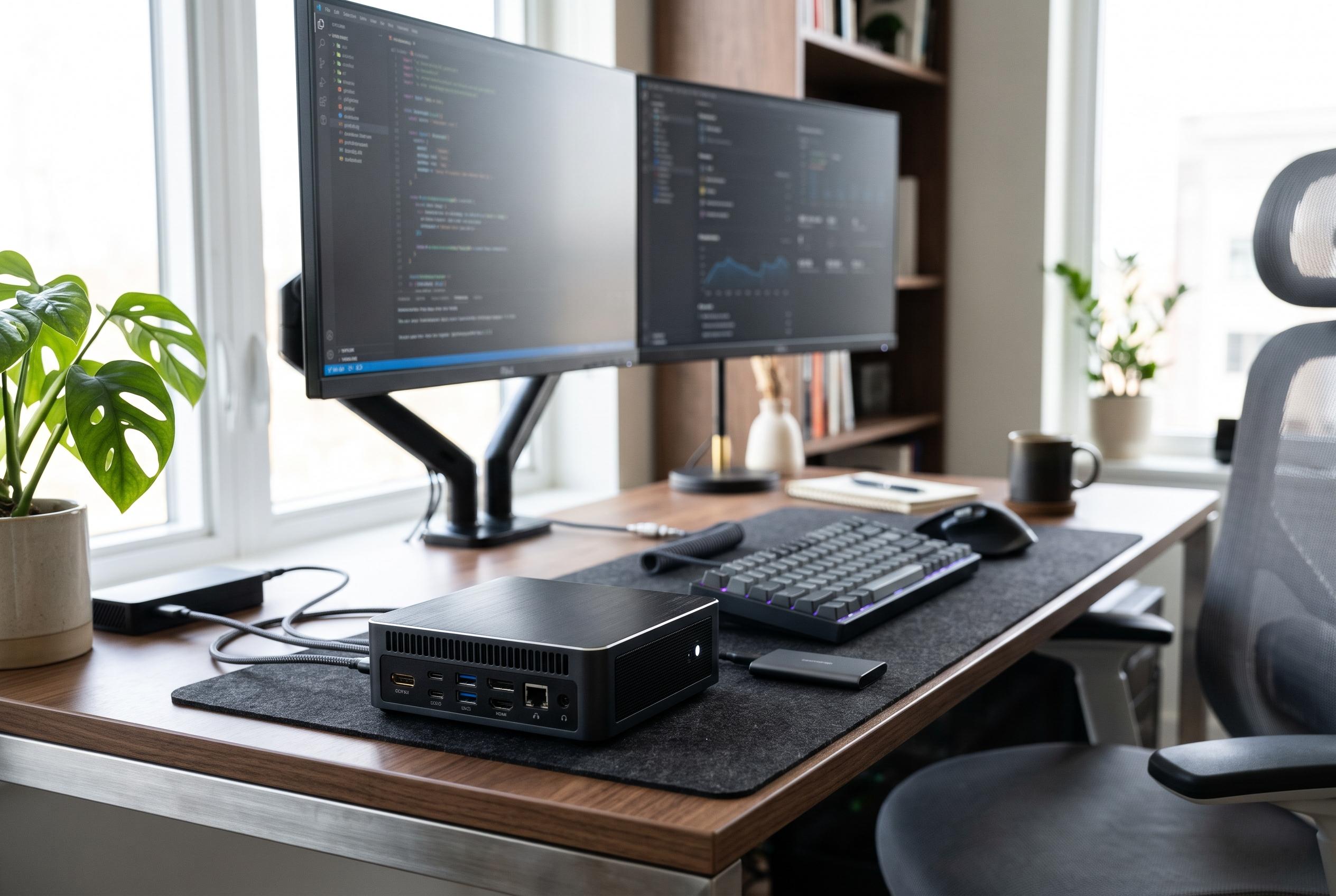

The EVO-X1 Pro delivers strong connectivity, ample memory and unusually capable integrated graphics in a compact design, but slower RAM, soldered memory and patchy support make its premium price harder to defend.
GMKtec’s EVO-X1 Pro is built around AMD’s latest refresh of the Strix Point family, marketed by AMD as Ryzen AI 400 and referred to here as Gorgon Point. In practice, it is a compact, aggressively specified mini-PC that pairs a 12-core, 24-thread processor with Radeon 890M graphics, a dedicated neural engine rated at up to 55 TOPS and enough memory and storage to make the configuration feel unusually complete at the point of sale. ComputerBase said the machine is sold from €1,499.99 with 64GB of RAM and a 1TB SSD, while a 2TB version costs only €50 more, making the larger model the more sensible purchase.
The processor itself is a modest refresh rather than a full redesign. According to ComputerBase, the chip still uses the same underlying STX1-B0 stepping as the earlier Strix Point parts, with the four full Zen 5 cores reaching up to 5.2GHz and the eight Zen 5c efficiency cores up to 3.3GHz. The integrated Radeon 890M brings 16 RDNA 3.5 compute units, and AMD’s latest graphics support matters here because the device is clearly aimed at buyers who want a small system that can do more than office work and media playback. For heavier graphics loads, GMKtec has also added an OCuLink port on the front, allowing an external desktop graphics card to be attached, although that link remains limited to four PCIe 4.0 lanes.
The memory and storage choices are notable because they reveal GMKtec’s cost-cutting strategy. ComputerBase reported that the company uses LPDDR5 at 6,400MT/s rather than faster LPDDR5X, even though the Ryzen AI 400 platform supports both DDR5 SODIMM modules and LPDDR5X up to 8,533MT/s. The review suggested the slower memory was probably chosen to keep the system affordable, especially given the unusually large 64GB capacity. The storage arrangement is more conventional: two M.2 PCIe 4.0 x4 slots are fitted, and the machine can take up to 16TB in total. TechRadar’s review similarly described the EVO-X1 Pro as a highly capable but expensive machine, noting that its non-upgradable soldered memory limits flexibility against rivals that still offer socketed RAM.
Connectivity is a major strength. ComputerBase and TechRadar both highlighted dual 2.5GbE Ethernet, WiFi 7, USB4, HDMI 2.1 and DisplayPort 2.1, alongside the OCuLink connection for external graphics. TechRadar added that the system supports triple-display output and that the cooling design stays relatively quiet even under load, although the review also stressed that the price is hard to justify when compared with cheaper HX 370-based alternatives that deliver similar day-to-day performance. That value argument is reinforced by the machine’s price in the US market, where TechRadar said the 64GB/1TB configuration sells for $1,599.99, again positioning the EVO-X1 Pro as a premium small-form-factor option rather than a budget choice.
Support, however, remains one of GMKtec’s weaker points. ComputerBase noted that the company advertises a one-year warranty and a seven-day return window for direct purchases, but also says non-defective returns are subject to a 15% repackaging or restocking fee. The review also described a fragmented support structure, with driver packages, manuals and Windows downloads split across different parts of GMKtec’s website and some links difficult to find. That leaves the EVO-X1 Pro in a familiar position for many imported mini-PCs: technically impressive, very well connected and unusually configurable for its size, but still burdened by uneven documentation and after-sales support.
Disclaimer: This content is intended for informational purposes only. Readers are advised to exercise their own judgement, conduct due diligence, or consult a qualified expert before acting on any information provided.