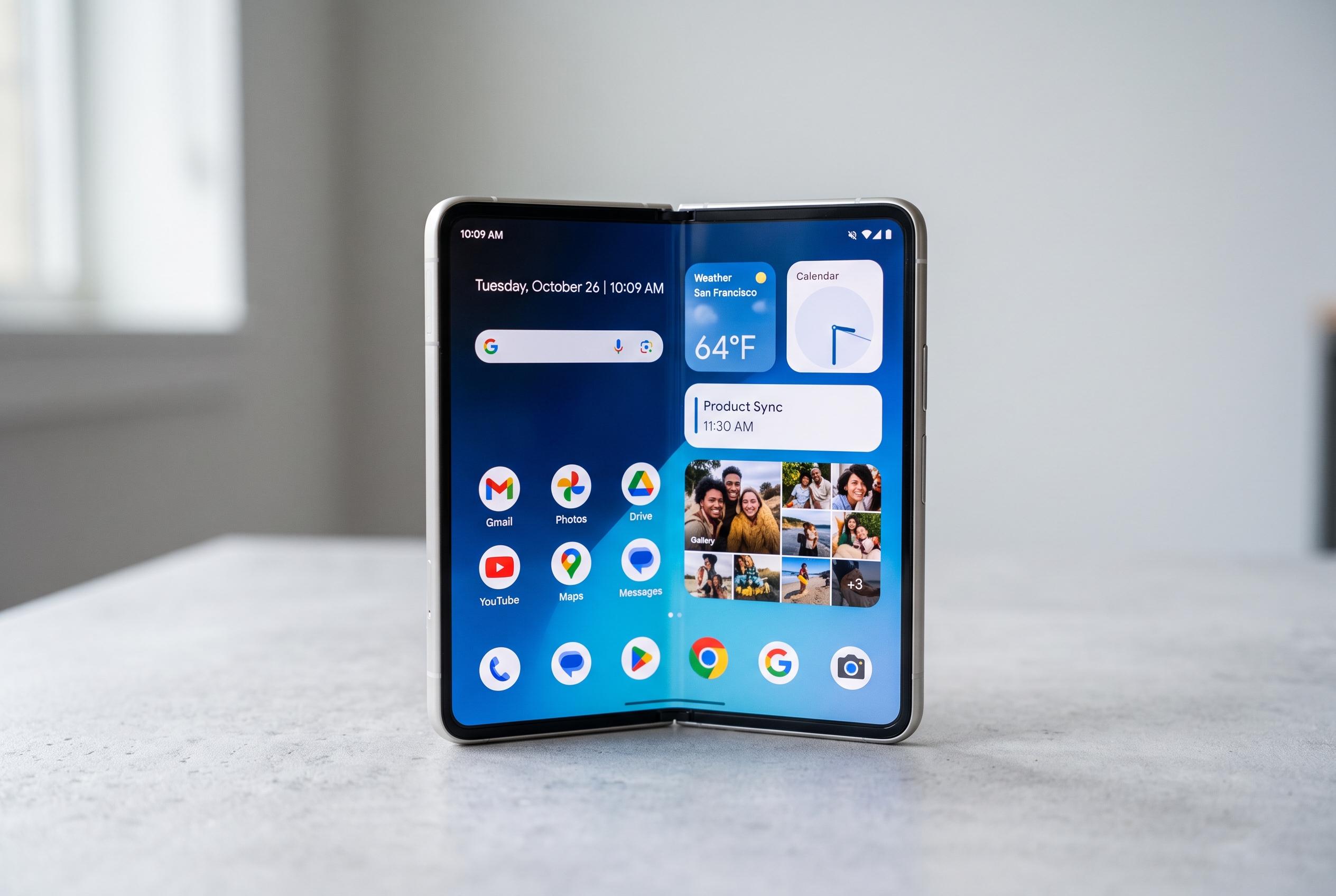

Google launches the Pixel 11 Pro Fold, offering a bigger cover screen, enhanced AI capabilities, and refined hardware, signalling a more mature foldable device for multitaskers and tech enthusiasts.
Google’s latest foldable makes a clearer case for the form factor than its predecessor. At S$2,499 for the 256GB model, the Pixel 11 Pro Fold is pitched at readers, multitaskers and anyone who wants a tablet-sized display without carrying a separate device. Google says the Olive finish is exclusive to its own store and that the phone is on sale through a wide local retail channel, including Singtel, StarHub and major online marketplaces.
The hardware changes are modest but meaningful. Google has trimmed the weight and thickness, enlarged the cover display to 6.5in, and paired the device with Tensor G6, 16GB of RAM and a Titan M3 security chip. Android Central reports that the new chip uses Arm’s latest C1 cores, a more efficient design and a MediaTek M90 modem, while Google claims around 20% better power efficiency and a 50% stronger TPU for AI tasks.
In day-to-day use, the outer screen matters most, and the larger panel should make the phone feel less compromised when closed. Google also claims the foldable now supports Qi2.2 charging at up to 25W with Pixelsnap magnetic alignment, alongside 30W wired charging. That arrives even as the battery capacity falls slightly to 4,806mAh from 5,015mAh, so endurance will depend heavily on how well the new chip offsets the smaller cell.
The software pitch leans hard on Gemini. Google has added Magic Capture, which records video and extracts still images at the same time, along with Camera Looks presets, a Creator Suite for video work and split-screen tools designed for the larger inner display. Android Central says the foldable also gains live translation features, floating app bubbles and improved dictation tools, reinforcing Google’s view that the device is as much an AI workstation as it is a phone.
Camera performance remains mixed, but the gains are real in the right conditions. Google has fitted a new 48-megapixel main sensor and says it gathers substantially more light, while the telephoto now reaches 30x Super Zoom. In the supplied review, the Pixel’s strongest result was night photography, where it pulled more detail from very dark scenes than an iPhone 17 Pro Max, but it lost ground in zoom, portrait, ultra-wide and macro shots. The takeaway is familiar for foldables: the main camera is flagship-grade, but the smaller body still forces compromises elsewhere.
For buyers considering a foldable for the first time, that trade-off is the point. The Pixel 11 Pro Fold looks like a more polished version of Google’s idea of a practical foldable: lighter, brighter, better connected and more software-led than before. But it is not a total redesign, and Android Central notes that Tensor G6 still does not erase Google’s long-standing limits in sustained high-performance workloads. For current owners of the previous model, this appears to be a refinement rather than a necessary upgrade.
Disclaimer: This content is intended for informational purposes only. Readers are advised to exercise their own judgement, conduct due diligence, or consult a qualified expert before acting on any information provided.