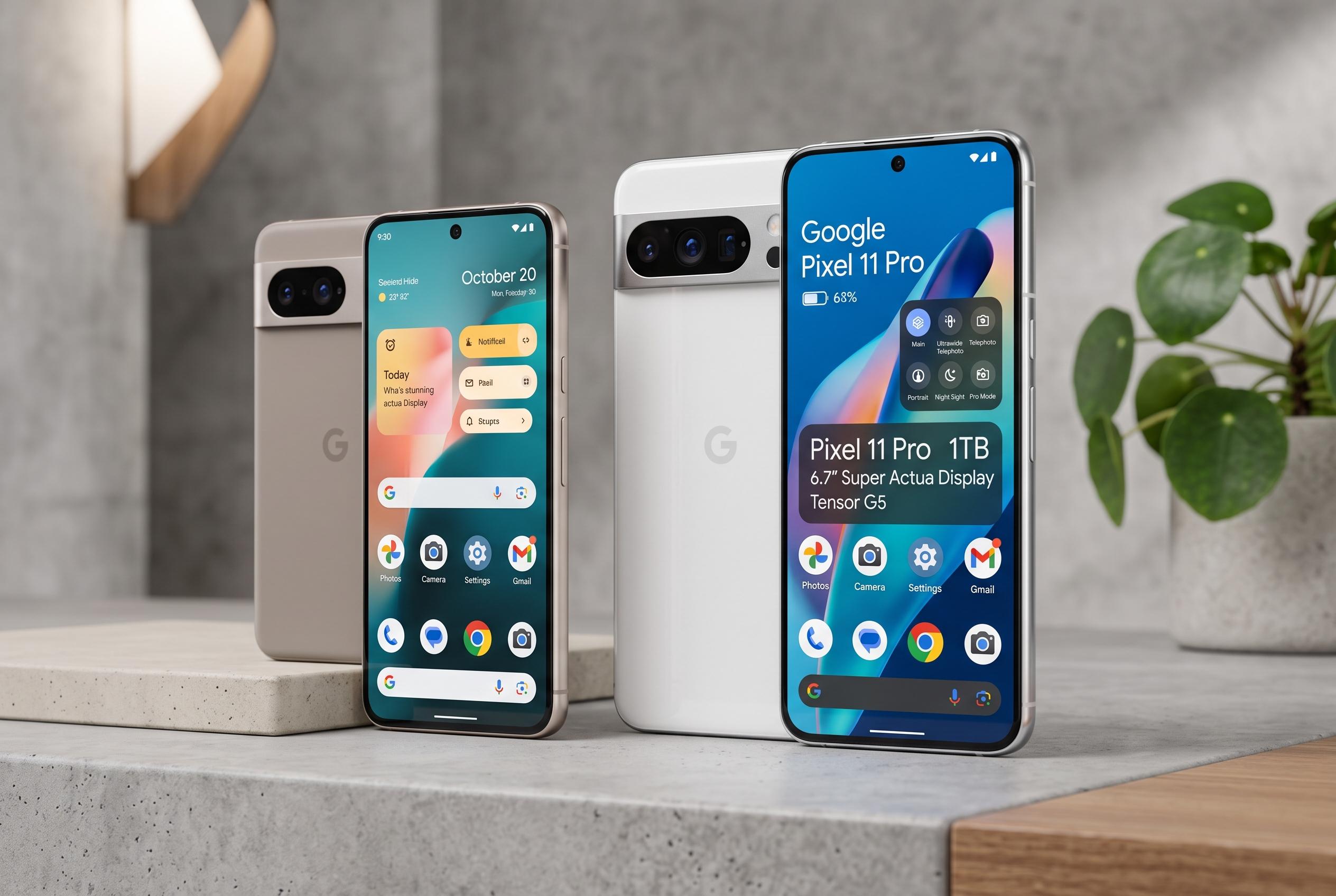

Google’s Pixel 11 lineup signals a significant departure from its predecessor, featuring larger storage options, upgraded displays, AI-powered features, and enhanced camera capabilities, positioning itself firmly in the premium market.
Google’s Pixel 11 line marks a clearer break from the Pixel 10 than a routine refresh. According to reports from the company’s launch and subsequent coverage by Android Central, What Hi-Fi and Digital Camera World, the new range shifts the base model to 256GB of storage, drops the 128GB option and moves all four phones to the Tensor G6 chip. Google is also leaning much more heavily on artificial intelligence, with Android 17 and Gemini Intelligence built around features such as live video translation, smarter voice-to-text, Circle to Search improvements and automated camera tools.
The most visible changes are in the display and industrial design. The Pixel 11 family includes the Pixel 11, Pixel 11 Pro, Pixel 11 Pro XL and Pixel 11 Pro Fold, and the Pro models now reach peak brightness levels of up to 3,600 nits, which should make outdoor viewing easier. Android Central said Google has also refined the design with edge-to-edge glass camera bars and added a new HiLight notification LED on the Pro phones, while What Hi-Fi reported spatial audio support across the range. The Fold model has been slimmed down and given brighter panels, strengthening Google’s pitch against other premium foldables.
Camera hardware is another area where the Pixel 11 appears to pull ahead. The standard model gets a 48MP main sensor with improved light sensitivity and a 5x telephoto lens, while the Pro and Pro XL step up to a 50MP main sensor and a 48MP telephoto unit with much longer zoom performance. Digital Camera World reported that the Pro models reach up to 120x Pro Zoom, while the regular Pixel 11 offers 30x Super Zoom. Google is also adding features such as Magic Capture, Pro Stable Video and a built-in teleprompter, all aimed at making the phones more useful for quick content creation rather than only still photography.
Power and storage show a similar step up. According to launch coverage, the Pixel 11 starts with 12GB of RAM, while the Pro models go to 16GB and storage options now run as high as 1TB. Battery life is being pushed beyond 30 hours, with faster wired charging and wireless PixelSnap charging on the standard model, and 45W charging on the Pro phones. Pricing starts at $899 for the base device and rises to $1,899 for the Pixel 11 Pro Fold, suggesting Google is targeting a more clearly premium market than with the Pixel 10. In practical terms, the Pixel 11 is less about a single headline feature and more about a package of incremental but meaningful changes: brighter screens, stronger AI, better cameras and more standard storage.
Disclaimer: This content is intended for informational purposes only. Readers are advised to exercise their own judgement, conduct due diligence, or consult a qualified expert before acting on any information provided.