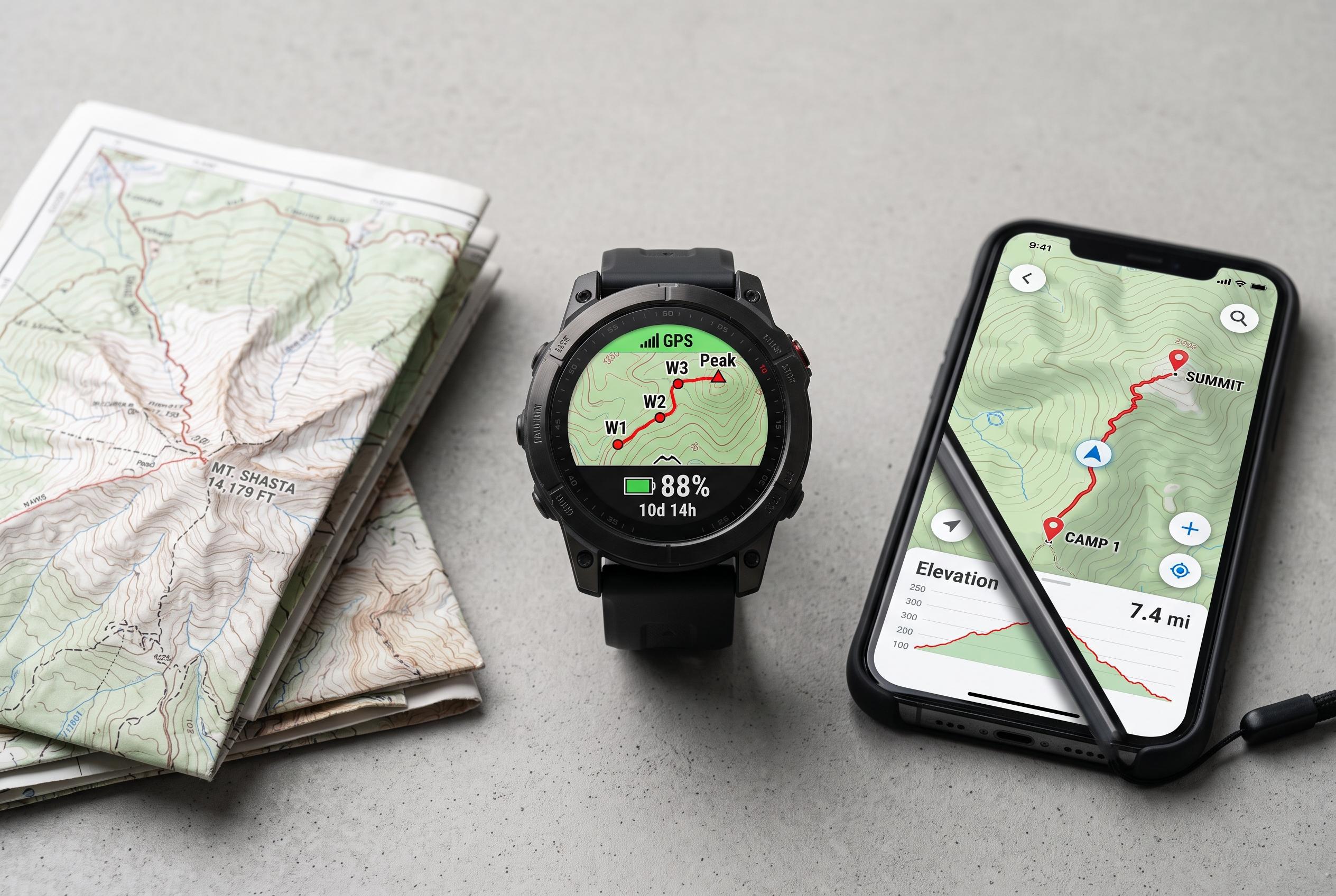

Leading GPS watch models now offer enhanced navigation, durability, and battery performance, transforming the outdoor experience for long-distance hikers and mountaineers.
Hikers have increasingly turned to GPS watches as a practical substitute for paper maps, especially on long or remote routes. According to TechRadar’s field testing, the best models now do more than log distance and pace: they provide offline maps, turn-by-turn navigation, rugged cases, long battery life and, in some cases, a built-in torch that can spare a headtorch for short after-dark tasks.
At the top end, the Garmin Fenix 8 stands out as the strongest all-rounder for buyers with deep pockets. TechRadar says it was tested on the Everest Base Camp trek, where its mountaineering and rucking modes proved useful for altitude tracking and pack-weight-based calorie estimates. It also offers preloaded colour maps, generous storage and an LED torch. The main weakness is endurance: for long days on the trail, the battery can still require charging every few days.
For multi-day trekking, the Suunto Vertical 2 looks like the better endurance choice. TechRadar found that its mapping was fast and clear on a bright AMOLED screen, while its battery life easily outlasted a five-day walk with substantial daily GPS use still leaving charge in reserve. The watch is more focused on navigation and outdoor performance than broad smartwatch functions, but that is also part of its appeal for serious hikers.
The Amazfit T-Rex Ultra 2 offers a more affordable route into the premium outdoor-watch category. Reviewers at TechRadar and Wareable describe it as a large, rugged device with a sharp AMOLED display, strong battery life and extensive mapping features. In practice, though, some navigation tools feel slower than on more expensive rivals, and the automatic rerouting promised by the software does not always perform as expected. Even so, it remains a compelling value option for hikers who want a lot of capability for less money.
The Coros Nomad takes a more stripped-back approach and, for many hikers, that is an advantage. Android Central says it combines dual-band GPS, on-device mapping and a MIP display that favours battery efficiency over visual flair. TechRadar’s testing found the maps detailed and easy to read, with accurate GPS and strong route storage. Its omissions are clear enough: there is no torch and no on-watch rerouting, but the long battery life and simple interface make it well suited to budget-conscious walkers.
Polar’s Grit X2 Pro rounds out the list as the most training-focused option. TechRadar says it is built for data-driven endurance users, with strong navigation, cold-weather resilience and detailed recovery and fuelling tools. Wareable and TechRadar both note its bright AMOLED display, dual-frequency GPS and offline mapping, but also its high price and limited smartwatch extras. For hikers who care as much about physiology as route-finding, it is one of the most technical options available.
What emerges from all five watches is that the best hiking device depends less on brand name than on use case. Offline maps, a readable display, robust materials and a battery that can survive long days in the hills matter more than message alerts or payment features. For some walkers, the right answer is a feature-packed Garmin. For others, especially those heading out for several days at a time, longer battery life and simpler software will matter more.
Disclaimer: This content is intended for informational purposes only. Readers are advised to exercise their own judgement, conduct due diligence, or consult a qualified expert before acting on any information provided.